One seedling of Rhododendron 'Canobie Candy' X Rhododendron flammeum 'Hazel Hamilton', which is Sally and John Perkins hybrid, has been determined to be a diploid using flow cytometry by
Dr. João Loureiro, Dr. Silvia Castro, José Cerca, and Mariana Castro
Plant Ecology and Evolution Group,
Centre for Functional Ecology,
Department of Life Sciences,
Faculty of Science and Technology,
University of Coimbra, Portugal.
In this case, a diploid crossed with a diploid produced a diploid (26 chromosomes) indicating normal meiosis occurred where each diploid parent contributed a 1x gamete (13 chromosomes). Diploid X diploid yielding diploid is the expected outcome.
Summary of Ploidy Levels
Diploid Rhododendron canescens,
Diploid Rhododendron flammeum,
Diploid Rhododendron flammeum 'Hazel Hamilton',
Diploid 'Canobie Candy',
Diploid One seedling of 'Canobie Candy' X 'Hazel Hamilton'
Source: Joe Bruso
John and Sally Perkins
H: Thursday, March 31, 2011
H: Wednesday, March 30, 2011
'Canobie Candy' is a Diploid
Rhododendron 'Canobie Candy', which is very likely a Rhododendron canescens hybrid seedling raised by Sally and John Perkins, has been determined to be a diploid using flow cytometry by
Dr. João Loureiro, Dr. Silvia Castro, José Cerca, and Mariana Castro
Plant Ecology and Evolution Group,
Centre for Functional Ecology,
Department of Life Sciences,
Faculty of Science and Technology,
University of Coimbra, Portugal.
Rhododendron canescens was determined to be a diploid.
Summary of Ploidy Levels
Diploid Rhododendron canescens,
Diploid 'Canobie Candy'
Source: John and Sally Perkins
John and Sally Perkins
Dr. João Loureiro, Dr. Silvia Castro, José Cerca, and Mariana Castro
Plant Ecology and Evolution Group,
Centre for Functional Ecology,
Department of Life Sciences,
Faculty of Science and Technology,
University of Coimbra, Portugal.
Rhododendron canescens was determined to be a diploid.
Summary of Ploidy Levels
Diploid Rhododendron canescens,
Diploid 'Canobie Candy'
Source: John and Sally Perkins
John and Sally Perkins


H: Tuesday, March 29, 2011
'Nancy Waterer' is a Tetraploid
Rhododendron 'Nancy Waterer', which is a 1869 Waterer Ghent hybrid, has been determined to be a tetraploid using flow cytometry by
Dr. João Loureiro, Dr. Silvia Castro, José Cerca, and Mariana Castro
Plant Ecology and Evolution Group,
Centre for Functional Ecology,
Department of Life Sciences,
Faculty of Science and Technology,
University of Coimbra, Portugal.
To date, all Ghent deciduous azaleas have tested as triploid or tetraploid.
Rhododendron 'Nancy Waterer' was also determined to be a tetraploid using flow cytometry by Tom Eeckhaut.
Summary of Ploidy Levels
Triploid 'Bronze Unique',
Triploid 'Daviesii',
Triploid 'Deep Rose',
Triploid 'Gloria Mundi',
Triploid 'Josephine Klinger',
Tetraploid 'Bijou des Amateurs',
Tetraploid 'Comte de Flandre',
Tetraploid 'Heureuse Surprise',
Tetraploid 'Ignacea',
Tetraploid 'Julius Caesar',
Tetraploid 'Lelia',
Tetraploid 'Madame Gustave Guillemot',
Tetraploid 'Nancy Waterer',
Tetraploid 'Raphael de Smet'
Source: Arnold Arboretum Accession Number: 1174-53
Source: Azaleatuin
Source: George Hibben from Arnold Arboretum
John and Sally Perkins
Dr. João Loureiro, Dr. Silvia Castro, José Cerca, and Mariana Castro
Plant Ecology and Evolution Group,
Centre for Functional Ecology,
Department of Life Sciences,
Faculty of Science and Technology,
University of Coimbra, Portugal.
To date, all Ghent deciduous azaleas have tested as triploid or tetraploid.
Rhododendron 'Nancy Waterer' was also determined to be a tetraploid using flow cytometry by Tom Eeckhaut.
Summary of Ploidy Levels
Triploid 'Bronze Unique',
Triploid 'Daviesii',
Triploid 'Deep Rose',
Triploid 'Gloria Mundi',
Triploid 'Josephine Klinger',
Tetraploid 'Bijou des Amateurs',
Tetraploid 'Comte de Flandre',
Tetraploid 'Heureuse Surprise',
Tetraploid 'Ignacea',
Tetraploid 'Julius Caesar',
Tetraploid 'Lelia',
Tetraploid 'Madame Gustave Guillemot',
Tetraploid 'Nancy Waterer',
Tetraploid 'Raphael de Smet'
Source: Arnold Arboretum Accession Number: 1174-53
Source: Azaleatuin
Source: George Hibben from Arnold Arboretum
John and Sally Perkins
H: Monday, March 28, 2011
'Raphael de Smet' is a Tetraploid
Rhododendron 'Raphael de Smet', which is a prior to 1889 L. de Smet Ghent hybrid, has been determined to be a tetraploid using flow cytometry by
Dr. João Loureiro, Dr. Silvia Castro, José Cerca, and Mariana Castro
Plant Ecology and Evolution Group,
Centre for Functional Ecology,
Department of Life Sciences,
Faculty of Science and Technology,
University of Coimbra, Portugal.
To date, all Ghent deciduous azaleas have tested as triploid or tetraploid.
Rhododendron 'Raphael de Smet' was also determined to be a tetraploid using flow cytometry by Tom Eeckhaut.
Summary of Ploidy Levels
Triploid 'Bronze Unique',
Triploid 'Daviesii',
Triploid 'Deep Rose',
Triploid 'Gloria Mundi',
Triploid 'Josephine Klinger',
Tetraploid 'Bijou des Amateurs',
Tetraploid 'Comte de Flandre',
Tetraploid 'Heureuse Surprise',
Tetraploid 'Ignacea',
Tetraploid 'Julius Caesar',
Tetraploid 'Lelia',
Tetraploid 'Madame Gustave Guillemot',
Tetraploid 'Nancy Waterer',
Tetraploid 'Raphael de Smet'
Source: Arnold Arboretum Accession Number: 19064
Source: Azaleatuin
John and Sally Perkins
Dr. João Loureiro, Dr. Silvia Castro, José Cerca, and Mariana Castro
Plant Ecology and Evolution Group,
Centre for Functional Ecology,
Department of Life Sciences,
Faculty of Science and Technology,
University of Coimbra, Portugal.
To date, all Ghent deciduous azaleas have tested as triploid or tetraploid.
Rhododendron 'Raphael de Smet' was also determined to be a tetraploid using flow cytometry by Tom Eeckhaut.
Summary of Ploidy Levels
Triploid 'Bronze Unique',
Triploid 'Daviesii',
Triploid 'Deep Rose',
Triploid 'Gloria Mundi',
Triploid 'Josephine Klinger',
Tetraploid 'Bijou des Amateurs',
Tetraploid 'Comte de Flandre',
Tetraploid 'Heureuse Surprise',
Tetraploid 'Ignacea',
Tetraploid 'Julius Caesar',
Tetraploid 'Lelia',
Tetraploid 'Madame Gustave Guillemot',
Tetraploid 'Nancy Waterer',
Tetraploid 'Raphael de Smet'
Source: Arnold Arboretum Accession Number: 19064
Source: Azaleatuin
John and Sally Perkins
H: Sunday, March 27, 2011
'Julius Caesar' is a Tetraploid
Rhododendron 'Julius Caesar', which is a prior to 1872 Ghent hybrid, has been determined to be a tetraploid using flow cytometry by
Dr. João Loureiro, Dr. Silvia Castro, José Cerca, and Mariana Castro
Plant Ecology and Evolution Group,
Centre for Functional Ecology,
Department of Life Sciences,
Faculty of Science and Technology,
University of Coimbra, Portugal.
Rhododendron 'Julius Caesar' is very fertile.
To date, all Ghent deciduous azaleas have tested as triploid or tetraploid.
Summary of Ploidy Levels
Triploid 'Bronze Unique',
Triploid 'Daviesii',
Triploid 'Deep Rose',
Triploid 'Gloria Mundi',
Triploid 'Josephine Klinger',
Tetraploid 'Comte de Flandre',
Tetraploid 'Ignacea',
Tetraploid 'Julius Caesar',
Tetraploid 'Lelia',
Tetraploid 'Madame Gustave Guillemot',
Tetraploid 'Nancy Waterer',
Tetraploid 'Raphael de Smet'
Source: Arnold Arboretum Accession Number: 17109
John and Sally Perkins
Dr. João Loureiro, Dr. Silvia Castro, José Cerca, and Mariana Castro
Plant Ecology and Evolution Group,
Centre for Functional Ecology,
Department of Life Sciences,
Faculty of Science and Technology,
University of Coimbra, Portugal.
Rhododendron 'Julius Caesar' is very fertile.
To date, all Ghent deciduous azaleas have tested as triploid or tetraploid.
Summary of Ploidy Levels
Triploid 'Bronze Unique',
Triploid 'Daviesii',
Triploid 'Deep Rose',
Triploid 'Gloria Mundi',
Triploid 'Josephine Klinger',
Tetraploid 'Comte de Flandre',
Tetraploid 'Ignacea',
Tetraploid 'Julius Caesar',
Tetraploid 'Lelia',
Tetraploid 'Madame Gustave Guillemot',
Tetraploid 'Nancy Waterer',
Tetraploid 'Raphael de Smet'
Source: Arnold Arboretum Accession Number: 17109
John and Sally Perkins
H: Saturday, March 26, 2011
"Parks Pink" is a Triploid
Rhododendron "Parks Pink", which is a Joe Parks hybrid, has been determined to be a triploid using flow cytometry by
Dr. João Loureiro, Dr. Silvia Castro, José Cerca, and Mariana Castro
Plant Ecology and Evolution Group,
Centre for Functional Ecology,
Department of Life Sciences,
Faculty of Science and Technology,
University of Coimbra, Portugal.
Rhododendron "Parks Pink", similar to many triploid deciduous azaleas, appears to be both seed and pollen sterile.
Summary of Ploidy Levels
Triploid "Parks Pink"
Source: John and Sally Perkins
John and Sally Perkins
Dr. João Loureiro, Dr. Silvia Castro, José Cerca, and Mariana Castro
Plant Ecology and Evolution Group,
Centre for Functional Ecology,
Department of Life Sciences,
Faculty of Science and Technology,
University of Coimbra, Portugal.
Rhododendron "Parks Pink", similar to many triploid deciduous azaleas, appears to be both seed and pollen sterile.
Summary of Ploidy Levels
Triploid "Parks Pink"
Source: John and Sally Perkins
John and Sally Perkins
H: Friday, March 25, 2011
'Bronze Unique' is a Triploid?
Rhododendron 'Bronze Unique', which is a 1849 Louis Verschaffelt Ghent hybrid, has been determined to be a triploid using flow cytometry by
Dr. João Loureiro, Dr. Silvia Castro, José Cerca, and Mariana Castro
Plant Ecology and Evolution Group,
Centre for Functional Ecology,
Department of Life Sciences,
Faculty of Science and Technology,
University of Coimbra, Portugal.
The Ghents are documented as having been produced from crossing diploid and tetraploid deciduous azalea species. This result appears to support that documentation.
The plant of Rhododendron 'Bronze Unique' tested does not agree in some characteristics with earlier descriptions of this cultivar. Moreover this plant tested at the high end of the range for triploids.
Summary of Ploidy Levels
Triploid 'Bronze Unique',
Triploid 'Daviesii',
Triploid 'Deep Rose',
Triploid 'Gloria Mundi',
Triploid 'Josephine Klinger'
Source: Arnold Arboretum Accession Number: 19403
John and Sally Perkins
Dr. João Loureiro, Dr. Silvia Castro, José Cerca, and Mariana Castro
Plant Ecology and Evolution Group,
Centre for Functional Ecology,
Department of Life Sciences,
Faculty of Science and Technology,
University of Coimbra, Portugal.
The Ghents are documented as having been produced from crossing diploid and tetraploid deciduous azalea species. This result appears to support that documentation.
The plant of Rhododendron 'Bronze Unique' tested does not agree in some characteristics with earlier descriptions of this cultivar. Moreover this plant tested at the high end of the range for triploids.
Summary of Ploidy Levels
Triploid 'Bronze Unique',
Triploid 'Daviesii',
Triploid 'Deep Rose',
Triploid 'Gloria Mundi',
Triploid 'Josephine Klinger'
Source: Arnold Arboretum Accession Number: 19403
John and Sally Perkins
H: Thursday, March 24, 2011
'Graf von Meran' is a Triploid?
A plant at the Arnold Arboretum labeled Rhododendron 'Graf von Meran', which is a 1858 J. Rinz Ghent hybrid, has been determined to be a triploid using flow cytometry by
Dr. João Loureiro, Dr. Silvia Castro, José Cerca, and Mariana Castro
Plant Ecology and Evolution Group,
Centre for Functional Ecology,
Department of Life Sciences,
Faculty of Science and Technology,
University of Coimbra, Portugal.
Rhododendron 'Graf von Meran' was determined to be a tetraploid using flow cytometry by Tom Eeckhaut.
Summary of Ploidy Levels
Triploid 'Bronze Unique',
Triploid 'Daviesii',
Triploid 'Deep Rose',
Triploid 'Gloria Mundi',
Triploid 'Graf von Meran' at Arnold Arboretum,
Triploid 'Josephine Klinger',
Tetraploid 'Graf von Meran' by Eeckhaut
Source: Arnold Arboretum Accession Number: 7101
John and Sally Perkins
Dr. João Loureiro, Dr. Silvia Castro, José Cerca, and Mariana Castro
Plant Ecology and Evolution Group,
Centre for Functional Ecology,
Department of Life Sciences,
Faculty of Science and Technology,
University of Coimbra, Portugal.
Rhododendron 'Graf von Meran' was determined to be a tetraploid using flow cytometry by Tom Eeckhaut.
Summary of Ploidy Levels
Triploid 'Bronze Unique',
Triploid 'Daviesii',
Triploid 'Deep Rose',
Triploid 'Gloria Mundi',
Triploid 'Graf von Meran' at Arnold Arboretum,
Triploid 'Josephine Klinger',
Tetraploid 'Graf von Meran' by Eeckhaut
Source: Arnold Arboretum Accession Number: 7101
John and Sally Perkins
H: Wednesday, March 23, 2011
(cumberlandense X arborescens) X calendualceum is a Triploid
Two seedlings of [(Rhododendron cumberlandense X Rhododendron arborescens) X Rhododendron calendulaceum] have been determined to be a triploid using flow cytometry by
Dr. João Loureiro, Dr. Silvia Castro, José Cerca, and Mariana Castro
Plant Ecology and Evolution Group,
Centre for Functional Ecology,
Department of Life Sciences,
Faculty of Science and Technology,
University of Coimbra, Portugal.
Rhododendron cumberlandense and Rhododendron arborescens are diploid species. Rhododendron calendulaceum is a tetraploid species.
In the case of these 2 triploids (39 chromosomes), a diploid crossed with a tetraploid produced a triploid indicating normal meiosis occurred where the diploid contributed a 1x gamete (13 chromosomes) and the tetraploid contributed a 2x gamete (26 chromosomes).
Summary of Ploidy Levels
Diploid Rhododendron cumberlandense,
Diploid Rhododendron arborescens,
Triploid 2 seedlings from [(Rhododendron cumberlandense X Rhododendron arborescens) X Rhododendron calendulaceum],
Tetraploid Rhododendron calendulaceum
Source: Joe Bruso
John and Sally Perkins
Dr. João Loureiro, Dr. Silvia Castro, José Cerca, and Mariana Castro
Plant Ecology and Evolution Group,
Centre for Functional Ecology,
Department of Life Sciences,
Faculty of Science and Technology,
University of Coimbra, Portugal.
Rhododendron cumberlandense and Rhododendron arborescens are diploid species. Rhododendron calendulaceum is a tetraploid species.
In the case of these 2 triploids (39 chromosomes), a diploid crossed with a tetraploid produced a triploid indicating normal meiosis occurred where the diploid contributed a 1x gamete (13 chromosomes) and the tetraploid contributed a 2x gamete (26 chromosomes).
Summary of Ploidy Levels
Diploid Rhododendron cumberlandense,
Diploid Rhododendron arborescens,
Triploid 2 seedlings from [(Rhododendron cumberlandense X Rhododendron arborescens) X Rhododendron calendulaceum],
Tetraploid Rhododendron calendulaceum
Source: Joe Bruso
John and Sally Perkins
H: Tuesday, March 22, 2011
(cumberlandense X viscosum) X 'Apricot Surprise' is a Triploid
Two seedlings of [(Rhododendron cumberlandense X Rhododendron viscosum) X 'Apricot Surprise'], which is a John and Sally Perkins hybrid, have been determined to be a triploid using flow cytometry by
Dr. João Loureiro, Dr. Silvia Castro, José Cerca, and Mariana Castro
Plant Ecology and Evolution Group,
Centre for Functional Ecology,
Department of Life Sciences,
Faculty of Science and Technology,
University of Coimbra, Portugal.
Rhododendron cumberlandense and Rhododendron viscosum are diploid species. 'Apricot Surprise' is a tetraploid.
In the case of these 2 triploids (39 chromosomes), a diploid crossed with a tetraploid produced a triploid indicating normal meiosis occurred where the diploid contributed a 1x gamete (13 chromosomes) and the tetraploid contributed a 2x gamete (26 chromosomes).
Summary of Ploidy Levels
Diploid Rhododendron cumberlandense,
Diploid Rhododendron viscosum,
Triploid 2 seedlings from [(Rhododendron cumberlandense X Rhododendron viscosum) X 'Apricot Surprise' ],
Tetraploid 'Apricot Surprise'
Seedlings from this same cross were sold at the November 14, 2010 Founders Day Meeting of the ARS Massachusetts Chapter and at the November 20, 2010 Banquet of the New England Rock Garden Society.
These seedlings were grown on by
Lindy Johnson
Appalachian Native Plants
676 Waddell Road
PO Box 736
Mountain City, TN 37683
Source: John and Sally Perkins
Source: Appalachian Native Plants
John and Sally Perkins
Dr. João Loureiro, Dr. Silvia Castro, José Cerca, and Mariana Castro
Plant Ecology and Evolution Group,
Centre for Functional Ecology,
Department of Life Sciences,
Faculty of Science and Technology,
University of Coimbra, Portugal.
Rhododendron cumberlandense and Rhododendron viscosum are diploid species. 'Apricot Surprise' is a tetraploid.
In the case of these 2 triploids (39 chromosomes), a diploid crossed with a tetraploid produced a triploid indicating normal meiosis occurred where the diploid contributed a 1x gamete (13 chromosomes) and the tetraploid contributed a 2x gamete (26 chromosomes).
Summary of Ploidy Levels
Diploid Rhododendron cumberlandense,
Diploid Rhododendron viscosum,
Triploid 2 seedlings from [(Rhododendron cumberlandense X Rhododendron viscosum) X 'Apricot Surprise' ],
Tetraploid 'Apricot Surprise'
Seedlings from this same cross were sold at the November 14, 2010 Founders Day Meeting of the ARS Massachusetts Chapter and at the November 20, 2010 Banquet of the New England Rock Garden Society.
These seedlings were grown on by
Lindy Johnson
Appalachian Native Plants
676 Waddell Road
PO Box 736
Mountain City, TN 37683
Source: John and Sally Perkins
Source: Appalachian Native Plants
John and Sally Perkins
H: Monday, March 21, 2011
'Deep Rose' is a Triploid
Rhododendron 'Deep Rose', which is an Ed Mezitt Ghent hybrid documented as Rhododendron arborescens (possibly cumberlandense) X red Ghent, has been determined to be a triploid using flow cytometry by
Dr. João Loureiro, Dr. Silvia Castro, José Cerca, and Mariana Castro
Plant Ecology and Evolution Group,
Centre for Functional Ecology,
Department of Life Sciences,
Faculty of Science and Technology,
University of Coimbra, Portugal.
To date all Ghents have tested as triploid or tetraploid.
Summary of Ploidy Levels
Diploid Rhododendron arborescens,
Diploid Rhododendron cumberlandense,
Triploid 'Bronze Unique',
Triploid 'Daviesii',
Triploid 'Deep Rose',
Triploid 'Gloria Mundi',
Triploid 'Graf von Meran',
Triploid 'Josephine Klinger'
Source: George Hibben
John and Sally Perkins
Dr. João Loureiro, Dr. Silvia Castro, José Cerca, and Mariana Castro
Plant Ecology and Evolution Group,
Centre for Functional Ecology,
Department of Life Sciences,
Faculty of Science and Technology,
University of Coimbra, Portugal.
To date all Ghents have tested as triploid or tetraploid.
Summary of Ploidy Levels
Diploid Rhododendron arborescens,
Diploid Rhododendron cumberlandense,
Triploid 'Bronze Unique',
Triploid 'Daviesii',
Triploid 'Deep Rose',
Triploid 'Gloria Mundi',
Triploid 'Graf von Meran',
Triploid 'Josephine Klinger'
Source: George Hibben
John and Sally Perkins
H: Sunday, March 20, 2011
'Lady Roseberry' is a Tetraploid
Rhododendron 'Lady Roseberry', which is a Knaphill hybrid, has been determined to be a tetraploid using flow cytometry by
Dr. João Loureiro, Dr. Silvia Castro, José Cerca, and Mariana Castro
Plant Ecology and Evolution Group,
Centre for Functional Ecology,
Department of Life Sciences,
Faculty of Science and Technology,
University of Coimbra, Portugal.
Summary of Ploidy Levels
Tetraploid 'Lady Roseberry'
Source: Arnold Arboretum Accession Number: 632-61
John and Sally Perkins
Dr. João Loureiro, Dr. Silvia Castro, José Cerca, and Mariana Castro
Plant Ecology and Evolution Group,
Centre for Functional Ecology,
Department of Life Sciences,
Faculty of Science and Technology,
University of Coimbra, Portugal.
Summary of Ploidy Levels
Tetraploid 'Lady Roseberry'
Source: Arnold Arboretum Accession Number: 632-61
John and Sally Perkins
H: Saturday, March 19, 2011
cumberlandense X 'Marydel' is a Triploid
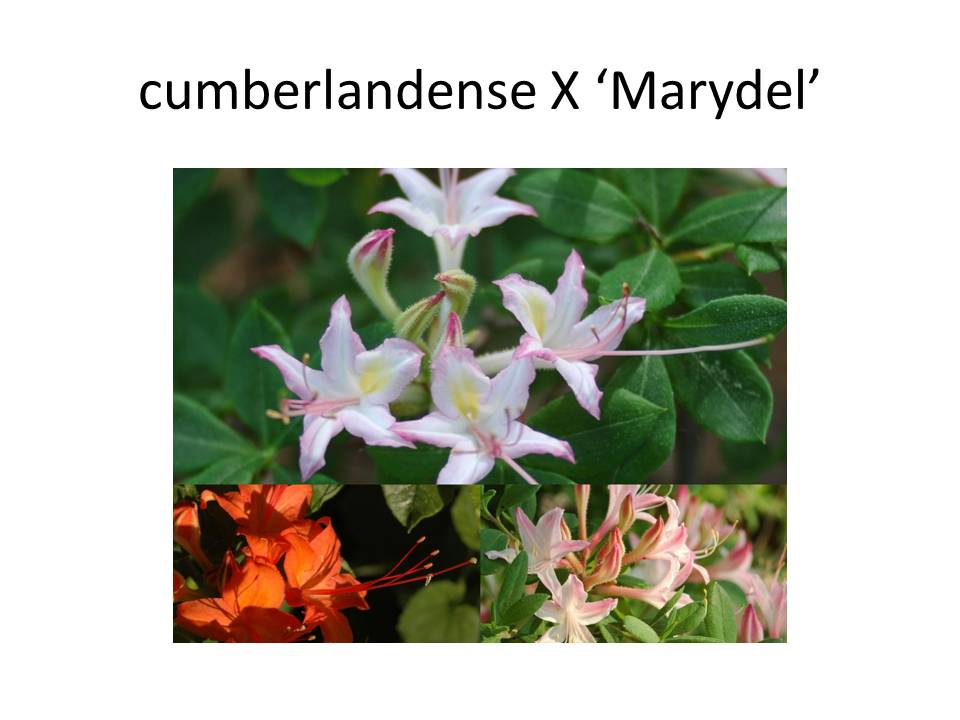
One seedling of Rhododendron cumberlandense orange X Rhododendron atlanticum 'Marydel', which is a Sally and John Perkins hybrid, has been determined to be a triploid using flow cytometry by
Dr. João Loureiro, Dr. Silvia Castro, José Cerca, and Mariana Castro
Plant Ecology and Evolution Group,
Centre for Functional Ecology,
Department of Life Sciences,
Faculty of Science and Technology,
University of Coimbra, Portugal.
This seedling of Rhododendron cumberlandense orange X Rhododendron atlanticum 'Marydel' looks remarkably similar to the tetraploid pollen parent 'Marydel' differing primarily in having a small yellow blotch.
To date this seedling has proven sterile as both a seed parent and a pollen parent.
In the case of this triploid (39 chromosomes), a diploid crossed with a tetraploid produced a triploid indicating normal meiosis occurred where the diploid contributed a 1x gamete (13 chromosomes) and the tetraploid contributed a 2x gamete (26 chromosomes).
Summary of Ploidy Levels
Diploid Rhododendron cumberlandense,
Triploid One seedling of Rhododendron cumberlandense X Rhododendron atlanticum 'Marydel',
Tetraploid Rhododendron atlanticum,
Tetraploid Rhododendron atlanticum 'Marydel'
Source: East Fork Nursery
John and Sally Perkins
H: Friday, March 18, 2011


Reminder: Massachusetts Chapter Meeting @ Sun Mar 20 1:30pm - 3:30pm (ARS Massachusetts Chapter Calendar)
Massachusetts Chapter MeetingDon Hyatt , DeBurlo Speaker, gives talk on Legacy of Joe Gable Hunnewell Building
| ||||||||||
Invitation from Google Calendar You are receiving this email at the account john.a.perkins@gmail.com because you are subscribed for reminders on calendar ARS Massachusetts Chapter Calendar. To stop receiving these notifications, please log in to https://www.google.com/calendar/ and change your notification settings for this calendar. |
'Toucan' is a Tetraploid
Rhododendron 'Toucan', which is a Waterer hybrid documented as a Mollis hybrid, has been determined to be a tetraploid using flow cytometry by
Dr. João Loureiro, Dr. Silvia Castro, José Cerca, and Mariana Castro
Plant Ecology and Evolution Group,
Centre for Functional Ecology,
Department of Life Sciences,
Faculty of Science and Technology,
University of Coimbra, Portugal.
Rhododendron 'Toucan' is very fertile.
Rhododendron molle is a diploid species.
Summary of Ploidy Levels
Diploid Rhododendron molle,
Tetraploid 'Toucan'
Source: Arnold Arboretum Accession Number: 189-72
John and Sally Perkins
Dr. João Loureiro, Dr. Silvia Castro, José Cerca, and Mariana Castro
Plant Ecology and Evolution Group,
Centre for Functional Ecology,
Department of Life Sciences,
Faculty of Science and Technology,
University of Coimbra, Portugal.
Rhododendron 'Toucan' is very fertile.
Rhododendron molle is a diploid species.
Summary of Ploidy Levels
Diploid Rhododendron molle,
Tetraploid 'Toucan'
Source: Arnold Arboretum Accession Number: 189-72
John and Sally Perkins
H: Thursday, March 17, 2011
'Daviesii' is a Fertile Triploid
Rhododendron 'Daviesii', which is a 1840 Isaac Davies hybrid often documented as Rhododendron viscosum X Rhododendron molle, has been determined to be a triploid using flow cytometry by
Dr. João Loureiro, Dr. Silvia Castro, José Cerca, and Mariana Castro
Plant Ecology and Evolution Group,
Centre for Functional Ecology,
Department of Life Sciences,
Faculty of Science and Technology,
University of Coimbra, Portugal.
Rhododendron 'Daviesii' is documented to be the seed parent of 'Moorgold', which is a Schmalscheidt hybrid. John Migas has indicated that 'Daviesii' sets viable seed.
Davies' notes indicate that 'Daviesii' was produced using "A. sinesis crossed a hardy white azaleas."
Rhododendron 'Viscosepalum', which is often documented to be Rhododendron molle X Rhododendron viscosum, has been determined to be a tetraploid.
The flow cytometry ploidy results for 'Daviesii' and 'Viscosepalum' indicate the pollen parent may have been the tetraploid Rhododendron atlanticum rather than the diploid Rhododendron viscosum. The normal bloom times for Rhododendron molle and Rhododendron atlanticum overlay whereas this is not the case for Rhododendron molle and Rhododendron viscosum. Rhododendron viscosum and Rhododendron atlanticum are known to colocate in the wild.
'Viscosepalum' and 'Daviesii' are sometimes confused in commercial settings.
Rhododendron 'Daviesii' was also determined to be a triploid using flow cytometry by Tom Eeckhaut.
Plants labeled Rhododendron 'Daviesii' have also tested as tetraploid and pentaploid.
Summary of Ploidy Levels
Diploid Rhododendron molle,
Diploid Rhododendron viscosum,
Triploid 'Graf von Meran',
Triploid 'Daviesii',
Triploid 'Gloria Mundi',
Triploid 'Josephine Klinger',
Tetraploid Rhododendron atlanticum,
Tetraploid 'Viscosepalum'
Source: Greer Gardens
Source: Whitney Nursery
Source: Azaleatuin
John and Sally Perkins
Dr. João Loureiro, Dr. Silvia Castro, José Cerca, and Mariana Castro
Plant Ecology and Evolution Group,
Centre for Functional Ecology,
Department of Life Sciences,
Faculty of Science and Technology,
University of Coimbra, Portugal.
Rhododendron 'Daviesii' is documented to be the seed parent of 'Moorgold', which is a Schmalscheidt hybrid. John Migas has indicated that 'Daviesii' sets viable seed.
Davies' notes indicate that 'Daviesii' was produced using "A. sinesis crossed a hardy white azaleas."
Rhododendron 'Viscosepalum', which is often documented to be Rhododendron molle X Rhododendron viscosum, has been determined to be a tetraploid.
The flow cytometry ploidy results for 'Daviesii' and 'Viscosepalum' indicate the pollen parent may have been the tetraploid Rhododendron atlanticum rather than the diploid Rhododendron viscosum. The normal bloom times for Rhododendron molle and Rhododendron atlanticum overlay whereas this is not the case for Rhododendron molle and Rhododendron viscosum. Rhododendron viscosum and Rhododendron atlanticum are known to colocate in the wild.
'Viscosepalum' and 'Daviesii' are sometimes confused in commercial settings.
Rhododendron 'Daviesii' was also determined to be a triploid using flow cytometry by Tom Eeckhaut.
Plants labeled Rhododendron 'Daviesii' have also tested as tetraploid and pentaploid.
Summary of Ploidy Levels
Diploid Rhododendron molle,
Diploid Rhododendron viscosum,
Triploid 'Graf von Meran',
Triploid 'Daviesii',
Triploid 'Gloria Mundi',
Triploid 'Josephine Klinger',
Tetraploid Rhododendron atlanticum,
Tetraploid 'Viscosepalum'
Source: Greer Gardens
Source: Whitney Nursery
Source: Azaleatuin
John and Sally Perkins
H: Wednesday, March 16, 2011
'Gloria Mundi' is a Fertile Triploid
Rhododendron 'Gloria Mundi', which is a 1835 J. Verleeuwen Ghent hybrid, has been determined to be a triploid using flow cytometry by
Dr. João Loureiro, Dr. Silvia Castro, José Cerca, and Mariana Castro
Plant Ecology and Evolution Group,
Centre for Functional Ecology,
Department of Life Sciences,
Faculty of Science and Technology,
University of Coimbra, Portugal.
Rhododendron 'Vlasta' is documented as a cross of 'Gloria Mundi' x 'Anthony Koster'.
Rhododendron 'Gloria Mundi' has set seedpods at the Arnold Arboretum when pollinated with known tetraploids.
The Ghents are documented as having been produced from crossing diploid and tetraploid deciduous azalea species. This result appears to support that documentation.
Rhododendron 'Gloria Mundi' was also determined to be a triploid using flow cytometry by Tom Eeckhaut.
Summary of Ploidy Levels
Triploid 'Bronze Unique',
Triploid 'Daviesii',
Triploid 'Deep Rose',
Triploid 'Gloria Mundi',
Triploid 'Josephine Klinger'
Source: Arnold Arboretum Accession Number: 10125
John and Sally Perkins
Dr. João Loureiro, Dr. Silvia Castro, José Cerca, and Mariana Castro
Plant Ecology and Evolution Group,
Centre for Functional Ecology,
Department of Life Sciences,
Faculty of Science and Technology,
University of Coimbra, Portugal.
Rhododendron 'Vlasta' is documented as a cross of 'Gloria Mundi' x 'Anthony Koster'.
Rhododendron 'Gloria Mundi' has set seedpods at the Arnold Arboretum when pollinated with known tetraploids.
The Ghents are documented as having been produced from crossing diploid and tetraploid deciduous azalea species. This result appears to support that documentation.
Rhododendron 'Gloria Mundi' was also determined to be a triploid using flow cytometry by Tom Eeckhaut.
Summary of Ploidy Levels
Triploid 'Bronze Unique',
Triploid 'Daviesii',
Triploid 'Deep Rose',
Triploid 'Gloria Mundi',
Triploid 'Josephine Klinger'
Source: Arnold Arboretum Accession Number: 10125
John and Sally Perkins
H: Tuesday, March 15, 2011
'Norma' is a Triploid
Rhododendron 'Norma', which is a 1888 L. de Smet Rustica hybrid, has been determined to be a triploid using flow cytometry by
Dr. João Loureiro, Dr. Silvia Castro, José Cerca, and Mariana Castro
Plant Ecology and Evolution Group,
Centre for Functional Ecology,
Department of Life Sciences,
Faculty of Science and Technology,
University of Coimbra, Portugal.
Rustica hybrids are a mixture of double flowered Ghents hybrids and the Mollis hybrids. The Mollis hybrids contain the diploid species Rhododendron molle. To date all Ghent hybrids (except one)including the doubles have tested as triploid or tetraploid.
Rhododendron 'Norma' was also determined to be a triploid using flow cytometry by Tom Eeckhaut.
Summary of Ploidy Levels
Diploid Rhododendron molle,
Triploid 'Norma'
Source: Arnold Arboretum Accession Number: 142-44
Source: Azaleatuin
John and Sally Perkins
Dr. João Loureiro, Dr. Silvia Castro, José Cerca, and Mariana Castro
Plant Ecology and Evolution Group,
Centre for Functional Ecology,
Department of Life Sciences,
Faculty of Science and Technology,
University of Coimbra, Portugal.
Rustica hybrids are a mixture of double flowered Ghents hybrids and the Mollis hybrids. The Mollis hybrids contain the diploid species Rhododendron molle. To date all Ghent hybrids (except one)including the doubles have tested as triploid or tetraploid.
Rhododendron 'Norma' was also determined to be a triploid using flow cytometry by Tom Eeckhaut.
Summary of Ploidy Levels
Diploid Rhododendron molle,
Triploid 'Norma'
Source: Arnold Arboretum Accession Number: 142-44
Source: Azaleatuin
John and Sally Perkins
H: Monday, March 14, 2011
'Chickasaw' is a Tetraploid
Rhododendron 'Chickasaw', which was found in the wild by Clarence Towe and documented as a natural hybrid involving Rhododendron periclymenoides and Rhododendron calendulaceum, has been determined to be a tetraploid using flow cytometry by
Dr. João Loureiro, Dr. Silvia Castro, José Cerca, and Mariana Castro
Plant Ecology and Evolution Group,
Centre for Functional Ecology,
Department of Life Sciences,
Faculty of Science and Technology,
University of Coimbra, Portugal.
Rhododendron 'Chickasaw' is "pollen sterile". 'Chickasaw' was suspected of being a triploid. Rhododendron 'Chickasaw' is seed fertile. Sally and John Perkins successfully crossed 'Chickasaw' by Rhododendron luteum 'Golden Comet'.
Summary of Ploidy Levels
Diploid Rhododendron periclymenoides,
Tetraploid Rhododendron calendulaceum,
Tetraploid Rhododendron luteum 'Golden Comet',
Tetraploid 'Chickasaw'
Source: John and Sally Perkins
John and Sally Perkins
Dr. João Loureiro, Dr. Silvia Castro, José Cerca, and Mariana Castro
Plant Ecology and Evolution Group,
Centre for Functional Ecology,
Department of Life Sciences,
Faculty of Science and Technology,
University of Coimbra, Portugal.
Rhododendron 'Chickasaw' is "pollen sterile". 'Chickasaw' was suspected of being a triploid. Rhododendron 'Chickasaw' is seed fertile. Sally and John Perkins successfully crossed 'Chickasaw' by Rhododendron luteum 'Golden Comet'.
Summary of Ploidy Levels
Diploid Rhododendron periclymenoides,
Tetraploid Rhododendron calendulaceum,
Tetraploid Rhododendron luteum 'Golden Comet',
Tetraploid 'Chickasaw'
Source: John and Sally Perkins
John and Sally Perkins
H: Sunday, March 13, 2011
Reminder: Massachusetts Chapter Meeting @ Sun Mar 20 1:30pm - 3:30pm (ARS Massachusetts Chapter Calendar)
Massachusetts Chapter MeetingDon Hyatt , DeBurlo Speaker, gives talk on Legacy of Joe Gable Hunnewell Building
| ||||||||||
Invitation from Google Calendar You are receiving this email at the account john.a.perkins@gmail.com because you are subscribed for reminders on calendar ARS Massachusetts Chapter Calendar. To stop receiving these notifications, please log in to https://www.google.com/calendar/ and change your notification settings for this calendar. |
'Apricot Surprise' is a Tetraploid
Rhododendron 'Apricot Surprise', which is in the Northern Lights group from the University of Minnesota, has been determined to be a tetraploid using flow cytometry by
Dr. João Loureiro, Dr. Silvia Castro, José Cerca Oliveira, and Mariana Castro
Plant Ecology and Evolution Group,
Centre for Functional Ecology,
Department of Life Sciences,
Faculty of Science and Technology,
University of Coimbra, Portugal.
Rhododendron 'Apricot Surprise' is fertile.
Summary of Ploidy Levels
Diploid Rhododendron 'Orchid Lights',
Tetraploid 'Apricot Surprise',
Tetraploid 'Candy Lights',
Tetraploid 'Golden Lights',
Tetraploid 'Lemon Lights',
Tetraploid 'Mandarin Lights',
Tetraploid 'Northern Hi-Lights',
Tetraploid 'Tri-Lights'
Source: John and Sally Perkins
John and Sally Perkins
Dr. João Loureiro, Dr. Silvia Castro, José Cerca Oliveira, and Mariana Castro
Plant Ecology and Evolution Group,
Centre for Functional Ecology,
Department of Life Sciences,
Faculty of Science and Technology,
University of Coimbra, Portugal.
Rhododendron 'Apricot Surprise' is fertile.
Summary of Ploidy Levels
Diploid Rhododendron 'Orchid Lights',
Tetraploid 'Apricot Surprise',
Tetraploid 'Candy Lights',
Tetraploid 'Golden Lights',
Tetraploid 'Lemon Lights',
Tetraploid 'Mandarin Lights',
Tetraploid 'Northern Hi-Lights',
Tetraploid 'Tri-Lights'
Source: John and Sally Perkins
John and Sally Perkins
H: Saturday, March 12, 2011
'Northern Hi-Lights' is a Tetraploid
Rhododendron 'Northern Hi-Lights', which is in the Northern Lights group from the University of Minnesota documented as Rhododendron atlanticum X 'Dayton Red', has been determined to be a tetraploid using flow cytometry by
Dr. João Loureiro, Dr. Silvia Castro, José Cerca Oliveira, and Mariana Castro
Plant Ecology and Evolution Group,
Centre for Functional Ecology,
Department of Life Sciences,
Faculty of Science and Technology,
University of Coimbra, Portugal.
Rhododendron 'Northern Hi-Lights' is fertile.
Summary of Ploidy Levels
Diploid Rhododendron 'Orchid Lights',
Tetraploid Rhododendron atlanticum,
Tetraploid 'Apricot Surprise',
Tetraploid 'Candy Lights',
Tetraploid 'Golden Lights',
Tetraploid 'Lemon Lights',
Tetraploid 'Mandarin Lights',
Tetraploid 'Northern Hi-Lights',
Tetraploid 'Tri-Lights'
Source: John and Sally Perkins
John and Sally Perkins
Dr. João Loureiro, Dr. Silvia Castro, José Cerca Oliveira, and Mariana Castro
Plant Ecology and Evolution Group,
Centre for Functional Ecology,
Department of Life Sciences,
Faculty of Science and Technology,
University of Coimbra, Portugal.
Rhododendron 'Northern Hi-Lights' is fertile.
Summary of Ploidy Levels
Diploid Rhododendron 'Orchid Lights',
Tetraploid Rhododendron atlanticum,
Tetraploid 'Apricot Surprise',
Tetraploid 'Candy Lights',
Tetraploid 'Golden Lights',
Tetraploid 'Lemon Lights',
Tetraploid 'Mandarin Lights',
Tetraploid 'Northern Hi-Lights',
Tetraploid 'Tri-Lights'
Source: John and Sally Perkins
John and Sally Perkins
H: Friday, March 11, 2011
'Golden Lights' is a Tetraploid
Rhododendron 'Golden Lights', which is in the Northern Lights group from the University of Minnesota documented as Rhododendron atlanticum X an Exbury, has been determined to be a tetraploid using flow cytometry by
Dr. João Loureiro, Dr. Silvia Castro, José Cerca Oliveira, and Mariana Castro
Plant Ecology and Evolution Group,
Centre for Functional Ecology,
Department of Life Sciences,
Faculty of Science and Technology,
University of Coimbra, Portugal.
Rhododendron 'Golden Lights' is fertile.
Summary of Ploidy Levels
Diploid Rhododendron 'Orchid Lights',
Tetraploid Rhododendron atlanticum,
Tetraploid 'Apricot Surprise',
Tetraploid 'Candy Lights',
Tetraploid 'Golden Lights',
Tetraploid 'Lemon Lights',
Tetraploid 'Mandarin Lights',
Tetraploid 'Northern Hi-Lights',
Tetraploid 'Tri-Lights'
Source: John and Sally Perkins
John and Sally Perkins
Dr. João Loureiro, Dr. Silvia Castro, José Cerca Oliveira, and Mariana Castro
Plant Ecology and Evolution Group,
Centre for Functional Ecology,
Department of Life Sciences,
Faculty of Science and Technology,
University of Coimbra, Portugal.
Rhododendron 'Golden Lights' is fertile.
Summary of Ploidy Levels
Diploid Rhododendron 'Orchid Lights',
Tetraploid Rhododendron atlanticum,
Tetraploid 'Apricot Surprise',
Tetraploid 'Candy Lights',
Tetraploid 'Golden Lights',
Tetraploid 'Lemon Lights',
Tetraploid 'Mandarin Lights',
Tetraploid 'Northern Hi-Lights',
Tetraploid 'Tri-Lights'
Source: John and Sally Perkins
John and Sally Perkins
H: Thursday, March 10, 2011
Reminder: P4M Workday: Planeview Nursery - Pot Cuttings @ Sat Mar 12 10am - 12pm (ARS Massachusetts Chapter Calendar)
P4M Workday: Planeview Nursery - Pot CuttingsStick Cuttings
| ||||||||||
Invitation from Google Calendar You are receiving this email at the account john.a.perkins@gmail.com because you are subscribed for reminders on calendar ARS Massachusetts Chapter Calendar. To stop receiving these notifications, please log in to https://www.google.com/calendar/ and change your notification settings for this calendar. |
'Elegans' is a Diploid
Rhododendron 'Elegans', which is a 1838 J. Booth hybrid documented as a R. arboreum ssp. arboreum hybrid, has been determined to be a diploid using flow cytometry by
Dr. João Loureiro, Dr. Silvia Castro, José Cerca, and Mariana Castro
Plant Ecology and Evolution Group,
Centre for Functional Ecology,
Department of Life Sciences,
Faculty of Science and Technology,
University of Coimbra, Portugal.
Summary of Ploidy Levels
Diploid 'Elegans'
Source: John Thornton
John and Sally Perkins
Dr. João Loureiro, Dr. Silvia Castro, José Cerca, and Mariana Castro
Plant Ecology and Evolution Group,
Centre for Functional Ecology,
Department of Life Sciences,
Faculty of Science and Technology,
University of Coimbra, Portugal.
Summary of Ploidy Levels
Diploid 'Elegans'
Source: John Thornton
John and Sally Perkins
H: Wednesday, March 09, 2011
'Bibiani' is a Diploid
Rhododendron 'Bibiani', which is a 1934 Rothschild hybrid documented as 'Moser's Maroon' x R. arboreum ssp. arboreum, has been determined to be a diploid using flow cytometry by
Dr. João Loureiro, Dr. Silvia Castro, José Cerca, and Mariana Castro
Plant Ecology and Evolution Group,
Centre for Functional Ecology,
Department of Life Sciences,
Faculty of Science and Technology,
University of Coimbra, Portugal.
Summary of Ploidy Levels
Diploid 'Bibiani'
Source: John Thornton
John and Sally Perkins
Dr. João Loureiro, Dr. Silvia Castro, José Cerca, and Mariana Castro
Plant Ecology and Evolution Group,
Centre for Functional Ecology,
Department of Life Sciences,
Faculty of Science and Technology,
University of Coimbra, Portugal.
Summary of Ploidy Levels
Diploid 'Bibiani'
Source: John Thornton
John and Sally Perkins
H: Tuesday, March 08, 2011
Rhododendron flammeum 'Harry's Speciosum' is a Diploid
Rhododendron flammeum 'Harry's Speciosum' has been determined to be a diploid using flow cytometry by
Dr. João Loureiro, Dr. Silvia Castro, José Cerca, and Mariana Castro
Plant Ecology and Evolution Group,
Centre for Functional Ecology,
Department of Life Sciences,
Faculty of Science and Technology,
University of Coimbra, Portugal.
Rhododendron flammeum was also determined to be a diploid using flow cytometry by Dr. Thomas Ranney, J.R. Jones, and Nathan Lynch.
Summary of Ploidy Levels
Diploid Rhododendron flammeun,
Diploid Rhododendron flammeum 'Brick Ruffles',
Diploid Rhododendron flammeum 'Harry's Speciosum',
Diploid Rhododendron flammeum 'Hazel Hamilton'
Source: Longwood Gardens
John and Sally Perkins
Dr. João Loureiro, Dr. Silvia Castro, José Cerca, and Mariana Castro
Plant Ecology and Evolution Group,
Centre for Functional Ecology,
Department of Life Sciences,
Faculty of Science and Technology,
University of Coimbra, Portugal.
Rhododendron flammeum was also determined to be a diploid using flow cytometry by Dr. Thomas Ranney, J.R. Jones, and Nathan Lynch.
Summary of Ploidy Levels
Diploid Rhododendron flammeun,
Diploid Rhododendron flammeum 'Brick Ruffles',
Diploid Rhododendron flammeum 'Harry's Speciosum',
Diploid Rhododendron flammeum 'Hazel Hamilton'
Source: Longwood Gardens
John and Sally Perkins
H: Monday, March 07, 2011
Reminder: Board Meeting @ Wed Mar 9 7:30pm - 9pm (ARS Massachusetts Chapter Calendar)
Board Meeting
| ||||||||||
Invitation from Google Calendar You are receiving this email at the account john.a.perkins@gmail.com because you are subscribed for reminders on calendar ARS Massachusetts Chapter Calendar. To stop receiving these notifications, please log in to https://www.google.com/calendar/ and change your notification settings for this calendar. |
'Will O The Wisp' is a Diploid
Rhododendron 'Will O The Wisp', which is a John Thornton hybrid documentd as Rhododendron minus X Rhododendron formosum, has been determined to be a diploid using flow cytometry by
Dr. João Loureiro, Dr. Silvia Castro, José Cerca, and Mariana Castro
Plant Ecology and Evolution Group,
Centre for Functional Ecology,
Department of Life Sciences,
Faculty of Science and Technology,
University of Coimbra, Portugal.
Rhododendron minus is a diploid species.
Summary of Ploidy Levels
Diploid Rhododendron minus,
Diploid 1 seedling from Rhododendron formosum X Rhododendron minus,
Diploid 'Will O The Wisp'
Source: John Thornton
John and Sally Perkins
Dr. João Loureiro, Dr. Silvia Castro, José Cerca, and Mariana Castro
Plant Ecology and Evolution Group,
Centre for Functional Ecology,
Department of Life Sciences,
Faculty of Science and Technology,
University of Coimbra, Portugal.
Rhododendron minus is a diploid species.
Summary of Ploidy Levels
Diploid Rhododendron minus,
Diploid 1 seedling from Rhododendron formosum X Rhododendron minus,
Diploid 'Will O The Wisp'
Source: John Thornton
John and Sally Perkins
H: Sunday, March 06, 2011
Rhododendron formosum X Rhododendron minus is a Diploid
One seedling of Rhododendron formosum X Rhododendron minus, which is a John Thornton hybrid, has been determined to be a diploid using flow cytometry by
Dr. João Loureiro, Dr. Silvia Castro, José Cerca, and Mariana Castro
Plant Ecology and Evolution Group,
Centre for Functional Ecology,
Department of Life Sciences,
Faculty of Science and Technology,
University of Coimbra, Portugal.
Rhododendron minus is a diploid species.
Summary of Ploidy Levels
Diploid Rhododendron minus,
Diploid 1 seedling from Rhododendron formosum X Rhododendron minus,
Diploid 'Will O The Wisp'
Source: John Thornton
John and Sally Perkins
Dr. João Loureiro, Dr. Silvia Castro, José Cerca, and Mariana Castro
Plant Ecology and Evolution Group,
Centre for Functional Ecology,
Department of Life Sciences,
Faculty of Science and Technology,
University of Coimbra, Portugal.
Rhododendron minus is a diploid species.
Summary of Ploidy Levels
Diploid Rhododendron minus,
Diploid 1 seedling from Rhododendron formosum X Rhododendron minus,
Diploid 'Will O The Wisp'
Source: John Thornton
John and Sally Perkins
H: Saturday, March 05, 2011
Reminder: P4M Workday: Planeview Nursery - Pot Cuttings @ Sat Mar 12 10am - 12pm (ARS Massachusetts Chapter Calendar)
P4M Workday: Planeview Nursery - Pot CuttingsStick Cuttings
| ||||||||||
Invitation from Google Calendar You are receiving this email at the account john.a.perkins@gmail.com because you are subscribed for reminders on calendar ARS Massachusetts Chapter Calendar. To stop receiving these notifications, please log in to https://www.google.com/calendar/ and change your notification settings for this calendar. |
Rhododendron prunifolium X Rhododendron austrinum is a Triploid
One seedling of Rhododendron prunifolium X Rhododendron austrinum, which is a John Thornton hybrid, has been determined to be a triploid using flow cytometry by
Dr. João Loureiro, Dr. Silvia Castro, José Cerca, and Mariana Castro
Plant Ecology and Evolution Group,
Centre for Functional Ecology,
Department of Life Sciences,
Faculty of Science and Technology,
University of Coimbra, Portugal.
Rhododendron prunifolium is a diploid species. Rhododendron austrinum is a tetraploid species.
In this case of this triploid (39 chromosomes), a diploid crossed with a tetraploid produced a triploid indicating normal meiosis occurred where the diploid contributed a 1x gamete (13 chromosomes) and the tetraploid contributed a 2x gamete (26 chromosomes).
Summary of Ploidy Levels
Diploid Rhododendron prunifolium,
Triploid 1 seedling from Rhododendron prunifolium X Rhododendron austrinum,
Tetraploid Rhododendron austrinum
Source: John Thornton
John and Sally Perkins
Dr. João Loureiro, Dr. Silvia Castro, José Cerca, and Mariana Castro
Plant Ecology and Evolution Group,
Centre for Functional Ecology,
Department of Life Sciences,
Faculty of Science and Technology,
University of Coimbra, Portugal.
Rhododendron prunifolium is a diploid species. Rhododendron austrinum is a tetraploid species.
In this case of this triploid (39 chromosomes), a diploid crossed with a tetraploid produced a triploid indicating normal meiosis occurred where the diploid contributed a 1x gamete (13 chromosomes) and the tetraploid contributed a 2x gamete (26 chromosomes).
Summary of Ploidy Levels
Diploid Rhododendron prunifolium,
Triploid 1 seedling from Rhododendron prunifolium X Rhododendron austrinum,
Tetraploid Rhododendron austrinum
Source: John Thornton
John and Sally Perkins
H: Friday, March 04, 2011
Rhododendron viscosum X Rhododendron austrinum is a Triploid
One seedling of Rhododendron viscosum syn. serrulatum X Rhododendron austrinum, which is a John Thornton hybrid, has been determined to be a triploid using flow cytometry by
Dr. João Loureiro, Dr. Silvia Castro, José Cerca, and Mariana Castro
Plant Ecology and Evolution Group,
Centre for Functional Ecology,
Department of Life Sciences,
Faculty of Science and Technology,
University of Coimbra, Portugal.
Rhododendron viscosum is a diploid species. Rhododendron austrinum is a tetraploid species.
In the case of this triploid (39 chromosomes), a diploid crossed with a tetraploid produced a triploid indicating normal meiosis occurred where the diploid contributed a 1x gamete (13 chromosomes) and the tetraploid contributed a 2x gamete (26 chromosomes).
Rhododendron viscosum syn. serrulatum is sometimes documented as Rhododendron serrulatum but is now considered merely a southern form of Rhododendron viscosum
Summary of Ploidy Levels
Diploid Rhododendron viscosum,
Triploid 1 seedling from Rhododendron viscosum syn. serrulatum X Rhododendron austrinum,
Tetraploid Rhododendron austrinum
Source: John Thornton
John and Sally Perkins
Dr. João Loureiro, Dr. Silvia Castro, José Cerca, and Mariana Castro
Plant Ecology and Evolution Group,
Centre for Functional Ecology,
Department of Life Sciences,
Faculty of Science and Technology,
University of Coimbra, Portugal.
Rhododendron viscosum is a diploid species. Rhododendron austrinum is a tetraploid species.
In the case of this triploid (39 chromosomes), a diploid crossed with a tetraploid produced a triploid indicating normal meiosis occurred where the diploid contributed a 1x gamete (13 chromosomes) and the tetraploid contributed a 2x gamete (26 chromosomes).
Rhododendron viscosum syn. serrulatum is sometimes documented as Rhododendron serrulatum but is now considered merely a southern form of Rhododendron viscosum
Summary of Ploidy Levels
Diploid Rhododendron viscosum,
Triploid 1 seedling from Rhododendron viscosum syn. serrulatum X Rhododendron austrinum,
Tetraploid Rhododendron austrinum
Source: John Thornton
John and Sally Perkins
H: Thursday, March 03, 2011
Rhododendron periclymenoides 'Doug Horegan' is a Diploid
Rhododendron periclymenoides 'Doug Horegan' has been determined to be a diploid using flow cytometry by
Dr. João Loureiro, Dr. Silvia Castro, José Cerca, and Mariana Castro
Plant Ecology and Evolution Group,
Centre for Functional Ecology,
Department of Life Sciences,
Faculty of Science and Technology,
University of Coimbra, Portugal.
Rhododendron periclymenoides was also determined to be a diploid using flow cytometry by Dr. Thomas Ranney, J.R. Jones, and Nathan Lynch.
Summary of Ploidy Levels
Diploid Rhododendron periclymenoides,
Diploid Rhododendron periclymenoides 'Appalachian Spring',
Diploid Rhododendron periclymenoides 'Doug Horegan'
Source: Longwood Gardens
John and Sally Perkins
Dr. João Loureiro, Dr. Silvia Castro, José Cerca, and Mariana Castro
Plant Ecology and Evolution Group,
Centre for Functional Ecology,
Department of Life Sciences,
Faculty of Science and Technology,
University of Coimbra, Portugal.
Rhododendron periclymenoides was also determined to be a diploid using flow cytometry by Dr. Thomas Ranney, J.R. Jones, and Nathan Lynch.
Summary of Ploidy Levels
Diploid Rhododendron periclymenoides,
Diploid Rhododendron periclymenoides 'Appalachian Spring',
Diploid Rhododendron periclymenoides 'Doug Horegan'
Source: Longwood Gardens
John and Sally Perkins
H: Wednesday, March 02, 2011
Reminder: Board Meeting @ Wed Mar 9 7:30pm - 9pm (ARS Massachusetts Chapter Calendar)
Board Meeting
| ||||||||||
Invitation from Google Calendar You are receiving this email at the account john.a.perkins@gmail.com because you are subscribed for reminders on calendar ARS Massachusetts Chapter Calendar. To stop receiving these notifications, please log in to https://www.google.com/calendar/ and change your notification settings for this calendar. |
Rhododendron canescens 'Cedar Lane' is a Diploid
Rhododendron canescens 'Cedar Lane' has been determined to be a diploid using flow cytometry by
Dr. João Loureiro, Dr. Silvia Castro, José Cerca, and Mariana Castro
Plant Ecology and Evolution Group,
Centre for Functional Ecology,
Department of Life Sciences,
Faculty of Science and Technology,
University of Coimbra, Portugal.
Rhododendron canescens was also determined to be a diploid using flow cytometry by Dr. Thomas Ranney, J.R. Jones, and Nathan Lynch.
Summary of Ploidy Levels
Diploid Rhododendron canescens,
Diploid Rhododendron canescens 'Cedar Lane'
Source: Longwood Gardens
John and Sally Perkins
Dr. João Loureiro, Dr. Silvia Castro, José Cerca, and Mariana Castro
Plant Ecology and Evolution Group,
Centre for Functional Ecology,
Department of Life Sciences,
Faculty of Science and Technology,
University of Coimbra, Portugal.
Rhododendron canescens was also determined to be a diploid using flow cytometry by Dr. Thomas Ranney, J.R. Jones, and Nathan Lynch.
Summary of Ploidy Levels
Diploid Rhododendron canescens,
Diploid Rhododendron canescens 'Cedar Lane'
Source: Longwood Gardens
John and Sally Perkins
H: Tuesday, March 01, 2011
Francisco Nascimento
As a student at University of Coimbra, Francisco Nascimento participated in a portion of the flow cytometry analysis of Rhododendron samples done by
Dr. João Loureiro, Dr. Silvia Castro, José Cerca, and Mariana Castro
Plant Ecology and Evolution Group,
Centre for Functional Ecology,
Department of Life Sciences,
Faculty of Science and Technology,
University of Coimbra, Portugal.
John and Sally Perkins
Dr. João Loureiro, Dr. Silvia Castro, José Cerca, and Mariana Castro
Plant Ecology and Evolution Group,
Centre for Functional Ecology,
Department of Life Sciences,
Faculty of Science and Technology,
University of Coimbra, Portugal.
John and Sally Perkins
'Mel's Rose' is a Triploid
Rhododendron 'Mel's Rose', which is sometimes listed as a Rhododendron calendulaceum but is possibly a man made Rhododendron austrinum hybrid, has been determined to be a triploid using flow cytometry by
Dr. João Loureiro, Dr. Silvia Castro, José Cerca, and Mariana Castro
Plant Ecology and Evolution Group,
Centre for Functional Ecology,
Department of Life Sciences,
Faculty of Science and Technology,
University of Coimbra, Portugal.
Summary of Ploidy Levels
Triploid 'Mel's Rose',
Tetraploid Rhododendron austrinum,
Tetraploid Rhododendron calendulaceum
Source: John Thornton
John and Sally Perkins
Dr. João Loureiro, Dr. Silvia Castro, José Cerca, and Mariana Castro
Plant Ecology and Evolution Group,
Centre for Functional Ecology,
Department of Life Sciences,
Faculty of Science and Technology,
University of Coimbra, Portugal.
Summary of Ploidy Levels
Triploid 'Mel's Rose',
Tetraploid Rhododendron austrinum,
Tetraploid Rhododendron calendulaceum
Source: John Thornton
John and Sally Perkins
Subscribe to:
Posts (Atom)