'July Jester' X 'My Mary', which is a John and Sally Perkins hybrid, has been determined to be a triploid using flow cytometry by
Dr. João Loureiro, Dr. Silvia Castro, and Mariana Castro
Plant Ecology and Evolution Group,
Centre for Functional Ecology,
Department of Life Sciences,
Faculty of Science and Technology,
University of Coimbra, Portugal.
In this case of this triploid (39 chromosomes), a diploid crossed with a tetraploid produced a triploid indicating normal meiosis occurred where the diploid contributed a 1x gamete (13 chromosomes) and the tetraploid contributed a 2x gamete (26 chromosomes).
Summary of Ploidy Levels
Diploid Rhododendron cumberlandense
Diploid Rhododendron prunifolium
Triploid 'July Jester' X 'My Mary'
Tetraploid Rhododendron austrinum
Tetraploid 'My Mary'
Source: John and Sally Perkins
John and Sally Perkins
Showing posts with label H_Perkins. Show all posts
Showing posts with label H_Perkins. Show all posts
H: Saturday, December 03, 2011
H: Thursday, December 01, 2011
"viscosum glaucum not" X 'Smoky Mountaineer' is a Triploid
"viscosum glaucum not" X Rhododendron calendulaceum 'Smoky Mountaineer', which is a John and Sally Perkins hybrid, has been determined to be a triploid using flow cytometry by
Dr. João Loureiro, Dr. Silvia Castro, and Mariana Castro
Plant Ecology and Evolution Group,
Centre for Functional Ecology,
Department of Life Sciences,
Faculty of Science and Technology,
University of Coimbra, Portugal.
In this case of this triploid (39 chromosomes), a diploid crossed with a tetraploid produced a triploid indicating normal meiosis occurred where the diploid contributed a 1x gamete (13 chromosomes) and the tetraploid contributed a 2x gamete (26 chromosomes).
Summary of Ploidy Levels
Triploid "viscosum glaucum not" X Rhododendron calendulaceum 'Smoky Mountaineer'
Tetraploid Rhododendron calendulaceum
Tetraploid Rhododendron calendulaceum 'Smoky Mountaineer'
This seedling was grown on by
Lindy Johnson
Appalachian Native Plants
676 Waddell Road
PO Box 736
Mountain City, TN 37683
Source: John and Sally Perkins
Source: Appalachian Native Plants
John and Sally Perkins
Dr. João Loureiro, Dr. Silvia Castro, and Mariana Castro
Plant Ecology and Evolution Group,
Centre for Functional Ecology,
Department of Life Sciences,
Faculty of Science and Technology,
University of Coimbra, Portugal.
In this case of this triploid (39 chromosomes), a diploid crossed with a tetraploid produced a triploid indicating normal meiosis occurred where the diploid contributed a 1x gamete (13 chromosomes) and the tetraploid contributed a 2x gamete (26 chromosomes).
Summary of Ploidy Levels
Triploid "viscosum glaucum not" X Rhododendron calendulaceum 'Smoky Mountaineer'
Tetraploid Rhododendron calendulaceum
Tetraploid Rhododendron calendulaceum 'Smoky Mountaineer'
This seedling was grown on by
Lindy Johnson
Appalachian Native Plants
676 Waddell Road
PO Box 736
Mountain City, TN 37683
Source: John and Sally Perkins
Source: Appalachian Native Plants
John and Sally Perkins


H: Wednesday, November 30, 2011
(pruniflorum X arborescens) X 'Smoky Mountaineer' is a Triploid
(Rhododendron pruniflorum X Rhododendron arborescens) X Rhododendron calendulaceum 'Smoky Mountaineer', which is a John and Sally Perkins hybrid, has been determined to be a triploid using flow cytometry by
Dr. João Loureiro, Dr. Silvia Castro, and Mariana Castro
Plant Ecology and Evolution Group,
Centre for Functional Ecology,
Department of Life Sciences,
Faculty of Science and Technology,
University of Coimbra, Portugal.
Rhododendron pruniflorum and Rhododendron arborescens are diploid species. Rhododendron calendulaceum is a tetraploid species.
In this case of this triploid (39 chromosomes), a diploid crossed with a tetraploid produced a triploid indicating normal meiosis occurred where the diploid contributed a 1x gamete (13 chromosomes) and the tetraploid contributed a 2x gamete (26 chromosomes).
Summary of Ploidy Levels
Diploid Rhododendron pruniflorum,
Diploid Rhododendron arborescens,
Triploid (Rhododendron pruniflorum X Rhododendron arborescens) X Rhododendron calendulaceum 'Smoky Mountaineer',
Tetraploid Rhododendron calendulaceum,
Tetraploid Rhododendron calendulaceum 'Smoky Mountaineer'
This seedling was grown on by
Lindy Johnson
Appalachian Native Plants
676 Waddell Road
PO Box 736
Mountain City, TN 37683
Source: John and Sally Perkins
Source: Appalachian Native Plants
John and Sally Perkins
Dr. João Loureiro, Dr. Silvia Castro, and Mariana Castro
Plant Ecology and Evolution Group,
Centre for Functional Ecology,
Department of Life Sciences,
Faculty of Science and Technology,
University of Coimbra, Portugal.
Rhododendron pruniflorum and Rhododendron arborescens are diploid species. Rhododendron calendulaceum is a tetraploid species.
In this case of this triploid (39 chromosomes), a diploid crossed with a tetraploid produced a triploid indicating normal meiosis occurred where the diploid contributed a 1x gamete (13 chromosomes) and the tetraploid contributed a 2x gamete (26 chromosomes).
Summary of Ploidy Levels
Diploid Rhododendron pruniflorum,
Diploid Rhododendron arborescens,
Triploid (Rhododendron pruniflorum X Rhododendron arborescens) X Rhododendron calendulaceum 'Smoky Mountaineer',
Tetraploid Rhododendron calendulaceum,
Tetraploid Rhododendron calendulaceum 'Smoky Mountaineer'
This seedling was grown on by
Lindy Johnson
Appalachian Native Plants
676 Waddell Road
PO Box 736
Mountain City, TN 37683
Source: John and Sally Perkins
Source: Appalachian Native Plants
John and Sally Perkins
H: Monday, November 28, 2011
prinophyllum X calendulaceum Engine Gap is a Triploid
Rhododendron prinophyllum X Rhododendron calendulaceum "Engine Gap", which is a John and Sally Perkins hybrid, has been determined to be a triploid using flow cytometry by
Dr. João Loureiro, Dr. Silvia Castro, and Mariana Castro
Plant Ecology and Evolution Group,
Centre for Functional Ecology,
Department of Life Sciences,
Faculty of Science and Technology,
University of Coimbra, Portugal.
Rhododendron prinophyllum is diploid. Rhododendron calendulaceum is a tetraploid species.
In this case of this triploid (39 chromosomes), a diploid crossed with a tetraploid produced a triploid indicating normal meiosis occurred where the diploid contributed a 1x gamete (13 chromosomes) and the tetraploid contributed a 2x gamete (26 chromosomes).
Summary of Ploidy Levels
Diploid Rhododendron prinophyllum,
Triploid Rhododendron prinophyllum X Rhododendron calendulaceum "Engine Gap",
Tetraploid Rhododendron calendulaceum
This seedling was grown on by
Lindy Johnson
Appalachian Native Plants
676 Waddell Road
PO Box 736
Mountain City, TN 37683
Source: John and Sally Perkins
Source: Appalachian Native Plants
John and Sally Perkins
Dr. João Loureiro, Dr. Silvia Castro, and Mariana Castro
Plant Ecology and Evolution Group,
Centre for Functional Ecology,
Department of Life Sciences,
Faculty of Science and Technology,
University of Coimbra, Portugal.
Rhododendron prinophyllum is diploid. Rhododendron calendulaceum is a tetraploid species.
In this case of this triploid (39 chromosomes), a diploid crossed with a tetraploid produced a triploid indicating normal meiosis occurred where the diploid contributed a 1x gamete (13 chromosomes) and the tetraploid contributed a 2x gamete (26 chromosomes).
Summary of Ploidy Levels
Diploid Rhododendron prinophyllum,
Triploid Rhododendron prinophyllum X Rhododendron calendulaceum "Engine Gap",
Tetraploid Rhododendron calendulaceum
This seedling was grown on by
Lindy Johnson
Appalachian Native Plants
676 Waddell Road
PO Box 736
Mountain City, TN 37683
Source: John and Sally Perkins
Source: Appalachian Native Plants
John and Sally Perkins
H: Sunday, November 27, 2011
'Canobie Candy' X calendulaceum Engine Gap is a Triploid
'Canobie Candy' X Rhododendron calendulaceum "Engine Gap", which is a John and Sally Perkins hybrid, has been determined to be a triploid using flow cytometry by
Dr. João Loureiro, Dr. Silvia Castro, and Mariana Castro
Plant Ecology and Evolution Group,
Centre for Functional Ecology,
Department of Life Sciences,
Faculty of Science and Technology,
University of Coimbra, Portugal.
'Canobie Candy' is diploid. Rhododendron calendulaceum is a tetraploid species.
In this case of this triploid (39 chromosomes), a diploid crossed with a tetraploid produced a triploid indicating normal meiosis occurred where the diploid contributed a 1x gamete (13 chromosomes) and the tetraploid contributed a 2x gamete (26 chromosomes).
Summary of Ploidy Levels
Diploid 'Canobie Candy',
Triploid 'Canobie Candy' X Rhododendron calendulaceum "Engine Gap",
Tetraploid Rhododendron calendulaceum
This seedling was grown on by
Lindy Johnson
Appalachian Native Plants
676 Waddell Road
PO Box 736
Mountain City, TN 37683
Source: John and Sally Perkins
Source: Appalachian Native Plants
John and Sally Perkins
Dr. João Loureiro, Dr. Silvia Castro, and Mariana Castro
Plant Ecology and Evolution Group,
Centre for Functional Ecology,
Department of Life Sciences,
Faculty of Science and Technology,
University of Coimbra, Portugal.
'Canobie Candy' is diploid. Rhododendron calendulaceum is a tetraploid species.
In this case of this triploid (39 chromosomes), a diploid crossed with a tetraploid produced a triploid indicating normal meiosis occurred where the diploid contributed a 1x gamete (13 chromosomes) and the tetraploid contributed a 2x gamete (26 chromosomes).
Summary of Ploidy Levels
Diploid 'Canobie Candy',
Triploid 'Canobie Candy' X Rhododendron calendulaceum "Engine Gap",
Tetraploid Rhododendron calendulaceum
This seedling was grown on by
Lindy Johnson
Appalachian Native Plants
676 Waddell Road
PO Box 736
Mountain City, TN 37683
Source: John and Sally Perkins
Source: Appalachian Native Plants
John and Sally Perkins
H: Saturday, November 26, 2011
molle x luteum is a Triploid
Rhododendron molle X Rhododendron luteum, which is a John and Sally Perkins hybrid, has been determined to be a triploid using flow cytometry by
Dr. João Loureiro, Dr. Silvia Castro, and Mariana Castro
Plant Ecology and Evolution Group,
Centre for Functional Ecology,
Department of Life Sciences,
Faculty of Science and Technology,
University of Coimbra, Portugal.
Rhododendron molle is diploid species. Rhododendron luteum is a tetraploid species.
In this case of this triploid (39 chromosomes), a diploid crossed with a tetraploid produced a triploid indicating normal meiosis occurred where the diploid contributed a 1x gamete (13 chromosomes) and the tetraploid contributed a 2x gamete (26 chromosomes).
Summary of Ploidy Levels
Diploid Rhododendron molle,
Triploid Rhododendron molle X Rhododendron luteum,
Tetraploid Rhododendron luteum
This seedling was grown on by
Lindy Johnson
Appalachian Native Plants
676 Waddell Road
PO Box 736
Mountain City, TN 37683
Source: John and Sally Perkins
Source: Appalachian Native Plants
John and Sally Perkins
Dr. João Loureiro, Dr. Silvia Castro, and Mariana Castro
Plant Ecology and Evolution Group,
Centre for Functional Ecology,
Department of Life Sciences,
Faculty of Science and Technology,
University of Coimbra, Portugal.
Rhododendron molle is diploid species. Rhododendron luteum is a tetraploid species.
In this case of this triploid (39 chromosomes), a diploid crossed with a tetraploid produced a triploid indicating normal meiosis occurred where the diploid contributed a 1x gamete (13 chromosomes) and the tetraploid contributed a 2x gamete (26 chromosomes).
Summary of Ploidy Levels
Diploid Rhododendron molle,
Triploid Rhododendron molle X Rhododendron luteum,
Tetraploid Rhododendron luteum
This seedling was grown on by
Lindy Johnson
Appalachian Native Plants
676 Waddell Road
PO Box 736
Mountain City, TN 37683
Source: John and Sally Perkins
Source: Appalachian Native Plants
John and Sally Perkins
H: Tuesday, April 05, 2011
'Canobie Coocheecoo' is a Tetraploid
Rhododendron 'Canobie Coocheecoo', which is a open pollinated 'Nacoochee Princess' seedling raised by Sally and John Perkins, has been determined to be a tetraploid using flow cytometry by
Dr. João Loureiro, Dr. Silvia Castro, José Cerca, and Mariana Castro
Plant Ecology and Evolution Group,
Centre for Functional Ecology,
Department of Life Sciences,
Faculty of Science and Technology,
University of Coimbra, Portugal.
Rhododendron 'Canobie Coocheecoo' is similar in appearance to 'Nacoochee Princess'.
Rhododendron atlanticum was determined to be a tetraploid.
Summary of Ploidy Levels
Tetraploid Rhododendron atlanticum,
Tetraploid 'Canobie Coocheecoo',
Tetraploid 'Marydel',
Tetraploid 'Nacoochee Princess'
Source: John and Sally Perkins
John and Sally Perkins
Dr. João Loureiro, Dr. Silvia Castro, José Cerca, and Mariana Castro
Plant Ecology and Evolution Group,
Centre for Functional Ecology,
Department of Life Sciences,
Faculty of Science and Technology,
University of Coimbra, Portugal.
Rhododendron 'Canobie Coocheecoo' is similar in appearance to 'Nacoochee Princess'.
Rhododendron atlanticum was determined to be a tetraploid.
Summary of Ploidy Levels
Tetraploid Rhododendron atlanticum,
Tetraploid 'Canobie Coocheecoo',
Tetraploid 'Marydel',
Tetraploid 'Nacoochee Princess'
Source: John and Sally Perkins
John and Sally Perkins
H: Thursday, March 31, 2011
'Canobie Candy' X 'Hazel Hamilton' is a Diploid
One seedling of Rhododendron 'Canobie Candy' X Rhododendron flammeum 'Hazel Hamilton', which is Sally and John Perkins hybrid, has been determined to be a diploid using flow cytometry by
Dr. João Loureiro, Dr. Silvia Castro, José Cerca, and Mariana Castro
Plant Ecology and Evolution Group,
Centre for Functional Ecology,
Department of Life Sciences,
Faculty of Science and Technology,
University of Coimbra, Portugal.
In this case, a diploid crossed with a diploid produced a diploid (26 chromosomes) indicating normal meiosis occurred where each diploid parent contributed a 1x gamete (13 chromosomes). Diploid X diploid yielding diploid is the expected outcome.
Summary of Ploidy Levels
Diploid Rhododendron canescens,
Diploid Rhododendron flammeum,
Diploid Rhododendron flammeum 'Hazel Hamilton',
Diploid 'Canobie Candy',
Diploid One seedling of 'Canobie Candy' X 'Hazel Hamilton'
Source: Joe Bruso
John and Sally Perkins
Dr. João Loureiro, Dr. Silvia Castro, José Cerca, and Mariana Castro
Plant Ecology and Evolution Group,
Centre for Functional Ecology,
Department of Life Sciences,
Faculty of Science and Technology,
University of Coimbra, Portugal.
In this case, a diploid crossed with a diploid produced a diploid (26 chromosomes) indicating normal meiosis occurred where each diploid parent contributed a 1x gamete (13 chromosomes). Diploid X diploid yielding diploid is the expected outcome.
Summary of Ploidy Levels
Diploid Rhododendron canescens,
Diploid Rhododendron flammeum,
Diploid Rhododendron flammeum 'Hazel Hamilton',
Diploid 'Canobie Candy',
Diploid One seedling of 'Canobie Candy' X 'Hazel Hamilton'
Source: Joe Bruso
John and Sally Perkins
H: Wednesday, March 30, 2011
'Canobie Candy' is a Diploid
Rhododendron 'Canobie Candy', which is very likely a Rhododendron canescens hybrid seedling raised by Sally and John Perkins, has been determined to be a diploid using flow cytometry by
Dr. João Loureiro, Dr. Silvia Castro, José Cerca, and Mariana Castro
Plant Ecology and Evolution Group,
Centre for Functional Ecology,
Department of Life Sciences,
Faculty of Science and Technology,
University of Coimbra, Portugal.
Rhododendron canescens was determined to be a diploid.
Summary of Ploidy Levels
Diploid Rhododendron canescens,
Diploid 'Canobie Candy'
Source: John and Sally Perkins
John and Sally Perkins
Dr. João Loureiro, Dr. Silvia Castro, José Cerca, and Mariana Castro
Plant Ecology and Evolution Group,
Centre for Functional Ecology,
Department of Life Sciences,
Faculty of Science and Technology,
University of Coimbra, Portugal.
Rhododendron canescens was determined to be a diploid.
Summary of Ploidy Levels
Diploid Rhododendron canescens,
Diploid 'Canobie Candy'
Source: John and Sally Perkins
John and Sally Perkins
H: Tuesday, March 22, 2011
(cumberlandense X viscosum) X 'Apricot Surprise' is a Triploid
Two seedlings of [(Rhododendron cumberlandense X Rhododendron viscosum) X 'Apricot Surprise'], which is a John and Sally Perkins hybrid, have been determined to be a triploid using flow cytometry by
Dr. João Loureiro, Dr. Silvia Castro, José Cerca, and Mariana Castro
Plant Ecology and Evolution Group,
Centre for Functional Ecology,
Department of Life Sciences,
Faculty of Science and Technology,
University of Coimbra, Portugal.
Rhododendron cumberlandense and Rhododendron viscosum are diploid species. 'Apricot Surprise' is a tetraploid.
In the case of these 2 triploids (39 chromosomes), a diploid crossed with a tetraploid produced a triploid indicating normal meiosis occurred where the diploid contributed a 1x gamete (13 chromosomes) and the tetraploid contributed a 2x gamete (26 chromosomes).
Summary of Ploidy Levels
Diploid Rhododendron cumberlandense,
Diploid Rhododendron viscosum,
Triploid 2 seedlings from [(Rhododendron cumberlandense X Rhododendron viscosum) X 'Apricot Surprise' ],
Tetraploid 'Apricot Surprise'
Seedlings from this same cross were sold at the November 14, 2010 Founders Day Meeting of the ARS Massachusetts Chapter and at the November 20, 2010 Banquet of the New England Rock Garden Society.
These seedlings were grown on by
Lindy Johnson
Appalachian Native Plants
676 Waddell Road
PO Box 736
Mountain City, TN 37683
Source: John and Sally Perkins
Source: Appalachian Native Plants
John and Sally Perkins
Dr. João Loureiro, Dr. Silvia Castro, José Cerca, and Mariana Castro
Plant Ecology and Evolution Group,
Centre for Functional Ecology,
Department of Life Sciences,
Faculty of Science and Technology,
University of Coimbra, Portugal.
Rhododendron cumberlandense and Rhododendron viscosum are diploid species. 'Apricot Surprise' is a tetraploid.
In the case of these 2 triploids (39 chromosomes), a diploid crossed with a tetraploid produced a triploid indicating normal meiosis occurred where the diploid contributed a 1x gamete (13 chromosomes) and the tetraploid contributed a 2x gamete (26 chromosomes).
Summary of Ploidy Levels
Diploid Rhododendron cumberlandense,
Diploid Rhododendron viscosum,
Triploid 2 seedlings from [(Rhododendron cumberlandense X Rhododendron viscosum) X 'Apricot Surprise' ],
Tetraploid 'Apricot Surprise'
Seedlings from this same cross were sold at the November 14, 2010 Founders Day Meeting of the ARS Massachusetts Chapter and at the November 20, 2010 Banquet of the New England Rock Garden Society.
These seedlings were grown on by
Lindy Johnson
Appalachian Native Plants
676 Waddell Road
PO Box 736
Mountain City, TN 37683
Source: John and Sally Perkins
Source: Appalachian Native Plants
John and Sally Perkins
H: Saturday, March 19, 2011
cumberlandense X 'Marydel' is a Triploid
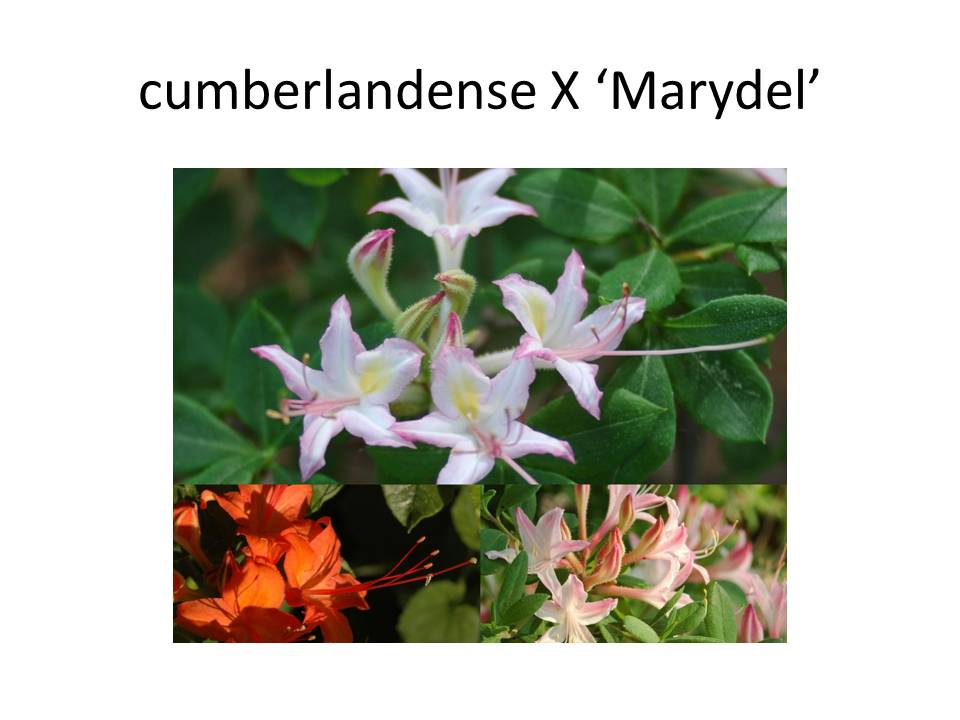
One seedling of Rhododendron cumberlandense orange X Rhododendron atlanticum 'Marydel', which is a Sally and John Perkins hybrid, has been determined to be a triploid using flow cytometry by
Dr. João Loureiro, Dr. Silvia Castro, José Cerca, and Mariana Castro
Plant Ecology and Evolution Group,
Centre for Functional Ecology,
Department of Life Sciences,
Faculty of Science and Technology,
University of Coimbra, Portugal.
This seedling of Rhododendron cumberlandense orange X Rhododendron atlanticum 'Marydel' looks remarkably similar to the tetraploid pollen parent 'Marydel' differing primarily in having a small yellow blotch.
To date this seedling has proven sterile as both a seed parent and a pollen parent.
In the case of this triploid (39 chromosomes), a diploid crossed with a tetraploid produced a triploid indicating normal meiosis occurred where the diploid contributed a 1x gamete (13 chromosomes) and the tetraploid contributed a 2x gamete (26 chromosomes).
Summary of Ploidy Levels
Diploid Rhododendron cumberlandense,
Triploid One seedling of Rhododendron cumberlandense X Rhododendron atlanticum 'Marydel',
Tetraploid Rhododendron atlanticum,
Tetraploid Rhododendron atlanticum 'Marydel'
Source: East Fork Nursery
John and Sally Perkins
H: Monday, January 17, 2011
'Canobie Sunset' is a Triploid
Rhododendron 'Canobie Sunset', which is Sally and John Perkins introduction documented as 'Fedora' open pollinated, has been determined to be a triploid using flow cytometry by
Dr. João Loureiro, Dr. Silvia Castro, José Cerca, and Mariana Castro
Plant Ecology and Evolution Group,
Centre for Functional Ecology,
Department of Life Sciences,
Faculty of Science and Technology,
University of Coimbra, Portugal.
'Canobie Sunset' is an evergreen azalea.
Summary of Ploidy Levels
Triploid 'Canobie Sunset'
Source: John and Sally Perkins
John and Sally Perkins
Dr. João Loureiro, Dr. Silvia Castro, José Cerca, and Mariana Castro
Plant Ecology and Evolution Group,
Centre for Functional Ecology,
Department of Life Sciences,
Faculty of Science and Technology,
University of Coimbra, Portugal.
'Canobie Sunset' is an evergreen azalea.
Summary of Ploidy Levels
Triploid 'Canobie Sunset'
Source: John and Sally Perkins
John and Sally Perkins
H: Monday, November 15, 2010
[(cumberlandense X viscosum) X colemanii] is a Triploid
Two seedlings of [(Rhododendron cumberlandense X R. viscosum) X R. colemanii], which is a John and Sally Perkins hybrid, have been determined to be a triploid using flow cytometry by
Dr. João Loureiro, Dr. Silvia Castro, José Cerca, and Mariana Castro
Plant Ecology and Evolution Group,
Centre for Functional Ecology,
Department of Life Sciences,
Faculty of Science and Technology,
University of Coimbra, Portugal.
Rhododendron cumberlandense and Rhododendron viscosum are diploid species. Rhododendron colemanii is a tetraploid species.
In this case of these 2 triploids (39 chromosomes), a diploid crossed with a tetraploid produced a triploid indicating normal meiosis occurred where the diploid contributed a 1x gamete (13 chromosomes) and the tetraploid contributed a 2x gamete (26 chromosomes).
Summary of Ploidy Levels
Diploid Rhododendron cumberlandense,
Diploid Rhododendron viscosum,
Triploid 2 seedlings from [(Rhododendron cumberlandense X R. viscosum) X R. colemanii],
Tetraploid Rhododendron colemanii
Seedlings from this same cross were sold at the November 14, 2010 Founders Day Meeting of the ARS Massachusetts Chapter and at the November 20, 2010 Banquet of the New England Rock Garden Society.
These seedlings were grown on by
Lindy Johnson
Appalachian Native Plants
676 Waddell Road
PO Box 736
Mountain City, TN 37683
Source: John and Sally Perkins
Source: Appalachian Native Plants
John and Sally Perkins
Dr. João Loureiro, Dr. Silvia Castro, José Cerca, and Mariana Castro
Plant Ecology and Evolution Group,
Centre for Functional Ecology,
Department of Life Sciences,
Faculty of Science and Technology,
University of Coimbra, Portugal.
Rhododendron cumberlandense and Rhododendron viscosum are diploid species. Rhododendron colemanii is a tetraploid species.
In this case of these 2 triploids (39 chromosomes), a diploid crossed with a tetraploid produced a triploid indicating normal meiosis occurred where the diploid contributed a 1x gamete (13 chromosomes) and the tetraploid contributed a 2x gamete (26 chromosomes).
Summary of Ploidy Levels
Diploid Rhododendron cumberlandense,
Diploid Rhododendron viscosum,
Triploid 2 seedlings from [(Rhododendron cumberlandense X R. viscosum) X R. colemanii],
Tetraploid Rhododendron colemanii
Seedlings from this same cross were sold at the November 14, 2010 Founders Day Meeting of the ARS Massachusetts Chapter and at the November 20, 2010 Banquet of the New England Rock Garden Society.
These seedlings were grown on by
Lindy Johnson
Appalachian Native Plants
676 Waddell Road
PO Box 736
Mountain City, TN 37683
Source: John and Sally Perkins
Source: Appalachian Native Plants
John and Sally Perkins
Subscribe to:
Posts (Atom)