'July Jester' X 'My Mary', which is a John and Sally Perkins hybrid, has been determined to be a triploid using flow cytometry by
Dr. João Loureiro, Dr. Silvia Castro, and Mariana Castro
Plant Ecology and Evolution Group,
Centre for Functional Ecology,
Department of Life Sciences,
Faculty of Science and Technology,
University of Coimbra, Portugal.
In this case of this triploid (39 chromosomes), a diploid crossed with a tetraploid produced a triploid indicating normal meiosis occurred where the diploid contributed a 1x gamete (13 chromosomes) and the tetraploid contributed a 2x gamete (26 chromosomes).
Summary of Ploidy Levels
Diploid Rhododendron cumberlandense
Diploid Rhododendron prunifolium
Triploid 'July Jester' X 'My Mary'
Tetraploid Rhododendron austrinum
Tetraploid 'My Mary'
Source: John and Sally Perkins
John and Sally Perkins
Showing posts with label 2x4. Show all posts
Showing posts with label 2x4. Show all posts
H: Saturday, December 03, 2011
H: Thursday, December 01, 2011
"viscosum glaucum not" X 'Smoky Mountaineer' is a Triploid
"viscosum glaucum not" X Rhododendron calendulaceum 'Smoky Mountaineer', which is a John and Sally Perkins hybrid, has been determined to be a triploid using flow cytometry by
Dr. João Loureiro, Dr. Silvia Castro, and Mariana Castro
Plant Ecology and Evolution Group,
Centre for Functional Ecology,
Department of Life Sciences,
Faculty of Science and Technology,
University of Coimbra, Portugal.
In this case of this triploid (39 chromosomes), a diploid crossed with a tetraploid produced a triploid indicating normal meiosis occurred where the diploid contributed a 1x gamete (13 chromosomes) and the tetraploid contributed a 2x gamete (26 chromosomes).
Summary of Ploidy Levels
Triploid "viscosum glaucum not" X Rhododendron calendulaceum 'Smoky Mountaineer'
Tetraploid Rhododendron calendulaceum
Tetraploid Rhododendron calendulaceum 'Smoky Mountaineer'
This seedling was grown on by
Lindy Johnson
Appalachian Native Plants
676 Waddell Road
PO Box 736
Mountain City, TN 37683
Source: John and Sally Perkins
Source: Appalachian Native Plants
John and Sally Perkins


H: Wednesday, November 30, 2011
(pruniflorum X arborescens) X 'Smoky Mountaineer' is a Triploid
(Rhododendron pruniflorum X Rhododendron arborescens) X Rhododendron calendulaceum 'Smoky Mountaineer', which is a John and Sally Perkins hybrid, has been determined to be a triploid using flow cytometry by
Dr. João Loureiro, Dr. Silvia Castro, and Mariana Castro
Plant Ecology and Evolution Group,
Centre for Functional Ecology,
Department of Life Sciences,
Faculty of Science and Technology,
University of Coimbra, Portugal.
Rhododendron pruniflorum and Rhododendron arborescens are diploid species. Rhododendron calendulaceum is a tetraploid species.
In this case of this triploid (39 chromosomes), a diploid crossed with a tetraploid produced a triploid indicating normal meiosis occurred where the diploid contributed a 1x gamete (13 chromosomes) and the tetraploid contributed a 2x gamete (26 chromosomes).
Summary of Ploidy Levels
Diploid Rhododendron pruniflorum,
Diploid Rhododendron arborescens,
Triploid (Rhododendron pruniflorum X Rhododendron arborescens) X Rhododendron calendulaceum 'Smoky Mountaineer',
Tetraploid Rhododendron calendulaceum,
Tetraploid Rhododendron calendulaceum 'Smoky Mountaineer'
This seedling was grown on by
Lindy Johnson
Appalachian Native Plants
676 Waddell Road
PO Box 736
Mountain City, TN 37683
Source: John and Sally Perkins
Source: Appalachian Native Plants
John and Sally Perkins
H: Monday, November 28, 2011
prinophyllum X calendulaceum Engine Gap is a Triploid
Rhododendron prinophyllum X Rhododendron calendulaceum "Engine Gap", which is a John and Sally Perkins hybrid, has been determined to be a triploid using flow cytometry by
Dr. João Loureiro, Dr. Silvia Castro, and Mariana Castro
Plant Ecology and Evolution Group,
Centre for Functional Ecology,
Department of Life Sciences,
Faculty of Science and Technology,
University of Coimbra, Portugal.
Rhododendron prinophyllum is diploid. Rhododendron calendulaceum is a tetraploid species.
In this case of this triploid (39 chromosomes), a diploid crossed with a tetraploid produced a triploid indicating normal meiosis occurred where the diploid contributed a 1x gamete (13 chromosomes) and the tetraploid contributed a 2x gamete (26 chromosomes).
Summary of Ploidy Levels
Diploid Rhododendron prinophyllum,
Triploid Rhododendron prinophyllum X Rhododendron calendulaceum "Engine Gap",
Tetraploid Rhododendron calendulaceum
This seedling was grown on by
Lindy Johnson
Appalachian Native Plants
676 Waddell Road
PO Box 736
Mountain City, TN 37683
Source: John and Sally Perkins
Source: Appalachian Native Plants
John and Sally Perkins
H: Sunday, November 27, 2011
'Canobie Candy' X calendulaceum Engine Gap is a Triploid
'Canobie Candy' X Rhododendron calendulaceum "Engine Gap", which is a John and Sally Perkins hybrid, has been determined to be a triploid using flow cytometry by
Dr. João Loureiro, Dr. Silvia Castro, and Mariana Castro
Plant Ecology and Evolution Group,
Centre for Functional Ecology,
Department of Life Sciences,
Faculty of Science and Technology,
University of Coimbra, Portugal.
'Canobie Candy' is diploid. Rhododendron calendulaceum is a tetraploid species.
In this case of this triploid (39 chromosomes), a diploid crossed with a tetraploid produced a triploid indicating normal meiosis occurred where the diploid contributed a 1x gamete (13 chromosomes) and the tetraploid contributed a 2x gamete (26 chromosomes).
Summary of Ploidy Levels
Diploid 'Canobie Candy',
Triploid 'Canobie Candy' X Rhododendron calendulaceum "Engine Gap",
Tetraploid Rhododendron calendulaceum
This seedling was grown on by
Lindy Johnson
Appalachian Native Plants
676 Waddell Road
PO Box 736
Mountain City, TN 37683
Source: John and Sally Perkins
Source: Appalachian Native Plants
John and Sally Perkins
H: Saturday, November 26, 2011
molle x luteum is a Triploid
Rhododendron molle X Rhododendron luteum, which is a John and Sally Perkins hybrid, has been determined to be a triploid using flow cytometry by
Dr. João Loureiro, Dr. Silvia Castro, and Mariana Castro
Plant Ecology and Evolution Group,
Centre for Functional Ecology,
Department of Life Sciences,
Faculty of Science and Technology,
University of Coimbra, Portugal.
Rhododendron molle is diploid species. Rhododendron luteum is a tetraploid species.
In this case of this triploid (39 chromosomes), a diploid crossed with a tetraploid produced a triploid indicating normal meiosis occurred where the diploid contributed a 1x gamete (13 chromosomes) and the tetraploid contributed a 2x gamete (26 chromosomes).
Summary of Ploidy Levels
Diploid Rhododendron molle,
Triploid Rhododendron molle X Rhododendron luteum,
Tetraploid Rhododendron luteum
This seedling was grown on by
Lindy Johnson
Appalachian Native Plants
676 Waddell Road
PO Box 736
Mountain City, TN 37683
Source: John and Sally Perkins
Source: Appalachian Native Plants
John and Sally Perkins
H: Monday, September 05, 2011
Rhododendron arborescens X Rhododendron calendulaceum is a Triploid
One seedling of Rhododendron arborescens X Rhododendron calendulaceum has been determined to be a triploid using flow cytometry by
Dr. João Loureiro, Dr. Silvia Castro, José Cerca, and Mariana Castro
Plant Ecology and Evolution Group,
Centre for Functional Ecology,
Department of Life Sciences,
Faculty of Science and Technology,
University of Coimbra, Portugal.
Rhododendron arborescens is diploid species. Rhododendron calendulaceum is a tetraploid species.
In the case of these triploid (39 chromosomes), a diploid crossed with a tetraploid produced a triploid indicating normal meiosis occurred where the diploid contributed a 1x gamete (13 chromosomes) and the tetraploid contributed a 2x gamete (26 chromosomes).
Summary of Ploidy Levels
Diploid Rhododendron arborescens,
Triploid 5 seedlings from Rhododendron occidentale SM189 X Rhododendron calendulaceum 'Colossus',
Tetraploid Rhododendron calendulaceum
Source: Bruce Clyburn
John and Sally Perkins
H: Sunday, September 04, 2011
occidentale SM189 X calendulaceum 'Colossus' is a Triploid
Five seedlings of Rhododendron occidentale SM189 X Rhododendron calendulaceum 'Colossus' have been determined to be a triploid using flow cytometry by
Dr. João Loureiro, Dr. Silvia Castro, José Cerca, and Mariana Castro
Plant Ecology and Evolution Group,
Centre for Functional Ecology,
Department of Life Sciences,
Faculty of Science and Technology,
University of Coimbra, Portugal.
Rhododendron occidentale is diploid species. Rhododendron calendulaceum is a tetraploid species.
In the case of these 5 triploids (39 chromosomes), a diploid crossed with a tetraploid produced a triploid indicating normal meiosis occurred where the diploid contributed a 1x gamete (13 chromosomes) and the tetraploid contributed a 2x gamete (26 chromosomes).
Summary of Ploidy Levels
Diploid Rhododendron occidentale,
Triploid 5 seedlings from Rhododendron occidentale SM189 X Rhododendron calendulaceum 'Colossus',
Tetraploid Rhododendron calendulaceum
Source: Bruce Clyburn
John and Sally Perkins
H: Wednesday, August 17, 2011
'Horizon Lakeside' X 'Doreen Gale' is a Triploid
Two seedlings of Rhododendron 'Horizon Lakeside' X 'Doreen Gale', which were raised by Marc Colombel, have been determined to be a triploid using flow cytometry by
Dr. João Loureiro, Dr. Silvia Castro, José Cerca, and Mariana Castro
Plant Ecology and Evolution Group,
Centre for Functional Ecology,
Department of Life Sciences,
Faculty of Science and Technology,
University of Coimbra, Portugal.
In the case of the triploid seedling of 'Horizon Lakeside' (2X) X 'Doreen Gale' (4X), a diploid by a tetraploid produced a tetraploid indicating that normal meiosis most likely occurred for both parents. In other words, the triploid seedlings of 'Horizon Lakeside' X 'Doreen Gale' having 39 chromosomes received 13 chromosomes from the diploid 'Horizon Lakeside' and 26 chromosomes from the tetraploid 'Doreen Gale'.
Summary of Ploidy Levels
Diploid 'Horizon Lakeside',
Tetraploid 'Doreen Gale',
Tetraploid 2 Seedlings of 'Horizon Lakeside' X 'Doreen Gale'
Source Marc Colombel
John and Sally Perkins
H: Wednesday, June 29, 2011
'Julia Caroline' is a Triploid
Rhododendron 'Julia Caroline', which is a Ned Brockenbrough hybrid documented as 'Horizon Lakeside' x 'Point Defiance', has been determined to be a triploid using flow cytometry by
Dr. João Loureiro, Dr. Silvia Castro, José Cerca Oliveira, and Mariana Castro
Plant Ecology and Evolution Group,
Centre for Functional Ecology,
Department of Life Sciences,
Faculty of Science and Technology,
University of Coimbra, Portugal.
Summary of Ploidy Levels
Diploid 'Anna',
Diploid 'Horizon Lakeside',
Diploid 'Nancy Evans',
Diploid 'Norman Gill'
Diploid 'The Honourable Jean Marie de Montague',
Triploid 'Julia Caroline',
Tetraploid 'Marinus Koster',
Tetraploid 'Point Defiance'
Source: Whitney Nursery
John and Sally Perkins
H: Monday, June 13, 2011
'Margaret Abbott' is a Tetraploid

'Margaret Abbott' (Frank Abbott) [4x]
Rhododendron prinophyllum [2x] X Rhododendron calendulaceum [4x]
Spring 2009 Saxtons River, VT
S and J Perkins
Rhododendron 'Margaret Abbott', which is a Frank Abbott hybrid documented as Rhododendron prinophyllum X Rhododendron calendulaceum, has been determined to be a tetraploid using flow cytometry by
Dr. João Loureiro, Dr. Silvia Castro, José Cerca Oliveira, and Mariana Castro
Plant Ecology and Evolution Group,
Centre for Functional Ecology,
Department of Life Sciences,
Faculty of Science and Technology,
University of Coimbra, Portugal.
Rhododendron 'Margaret Abbott' was named by Frank to honor his wife. Frank was amazed he crossed a pink with a yellow to produce this lone fragrant ruffled white flower with a yellow flare. See A Love Affair With A Flower by Marge Runnion. See Frank Abbott's Village of Azaleas by John and Sally Perkins.
Notice in the image above on the flower facing forward, 'Margaret Abbott' has, at the end of the stamens, tagged anthers, such anthers rarely appear on a deciduous azalea. 'Margaret Abbott' is known to be partially seed fertile but does not appear to have viable pollen.
Notice, also, for 'Margaret Abbott' that the diploid is the seed parent and the tetraploid is the pollen parent. For deciduous azaleas, diploids usually accept pollen from tetraploids but tetraploids usually reject pollen from diploids. See Rules of Engagement by John and Sally Perkins.
In the case of the tetraploid 'Margaret Abbott', a diploid crossed with a tetraploid produced a tetraploid indicating that unreduced meiosis may have occurred for the diploid seed parent. In other words, 'Margaret Abbott' having 52 chromosomes received something on the order of 26 chromosomes from the diploid Rhododendron prinophyllum and 26 chromosomes from the tetraploid Rhododendron calendulaceum. See Unreduced Meiosis. See Ploidy of Deciduous Azaleas Species.
In every other case we have tested where a diploid deciduous azalea is crossed with a tetraploid deciduous azalea, the resulting offspring have been triploids having 39 chromosomes receiving 13 chromosomes from the diploid seed parent and 26 chromosomes from the tetraploid pollen parent. See 2X4 for Deciduous Azaleas. See Normal Meiosis.
Natural interactions of diploid deciduous azalea species and tetraploid diploid deciduous azalea species do occur in places such as Audra State Park. Plants that appear to be interploidy hybrids have tested as triploid and tetraploid. The ploidy results for 'Margaret Abbott' indicated that unreduced gametes of the diploid seed parent may be one of the mechanism causing tetraploids to be produced by diploid X tetraploid interaction. See Audra State Park: Ploidy Haven. See Rhododendron prinophyllum by Elizabeth Carlhian. See Rhododendron arborescens by Susan Clark. See Rhododendron calendulaceum by Joe Bruso.
The hybridizers of the Ghents, including some done by Ed Mezitt, the Rusticas, and the Northen Lights series crossed diploid and tetraploid deciduous azaleas. See Ghent. See Rustica. See Mezitt.
For large leaf elepidote hybrid Rhododendrons we have discovered several instances where a diploid X tetraploid results in tetraploids as well as triploids and diploids. For instance, Rhododendron 'Horizon Monarch', which is a Ned Brockenbrough hybrid documented as 'Nancy Evans' x 'Point Defiance', has been determined to be a tetraploid. 'Nancy Evans' has been determined to be a diploid and 'Point Defiance' has been determined to be a tetraploid. See 2X4 for Large Leaf Elepidotes. See 4X2 for Large Leaf Elepidotes.
For large leaf elepidote hybrid Rhododendrons we have discovered fertile triploids and the offspring of these triploids can be tetraploids. For instance, Rhododendron 'Countess of Derby', which is a 1913 Henry White hybrid documented as 'Pink Pearl' x 'Cynthia', has been determined to be a tetraploid. Both 'Pink Pearl' and 'Cynthia' have been determined to be triploids. See It is 1913 So What Do You Do? by John and Sally Perkins. See Fertile Triploids. See Pink Pearl.
For large leaf elepidote hybrid Rhododendrons we have discovered tetraploids can produce diploid offspring in the first generation. See Super Reduced Meiosis.
Although there are no known polyploid elepidote species, many elepidote hybridizers, including Barlup, Bones, Brack, Briggs, Brockenbrough, Broughton, Bruns, Colombel, Croux and Fils, de la Sablière, Endtz, Evans, Felix and Dijkhuis, Fujioka, Greer, Gehnrich, Hachmann, Hartman, Heinje, Henny and Wennekamp, Hobbie, Kavka, Kehr, Korn, Koster, Lem, Loder, Lofthouse, Mangles, Markeeta, McCullough, Mossman, Murcott, Naylor, Patterson, Pearce, Rabideau, Sanders, Schannen, Seabrook, Standish and Noble, Stead, Stockman, Thornton, vanNes, VanVeen, von Martin, Walton, Waterer, White, Whitney, Wilson, and Woodward have worked with or produced ployploid elepidotes hybrids and in some cases are best known for these polyploid hybrids.
Clarence Towe aided us in confirming that the plant pictured above is 'Margaret Abbott'.
To see a poster on the ploidy results (Click on the poster image to enlarge):
Ploidy Research Poster by José Cerca Oliveira.
To see the research team:
Research Team of Dr. João Loureiro, Dr. Silvia Castro, José Cerca Oliveira, and Mariana Castro.
To see other images of Frank Abbott's azaleas visit the following:
Abbott Azaleas by S & J Perkins.
The "In The Collections" web page of the Arnold Arboretum includes a reference to our ploidy research.
Summary of Ploidy Levels
Diploid Rhododendron molle,
Diploid Rhododendron prinophyllum,
Diploid 'Frank Abbott',
Diploid "Jane Abbott" (grex),
Diploid 'Nancy Evans',
Triploid 'Cynthia',
Triploid 'Pink Pearl',
Tetraploid Rhododendron calendulaceum,
Tetraploid 'Countess of Derby',
Tetraploid 'Horizon Monarch',
Tetraploid 'Margaret Abbott',
Tetraploid 'Point Defiance'
Source: John Abbott
Ploidy Results by Groups
Rhododendron Species,
Diploid Deciduous Azaleas,
Triploid Deciduous Azaleas,
Tetraploid Deciduous Azaleas,
Diploid Large Leaf Elepidotes,
Triploid Large Leaf Elepidotes,
Tetraploid Large Leaf Elepidotes,
Diploid Lepidotes,
Triploid Lepidotes,
Tetraploid Lepidotes,
Diploid Everegreen Azaleas,
Triploid Evergreen Azaleas,
Diploids,
Triploids,
Fertile Triploids,
Tetraploids,
Ghents,
Northern Lights, and
Rusticas
The following people and organizations donored samples for this reasearch:
John Abbott,
Vivian Abney of East Fork Nursery,
Arnold Arboretum,
Audra State Park,
Bartlett Arboretum,
Jim Barlup,
Bruce Clyburn,
Jane Brooks,
Joe Bruso,
Werner Brack,
Ned Brockenbrough,
Canobie Lake, NH,
Dick Cavender,
Connecticut College Arboretum,
Marc Colombel,
Mike Creel,
Al Fitzburg,
Robert Fox,
Harold Greer of Greer Gardens,
George Hibben,
Highstead Arboretum,
Don Hyatt,
Lindy Johnson of Appalachian Native Plants,
Richard Jaynes of Broken Arrow Nursery,
Doug Jolley,
Fred Knippel,
Longwood Gardens,
Ron Miller,
Dick Murcott,
Planview Nursery,
John and Sally Perkins,
Ron Rabideau of RareFind Nursery,
Ellie Sather of Whitney Gardens,
Stoddard Blog, NH,
John Thornton,
Hendrik Van Oostand of Azaleatuin,
Kathy Van Veen of Van Veen Nursery
John and Sally Perkins
H: Saturday, April 16, 2011
'Horizon Lakeside' x 'Point Defiance' is a Tetraploid
Two seedlings of Rhododendron 'Horizon Lakeside' x 'Point Defiance', which were raised by Ned Brockenbrough, have been determined to be a tetraploid using flow cytometry by
Dr. João Loureiro, Dr. Silvia Castro, José Cerca, and Mariana Castro
Plant Ecology and Evolution Group,
Centre for Functional Ecology,
Department of Life Sciences,
Faculty of Science and Technology,
University of Coimbra, Portugal.
Summary of Ploidy Levels
Diploid 'Horizon Lakeside'
Tetraploid 'Point Defiance'
Tetraploid 2 Seedlings of 'Horizon Lakeside' x 'Point Defiance'
Source: Ned Brockenbrough
John and Sally Perkins
H: Friday, April 15, 2011
'Nancy Evans' x 'Point Defiance' is a Tetraploid
One seedling of Rhododendron 'Nancy Evans' x 'Point Defiance', which was raised by Ned Brockenbrough, has been determined to be a tetraploid using flow cytometry by
Dr. João Loureiro, Dr. Silvia Castro, José Cerca, and Mariana Castro
Plant Ecology and Evolution Group,
Centre for Functional Ecology,
Department of Life Sciences,
Faculty of Science and Technology,
University of Coimbra, Portugal.
Summary of Ploidy Levels
Diploid 'Nancy Evans'
Tetraploid 'Point Defiance'
Tetraploid 1 Seedling of 'Nancy Evans' x 'Point Defiance'
Source: Ned Brockenbrough
John and Sally Perkins
H: Wednesday, March 23, 2011
(cumberlandense X arborescens) X calendualceum is a Triploid
Two seedlings of [(Rhododendron cumberlandense X Rhododendron arborescens) X Rhododendron calendulaceum] have been determined to be a triploid using flow cytometry by
Dr. João Loureiro, Dr. Silvia Castro, José Cerca, and Mariana Castro
Plant Ecology and Evolution Group,
Centre for Functional Ecology,
Department of Life Sciences,
Faculty of Science and Technology,
University of Coimbra, Portugal.
Rhododendron cumberlandense and Rhododendron arborescens are diploid species. Rhododendron calendulaceum is a tetraploid species.
In the case of these 2 triploids (39 chromosomes), a diploid crossed with a tetraploid produced a triploid indicating normal meiosis occurred where the diploid contributed a 1x gamete (13 chromosomes) and the tetraploid contributed a 2x gamete (26 chromosomes).
Summary of Ploidy Levels
Diploid Rhododendron cumberlandense,
Diploid Rhododendron arborescens,
Triploid 2 seedlings from [(Rhododendron cumberlandense X Rhododendron arborescens) X Rhododendron calendulaceum],
Tetraploid Rhododendron calendulaceum
Source: Joe Bruso
John and Sally Perkins
H: Tuesday, March 22, 2011
(cumberlandense X viscosum) X 'Apricot Surprise' is a Triploid
Two seedlings of [(Rhododendron cumberlandense X Rhododendron viscosum) X 'Apricot Surprise'], which is a John and Sally Perkins hybrid, have been determined to be a triploid using flow cytometry by
Dr. João Loureiro, Dr. Silvia Castro, José Cerca, and Mariana Castro
Plant Ecology and Evolution Group,
Centre for Functional Ecology,
Department of Life Sciences,
Faculty of Science and Technology,
University of Coimbra, Portugal.
Rhododendron cumberlandense and Rhododendron viscosum are diploid species. 'Apricot Surprise' is a tetraploid.
In the case of these 2 triploids (39 chromosomes), a diploid crossed with a tetraploid produced a triploid indicating normal meiosis occurred where the diploid contributed a 1x gamete (13 chromosomes) and the tetraploid contributed a 2x gamete (26 chromosomes).
Summary of Ploidy Levels
Diploid Rhododendron cumberlandense,
Diploid Rhododendron viscosum,
Triploid 2 seedlings from [(Rhododendron cumberlandense X Rhododendron viscosum) X 'Apricot Surprise' ],
Tetraploid 'Apricot Surprise'
Seedlings from this same cross were sold at the November 14, 2010 Founders Day Meeting of the ARS Massachusetts Chapter and at the November 20, 2010 Banquet of the New England Rock Garden Society.
These seedlings were grown on by
Lindy Johnson
Appalachian Native Plants
676 Waddell Road
PO Box 736
Mountain City, TN 37683
Source: John and Sally Perkins
Source: Appalachian Native Plants
John and Sally Perkins
H: Saturday, March 19, 2011
cumberlandense X 'Marydel' is a Triploid
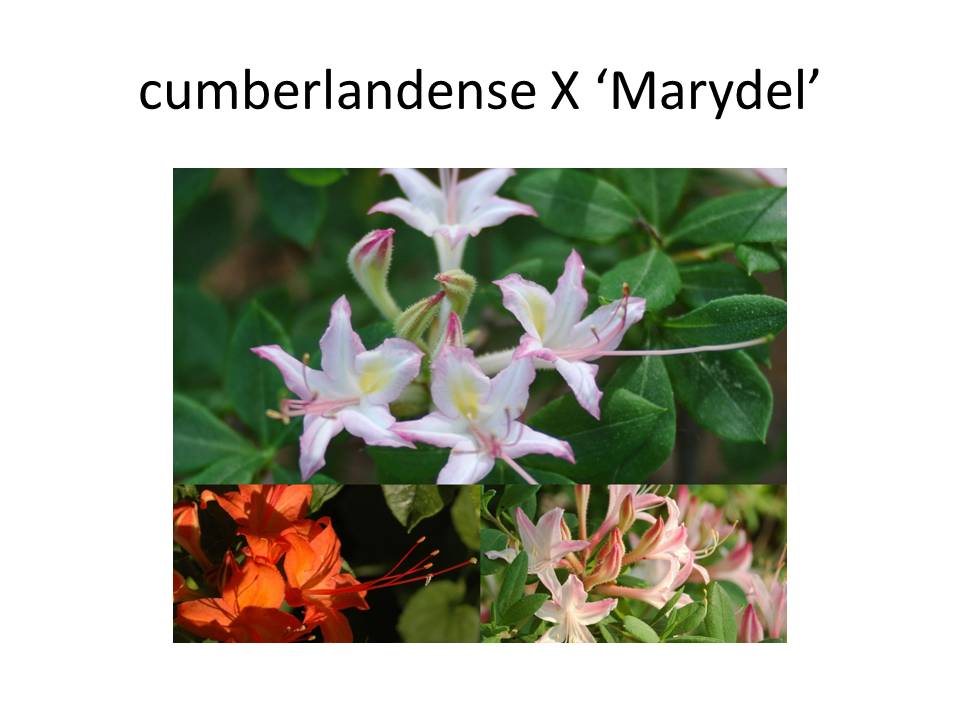
One seedling of Rhododendron cumberlandense orange X Rhododendron atlanticum 'Marydel', which is a Sally and John Perkins hybrid, has been determined to be a triploid using flow cytometry by
Dr. João Loureiro, Dr. Silvia Castro, José Cerca, and Mariana Castro
Plant Ecology and Evolution Group,
Centre for Functional Ecology,
Department of Life Sciences,
Faculty of Science and Technology,
University of Coimbra, Portugal.
This seedling of Rhododendron cumberlandense orange X Rhododendron atlanticum 'Marydel' looks remarkably similar to the tetraploid pollen parent 'Marydel' differing primarily in having a small yellow blotch.
To date this seedling has proven sterile as both a seed parent and a pollen parent.
In the case of this triploid (39 chromosomes), a diploid crossed with a tetraploid produced a triploid indicating normal meiosis occurred where the diploid contributed a 1x gamete (13 chromosomes) and the tetraploid contributed a 2x gamete (26 chromosomes).
Summary of Ploidy Levels
Diploid Rhododendron cumberlandense,
Triploid One seedling of Rhododendron cumberlandense X Rhododendron atlanticum 'Marydel',
Tetraploid Rhododendron atlanticum,
Tetraploid Rhododendron atlanticum 'Marydel'
Source: East Fork Nursery
John and Sally Perkins
H: Saturday, March 05, 2011
Rhododendron prunifolium X Rhododendron austrinum is a Triploid
One seedling of Rhododendron prunifolium X Rhododendron austrinum, which is a John Thornton hybrid, has been determined to be a triploid using flow cytometry by
Dr. João Loureiro, Dr. Silvia Castro, José Cerca, and Mariana Castro
Plant Ecology and Evolution Group,
Centre for Functional Ecology,
Department of Life Sciences,
Faculty of Science and Technology,
University of Coimbra, Portugal.
Rhododendron prunifolium is a diploid species. Rhododendron austrinum is a tetraploid species.
In this case of this triploid (39 chromosomes), a diploid crossed with a tetraploid produced a triploid indicating normal meiosis occurred where the diploid contributed a 1x gamete (13 chromosomes) and the tetraploid contributed a 2x gamete (26 chromosomes).
Summary of Ploidy Levels
Diploid Rhododendron prunifolium,
Triploid 1 seedling from Rhododendron prunifolium X Rhododendron austrinum,
Tetraploid Rhododendron austrinum
Source: John Thornton
John and Sally Perkins
H: Friday, March 04, 2011
Rhododendron viscosum X Rhododendron austrinum is a Triploid
One seedling of Rhododendron viscosum syn. serrulatum X Rhododendron austrinum, which is a John Thornton hybrid, has been determined to be a triploid using flow cytometry by
Dr. João Loureiro, Dr. Silvia Castro, José Cerca, and Mariana Castro
Plant Ecology and Evolution Group,
Centre for Functional Ecology,
Department of Life Sciences,
Faculty of Science and Technology,
University of Coimbra, Portugal.
Rhododendron viscosum is a diploid species. Rhododendron austrinum is a tetraploid species.
In the case of this triploid (39 chromosomes), a diploid crossed with a tetraploid produced a triploid indicating normal meiosis occurred where the diploid contributed a 1x gamete (13 chromosomes) and the tetraploid contributed a 2x gamete (26 chromosomes).
Rhododendron viscosum syn. serrulatum is sometimes documented as Rhododendron serrulatum but is now considered merely a southern form of Rhododendron viscosum
Summary of Ploidy Levels
Diploid Rhododendron viscosum,
Triploid 1 seedling from Rhododendron viscosum syn. serrulatum X Rhododendron austrinum,
Tetraploid Rhododendron austrinum
Source: John Thornton
John and Sally Perkins
H: Saturday, January 15, 2011
'Voluptuous' x 'Point Defiance' is a Triploid
A seedling of 'Voluptuous' x 'Point Defiance', which is a Werner Brack hybrid, has been determined to be a triploid using flow cytometry by
Dr. João Loureiro, Dr. Silvia Castro, José Cerca, and Mariana Castro
Plant Ecology and Evolution Group,
Centre for Functional Ecology,
Department of Life Sciences,
Faculty of Science and Technology,
University of Coimbra, Portugal.
In the case of this triploid seedling of 'Voluptuous' x 'Point Defiance', a diploid crossed with a tetraploid produced a triploid indicating that normal reduced meiosis most likely occurred for both parents. In other words, the triploid seedling having 39 chromosomes received 13 chromosomes from the diploid 'Voluptuous' and 26 chromosomes from the tetraploid 'Point Defiance'. Tetraploids usually contribute 26 chromosomes to their offspring.
Three seedlings were ploidy tested from the Brack cross of 'Voluptuous' x 'Point Defiance'. 'Orange Leopard' and 'Stony Brook' tested as diploid. This unnamed seedling tested as triploid. This indicates that the offspring of a given cross can have different ploidy levels from one offspring to another.
Summary of Ploidy Levels
Diploid 'Orange Leopard',
Diploid 'Stony Brook',
Diploid 'Voluptuous',
Triploid Seedling of 'Voluptuous' x 'Point Defiance',
Tetraploid 'Point Defiance'
Source: Werner Brack
John and Sally Perkins
H: Friday, January 14, 2011
'Orange Leopard' is a Diploid
Rhododendron 'Orange Leopard', which is a Werner Brack hybrid documented as 'Voluptuous' x 'Point Defiance', has been determined to be a diploid using flow cytometry by
Dr. João Loureiro, Dr. Silvia Castro, José Cerca, and Mariana Castro
Plant Ecology and Evolution Group,
Centre for Functional Ecology,
Department of Life Sciences,
Faculty of Science and Technology,
University of Coimbra, Portugal.
In the case of diploid 'Orange Leopard', a diploid crossed with a tetraploid produced a diploid indicating that supper reduced meiosis most likely occurred for the tetraploid parent. In other words, 'Orange Leopard' having 26 chromosomes received 13 chromosomes from the diploid 'Voluptuous' and 13 chromosomes from the tetraploid 'Point Defiance'. Tetraploids usually contribute 26 chromosomes to their offspring.
Three seedlings were ploidy tested from the Brack cross of 'Voluptuous' x 'Point Defiance'. 'Orange Leopard' and 'Stony Brook' tested as diploid. An unnamed seedling tested as triploid. This indicates that the offspring of a given cross can have different ploidy levels from one offspring to another.
Summary of Ploidy Levels
Diploid 'Orange Leopard',
Diploid 'Stony Brook',
Diploid 'Voluptuous',
Triploid Seedling of 'Voluptuous' x 'Point Defiance',
Tetraploid 'Point Defiance'
Source: Werner Brack
John and Sally Perkins
Subscribe to:
Posts (Atom)