A video on how to do crosses with Joe Bruso.
http://www.youtube.com/watch?v=k3KLnw4YxiE
Showing posts with label GroupPropagation. Show all posts
Showing posts with label GroupPropagation. Show all posts
H: Sunday, November 20, 2011
H: Thursday, May 22, 2008
[Reminder] Propagation Group: Bruso Home @ Sat May 24 10am – 11:30am (ARS Massachusetts Chapter Calendar)

John Perkins, this is a reminder for
Propagation Group: Bruso Home
Sat May 24 10am – 11:30am
(Timezone: Eastern Time)
61 South Mill St., Hopkinton, MA (map)
Calendar: ARS Massachusetts Chapter Calendar
The purposes of this group are to share information, experiences, seeds and plants.
The focus will be on growing rhododendrons from seed.
More event details»

You are receiving this email at the account john.a.perkins@gmail.com because you are subscribed for reminders on calendar ARS Massachusetts Chapter Calendar.
To stop receiving these notifications, please log in to http://www.google.com/calendar/ and change your notification settings for this calendar.


H: Saturday, May 17, 2008
[Reminder] Propagation Group: Putnam Bluilding: Bruso Home @ Sat May 24 10am – 11:30am (ARS Massachusetts Chapter Calendar)
John Perkins, this is a reminder for
Propagation Group: Putnam Bluilding: Bruso Home
Sat May 24 10am – 11:30am
(Timezone: Eastern Time)
61 South Mill St., Hopkinton, MA (map)
Calendar: ARS Massachusetts Chapter Calendar
The purposes of this group are to share information, experiences, seeds and plants.
The focus will be on growing rhododendrons from seed.
More event details»
You are receiving this email at the account john.a.perkins@gmail.com because you are subscribed for reminders on calendar ARS Massachusetts Chapter Calendar.
To stop receiving these notifications, please log in to http://www.google.com/calendar/ and change your notification settings for this calendar.
H: Thursday, May 08, 2008
H: Monday, April 28, 2008
Propagation Group Meeting
At the April meeting of the Propagation Group, we decided to hold the last meeting of the season at my home on Saturday, May 24, 10:00 AM.
On the agenda:
- Demonstration of hybridizing with rhododendrons.
- Tour of our garden.
Please let me know whether or not you will be coming to this meeting.
Our address is 61 South Mill St., Hopkinton, MA.
Joe Bruso
508.435.8217
Need a new ride? Check out the largest site for U.S. used car listings at AOL Autos.
H: Monday, March 31, 2008
[Reminder] Propagation Group: Putnam Bluilding, Elm Bank @ Wed Apr 2 7:30pm - 9pm (ARS Massachusetts Chapter Calendar)
John Perkins, this is a reminder for
Propagation Group: Putnam Bluilding, Elm Bank
Wed Apr 2 7:30pm – 9pm
(Timezone: Eastern Time)
900 Washington Street Wellesley, MA 02482 (map)
Calendar: ARS Massachusetts Chapter Calendar
The purposes of this group are to share information, experiences, seeds and plants.
The focus will be on growing rhododendrons from seed.
More event details»
You are receiving this email at the account john.a.perkins@gmail.com because you are subscribed for reminders on calendar ARS Massachusetts Chapter Calendar.
To stop receiving these notifications, please log in to http://www.google.com/calendar/ and change your notification settings for this calendar.
H: Sunday, March 30, 2008
Propagation Group Meeting Wednesday, April 2
Below is the agenda for the April meeting.
Hope to see you there!
Joe
Date/Time:
Location: Putnam Building, Elm Bank,
Directions: See MHS website: www.masshort.org
Agenda
1) Discussions
a) Seedling Exchange at Founders' Day? (
b) May Prop Group Meeting – No meeting May 4. Alternatives?
i) Tour of
c) Seed Care & Storage
d) Volunteers for May Shows (Clerk, Registration, etc)
e) Improving Results
i) Members' results & advice on ways to make improvements – BRING SAMPLE PLANTS
f) Next Steps: (Handout: Caring for Small Rhododendrons)
i) Spring/Summer Care
ii) First Fall & Winter
2) Break
3) Demos
a) Seed Sowing – for anyone attending for the first time.
b) Transplanting – as needed
4) Slide Show: Plants raised from seed.
5) Future Meetings:
a) May Meeting – TBD. Not
b) No summer meetings.
c) Meetings resume
Create a Home Theater Like the Pros. Watch the video on AOL Home.
H: Saturday, March 29, 2008
2008 RSF Ordered Arrived
The combined order of 24 Rhododendrons from the Rhododendron Species Foundation has arrived and been potted for delivery to ARS Massachusetts Chapter members.
H: Wednesday, March 26, 2008
[Reminder] Propagation Group: Putnam Bluilding, Elm Bank @ Wed Apr 2 7:30pm - 9pm (ARS Massachusetts Chapter Calendar)
John Perkins, this is a reminder for
Propagation Group: Putnam Bluilding, Elm Bank
Wed Apr 2 7:30pm – 9pm
(Timezone: Eastern Time)
900 Washington Street Wellesley, MA 02482 (map)
Calendar: ARS Massachusetts Chapter Calendar
The purposes of this group are to share information, experiences, seeds and plants.
The focus will be on growing rhododendrons from seed.
More event details»
You are receiving this email at the account john.a.perkins@gmail.com because you are subscribed for reminders on calendar ARS Massachusetts Chapter Calendar.
To stop receiving these notifications, please log in to http://www.google.com/calendar/ and change your notification settings for this calendar.
H: Tuesday, March 04, 2008
Atlantic Rhododendron & Horticultural Soc. Seed Exchange
In case any of you need yet another source for rhododendron (and companion plant) seed, here's another exchange that just opened to non-members of their organization. The cost per packet is very reasonable: $2 to $2.50 each.
Joe
In a message dated 2/20/2008 11:28:37 A.M. Eastern Standard Time, sbryson@stfx.ca writes:
Just a note to draw to everyone's attention that the 2008 ARHS Seed Exchange will be open to the public as of Feb29, 2008. It will stay open until April30, 2008.
The list is online at our Willow Garden site. I will be doing an update within the week to indicate which lots may now be unavailable.
Hope you find something of interest.
Cheers
Sharon & Bill
Antigonish Nova Scotia
CANADA zone5b
It's Tax Time! Get tips, forms and advice on AOL Money & Finance.
H: Monday, March 03, 2008
[Reminder] Propagation Group: Putnam Bluilding, Elm Bank @ Wed Mar 5 7:30pm - 9pm (ARS Massachusetts Chapter Calendar)
John Perkins, this is a reminder for
Propagation Group: Putnam Bluilding, Elm Bank
Wed Mar 5 7:30pm – 9pm
(Timezone: Eastern Time)
900 Washington Street Wellesley, MA 02482 (map)
Calendar: ARS Massachusetts Chapter Calendar
The purposes of this group are to share information, experiences, seeds and plants.
The focus will be on growing rhododendrons from seed.
More event details»
You are receiving this email at the account john.a.perkins@gmail.com because you are subscribed for reminders on calendar ARS Massachusetts Chapter Calendar.
To stop receiving these notifications, please log in to http://www.google.com/calendar/ and change your notification settings for this calendar.
H: Sunday, March 02, 2008
Propagation Group Meeting Wednesday, Mar 5, 7:30 PM, Elm Bank
Date/Time:
Location: Putnam Building, Elm Bank,
Directions are on the MHS website: www.masshort.org
I will have a number of extra seedlings for sharing with the group. If you have any extras you want to share, please bring them in.
Finally, we will discuss the technique of rooting hard to root species like Yak, Fortunei by sticking them in Feb or March. If you have these plants, please bring in cuttings to try.
I'll have materials on hand, and will be available to give demos on seed sowing through potting up for anyone who is coming for the first time, or who missed a meeting or two.
Please contact me if you have any questions.
Joe Bruso
Delicious ideas to please the pickiest eaters. Watch the video on AOL Living.
H: Wednesday, February 27, 2008
[Reminder] Propagation Group: Putnam Bluilding, Elm Bank @ Wed Mar 5 7:30pm - 9pm (ARS Massachusetts Chapter Calendar)
John Perkins, this is a reminder for
Propagation Group: Putnam Bluilding, Elm Bank
Wed Mar 5 7:30pm – 9pm
(Timezone: Eastern Time)
900 Washington Street Wellesley, MA 02482 (map)
Calendar: ARS Massachusetts Chapter Calendar
The purposes of this group are to share information, experiences, seeds and plants.
The focus will be on growing rhododendrons from seed.
More event details»
You are receiving this email at the account john.a.perkins@gmail.com because you are subscribed for reminders on calendar ARS Massachusetts Chapter Calendar.
To stop receiving these notifications, please log in to http://www.google.com/calendar/ and change your notification settings for this calendar.
H: Monday, February 04, 2008
[Reminder] Propagation Group: Putnam Bluilding, Elm Bank @ Wed Feb 6 7:30pm - 9pm (ARS Massachusetts Chapter Calendar)
John Perkins, this is a reminder for
Propagation Group: Putnam Bluilding, Elm Bank
Wed Feb 6 7:30pm – 9pm
(Eastern Time)
900 Washington Street Wellesley, MA 02482 (map)
Calendar: ARS Massachusetts Chapter Calendar
The purposes of this group are to share information, experiences, seeds and plants.
The focus will be on growing rhododendrons from seed.
More event details»
You are receiving this email at the account john.a.perkins@gmail.com because you are subscribed for reminders on calendar ARS Massachusetts Chapter Calendar.
To stop receiving these notifications, please log in to http://www.google.com/calendar/ and change your notification settings for this calendar.
H: Saturday, February 02, 2008
Wednesday Prop Group Meeting
I would like to add some comments in absentia (too far a drive during the week):
As far as too much fertilizer, or salt build up for that matter, I like to put my seedlings outside on a rainy night (with no tray beneath them); by morning they have been cleansed. I try to avoid tap water because of it can cause salt build up. I am lucky enough to have a stream on my land, but before moving here, I used rain water. If you cannot put your babies out for the night, elevate them so the bottom of the pots are above the tray and drench them with rainwater and toss the runoff; this will flush excess salt or fertilizer.
As far as seedling exchanges, I like to give my excess away at the Founder's Day Brunch. In fact I plant a extra tray or two for that purpose; this year I hope to offer bureavii, wiltonii, and two of my, admittedly no-so-exciting, crosses (janet blair x helmseyanum and scintillation x sinogrande). I start them in my basement about now and leave them out all summer; by November they are ready for the Brunch.
I wonder if we should informally designate the Brunch as an event to distribute excess seedlings?
Note on the ARS seed exchange; I have gotten some very interesting plants from Alan Clark's Arunachal Pradesh expedition. Some of that see is still around.
Another point on the ARS seed exchange; who has a cheque book for Pounds Sterling?
As far as too much fertilizer, or salt build up for that matter, I like to put my seedlings outside on a rainy night (with no tray beneath them); by morning they have been cleansed. I try to avoid tap water because of it can cause salt build up. I am lucky enough to have a stream on my land, but before moving here, I used rain water. If you cannot put your babies out for the night, elevate them so the bottom of the pots are above the tray and drench them with rainwater and toss the runoff; this will flush excess salt or fertilizer.
As far as seedling exchanges, I like to give my excess away at the Founder's Day Brunch. In fact I plant a extra tray or two for that purpose; this year I hope to offer bureavii, wiltonii, and two of my, admittedly no-so-exciting, crosses (janet blair x helmseyanum and scintillation x sinogrande). I start them in my basement about now and leave them out all summer; by November they are ready for the Brunch.
I wonder if we should informally designate the Brunch as an event to distribute excess seedlings?
Note on the ARS seed exchange; I have gotten some very interesting plants from Alan Clark's Arunachal Pradesh expedition. Some of that see is still around.
Another point on the ARS seed exchange; who has a cheque book for Pounds Sterling?
On Feb 2, 2008 8:27 AM, <Jpbruso@aol.com> wrote:
There is sufficient interest in holding Wednesdays meeting to go forward. CJ Patterson will be leading the discussions. Below is an "agenda" with ideas for this meeting. Please bring a copy to the meeting.One thing CJ will be covering is rooting hard to root plant types (such as Yak) - this is the time of year when they appear to root the easiest.Note that the RHS seed exchange is due to open to the public within a few days. They have a nice selection of WILD COLLECTED seed - the best source I know of for this.Location & time are same as prior two meetings.Please RSVP CJ Phyllodoce@aol.com so she can plan accordingly (don't send to me - I won't be there)Have fun!JoeDate/Time: Wednesday, Feb 6, 2008 7:30 PM.
Location: Putnam Building, Elm Bank, Wellesley, MA.
Directions are on the MHS website: www.masshort.org
Agenda
1) Discussions
a) Seed Propagation
i) Problems discussion – obvervation of members' results, and advice on ways to improve results (not enough light, too much fertilizer, etc.)
ii) Next Steps:
(1) Taking cuttings of seedlings – Mike Creel method.
(2) Transplanting ("potting up")
b) Seed Sources
i) ARS Seed Exchange
(1) 2008 list at: www.rhododendron.dk/ARS_seed. - Click on [SEED LIST 2008]
(2) http://www.rhododendron.org/seedexchange.htm - Directions for ordering. Orders can be placed by ARS members starting Feb 26, 2008.
ii) Royal Horticultural Society, Rhodo Magnolia & Camellia Group – Much wild collected seed. Members get first crack, but it opens to non-members after a certain date.
(1) http://www.rhodogroup-rhs.org/ - AVAILABLE IN A FEW DAYS
iii) Rhododendron Species Foundation
(1) http://www.rhodygarden.org/page/page/1083572.htm - 2008 list not yet posted.
c) Open Discussion
2) Sticking Cuttings – hard to root species like Yak, Fortunei (Feb or March, weather dependent). BRING IN CUTTINGS OF THESE TO TRY.
3) Seedling Exchange – Bring your extras to exchange (I'll have some of mine available)
4) Demos
a) Thinning/Transplanting – BRING SEEDLINGS READY TO TRANSPLANT.
i) Pots, soil, etc. will be provided to practice with.
b) Seed Sowing, thinning – reprise of last month's for those who wish it.
5) Future Meetings:
a) 2/6/08
b) 3/5/08
c) 4/2/08
d) 5/4/08 – Sunday, 1:00 PM – hybridizing demo in Display Garden prior to Chap Garden Party (2:00 PM)
Who's never won? Biggest Grammy Award surprises of all time on AOL Music.
Wednesday Prop Group Meeting
There is sufficient interest in holding Wednesdays meeting to go forward. CJ Patterson will be leading the discussions. Below is an "agenda" with ideas for this meeting. Please bring a copy to the meeting.
One thing CJ will be covering is rooting hard to root plant types (such as Yak) - this is the time of year when they appear to root the easiest.
Note that the RHS seed exchange is due to open to the public within a few days. They have a nice selection of WILD COLLECTED seed - the best source I know of for this.
Location & time are same as prior two meetings.
Please RSVP CJ Phyllodoce@aol.com so she can plan accordingly (don't send to me - I won't be there)
Date/Time:
Location: Putnam Building, Elm Bank,
Directions are on the MHS website: www.masshort.org
Agenda
1) Discussions
a) Seed Propagation
i) Problems discussion – obvervation of members' results, and advice on ways to improve results (not enough light, too much fertilizer, etc.)
ii) Next Steps:
(1) Taking cuttings of seedlings – Mike Creel method.
(2) Transplanting ("potting up")
b) Seed Sources
i) ARS Seed Exchange
(1) 2008 list at: www.rhododendron.dk/ARS_seed. - Click on [SEED LIST 2008]
(2) http://www.rhododendron.org/seedexchange.htm - Directions for ordering. Orders can be placed by ARS members starting
ii) Royal Horticultural Society, Rhodo Magnolia & Camellia Group – Much wild collected seed. Members get first crack, but it opens to non-members after a certain date.
(1) http://www.rhodogroup-rhs.org/ - AVAILABLE IN A FEW DAYS
iii) Rhododendron Species Foundation
(1) http://www.rhodygarden.org/page/page/1083572.htm - 2008 list not yet posted.
c) Open Discussion
2) Sticking Cuttings – hard to root species like Yak, Fortunei (Feb or March, weather dependent). BRING IN CUTTINGS OF THESE TO TRY.
3) Seedling Exchange – Bring your extras to exchange (I'll have some of mine available)
4) Demos
a) Thinning/Transplanting – BRING SEEDLINGS READY TO TRANSPLANT.
i) Pots, soil, etc. will be provided to practice with.
b) Seed Sowing, thinning – reprise of last month's for those who wish it.
5) Future Meetings:
a)
b)
c)
d) 5/4/08 – Sunday, 1:00 PM – hybridizing demo in Display Garden prior to Chap Garden Party (2:00 PM)
Who's never won? Biggest Grammy Award surprises of all time on AOL Music.
H: Monday, January 14, 2008
Winter Protection of Tender Rhododendrons
C.J. Patterson, Norwell, MA
The topic we are about to discuss is a secret. You might want to lower the blinds and send the kids out to a movie before starting. It has, in the past, been considered cheating, and the funny mystic rites passed on to initiates in dribs and drabs. There was official sanction against it at truss shows, although we are now more enlightened and Rule X has been removed from the rulebook.
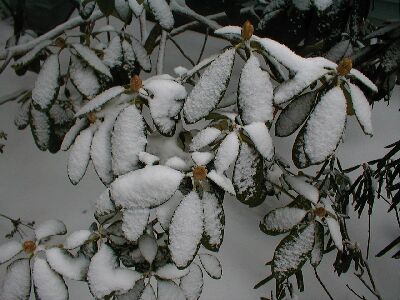
'Gomer Waterer'
I speak, of course, of Winter Protection of Rhododendrons. OK, go ahead and laugh, but I am perfectly serious! Twenty years ago, Winter Protection was in the same no-no category that trimming leaves, leaf polish, and food coloring are in today. Why? Actually there was a good reason, believe it or not. Twenty years ago the members of the Massachusetts Chapter were just beginning to take the measure of our rhododendrons, trying many new and unknown varieties in our gardens and greenhouses. The rest of the rhododendron world was incredibly generous to us with both plants and advice, and while we were terribly grateful for the former, we soon found out that the latter often made no sense in our area. Plants that grew heartily when just "stuck in" often turned up their toes when given the T.L.C. recommended by the English or our West Coast friends. In particular we were most often warned that plants were "not hardy" for the East Coast. It was, it seemed, too cold for most rhododendrons in our neighborhood. (Even the famous Dr. David Leach made this mistake. If you consult his Rhododendrons of the World, you will see that he considered only a handful of species growable on the East Coast.) Because we wanted to grow rhododendrons out of doors, we became suspicious of any methods of ameliorating our New England weather. To say " yes, Mr. X grows that, but he protects it" would both sully the grower and condemn the variety. Gradually, as we became more familiar with our treasures and how to grow them in our uncertain weather, we have recognized winter protection for what it is - a very valuable tool for both the ambitious grower with irreplaceable rarities and the novice with his first few "tricky" varieties.
The techniques you will choose depend on three factors: the size of your plant, the current health of the plant, and which part of Winter you are trying to protect against. Some things can be done for just about any rhody, others are only suitable for special cases. Small plants are best treated en masse, in nursery beds, or otherwise herded together, as they have special needs and are also more vulnerable. All rhododendrons are hardier when mature than as babies.
For larger plants, there is a physical limit to protection; eventually you will have to come to grips with reality and let a plant either sink or swim. Reality usually sets in at about four feet. Health is an important factor too; a healthy plant is a hardy plant, or at least as hardy as it is gonna get. If you are going to try to sneak rhododendron rex past Ma Nature in Zone 6, you need to make it as happy and healthy as possible to have even a ghost of a chance. Which part of winter are you trying to defeat? If the plants are normally hardy in your area and you are simply giving them time to become established, that is fairly simple. If the plants are borderline hardy ones that just need a little help to get past the worst excesses of winter, that is also pretty easy in most cases. Perhaps you didn't get everything planted from the terrific end-of-season sale at your local rhody emporium and you need a place to stash them for the winter? Hey, no problem! But if you are thinking of a specimen plant of 'Dr. Calstocker' on your front lawn, you need a reality check, because Ma Nature will always be one step ahead of you. It's her job.
The simplest winter protection is a deep (four to six inches) fluffy mulch of whole or chopped (not ground!) oak leaves or salt marsh hay spread out over the root zone and snugged right up to the base of the plant. It is especially effective with seedlings and rooted cuttings, although it is useful for somewhat older plants as well. This mimics the protection that the mass of an older plant will give to its own root zone; it shades the soil and prevents rapid freezing and thawing, and it shades the stems on young plants to prevent bark split. This mulch can be applied right on top of your regular mulch as soon as the ground freezes, and should be taken away in the spring. If you are mulching a nursery bed full of young'uns from P4M, you can even tease a THIN layer of hay, or perhaps scatter some fresh pine needles over the leaves as well, which will give some protection from winter sun. This is not necessary if the beds have shading in the winter from high pines or from artificial sources, and in any case should never cover more than 50% of the leaf surface. This technique is contraindicated for large, dense, mature plants; the extra protection will only coax Mr. Vole to take up residence and you don't want that. Trust me on this.
Another good, easy technique for protecting a nursery bed is to erect either old-fashioned wooden snowfencing or lattice over the bed, like a cover, except that it is set eighteen inches to two feet above the ground - enough clearance to be able to reach in and check the plants or fluff up the mulch. For larger plants in a nursery row, I have seen snowfencing effective up to four feet above the ground; higher than that and the side wind tends to cancel out the benefits. The lattice can be removed in the summer, or left on all year for babies. You can think of this as a very tall mulch - it serves all of the same purposes, except to retain soil moisture, and works as well for medium sized plants as babies.
For hybridizers, a variation on this method can be very useful if you are using plants in your breeding program that are not quite hardy in your area. In a raised bed, plant your breeding stock with enough room to grow large enough to bud up. Now erect sides on top of your raised bed (you can use 1 X stock or outdoor plywood for this - it won't be in contact with the ground). Finish with snowfence or lattice on top. When you are done you will have a box, open at the top, but otherwise well protected from the weather.
There are two major problems with this setup; first, it is unsightly, and thus unsuited for high-profile spots in the garden, and second, it is very attractive to rodents and you will have to trap or bait inside the bed. This is particularly bad in good snow years; do not neglect this chore. I know it sounds like a lot of work, but I have known breeders to get a zone and a half extra this way. Does it go without saying that this is for plants that will bud up as reasonably compact plants - say, no more than 18 to twenty-four inches?
Perhaps your problem is not a nursery bed but a single plant in need of a little extra help? If the variety is one that you are not worried about the hardiness of, but just a plant planted late in the year, or maybe one whose top is not well balanced to its rootball, then the familiar "tent" made of burlap and stakes can be all that is needed. Sometimes in New England we suddenly get unusually dry, cold weather, often accompanied by cutting winds, and the frozen ground makes it difficult to put up a formal tent. If the plant you are protecting is small, it is easy to just lay a few pine boughs over it. But if you have a larger plant, two, three, or four feet tall, this obviously won't work. Instead, cut three or four young white pines about a foot taller than the plant to be protected, and lean them, teepee style, against the plant. Tie the top, arrange the branches for the best protection, and Presto! a tent that will shade and cut the wind until spring. Either of these "tents" will give you about half a zone of protection.
Of course the ultimate winter protection is a cold greenhouse, with nighttime temperatures maintained artificially with a heater. Drawbacks? Cost, for one: greenhouse, foundation, no-freeze water system, heater, cooling system, and the energy costs to run the thing. The less labor-intensive you make it, the more expensive it will be to build and run. How about a Quonset Hut? Less expensive than a true greenhouse, yes, but still pricey if all you want to protect is something smaller than a crop. In addition, you will still have to deal with overheating, temperature fluctuations, sunburn, and plant maintenance; many an amateur nurseryman has lost a crop by going on vacation in the winter, when nothing is happening.
So what we need is a place to keep a relatively small number of plants protected from the elements that will not cost an arm and a leg and will need a minimum of attention. What we need is a coldframe. Coldframes come in all sizes and shapes, but all are essentially the same thing - a pit dug in the ground, lined to shore up the sides so they don't cave in, and covered with a light-permeable lid with provision for ventilation and access for maintenance of the plants kept within. Properly built and maintained, they will last several lifetimes.
I have seen coldframes as big as barns; well, it was a barn, built over a pit twenty feet deep, with celestory windows for light and a big ramp for truck access. This overwintering facility for a large wholesale nursery provided the minimum of maintenance (mostly done by Ma Nature) with a maximum of flexibility, allowing plants to be shipped dormant over an extended period in the spring. If you have the good fortune to be given a tour of Wellesley College's greenhouses, don't miss their big walk-in coldframes. These were renovated about a decade ago by the Wellesley greenhouse staff to take advantage of advances in glazing technology, and they are now handsome units, clean and airy, striking envy in the hearts of their fellow gardeners.
Most of us, of course, don't need garage-sized coldframes but there is a bare minimum you must observe if it is to work for you. Simply put, by digging down into the earth you are tapping into the stored heat trapped in the earth at the end of the summer. Every day the sun shines, the glazing allows the frame to renew at least part of the heat released at night into the frame (the frame is opened a little every day so that the heat buildup is not too radical and harms the plants). Thus the bottom of the frame is the last place to freeze in the early winter and the first place to thaw in the early spring; in addition, temperature variations are evened out so there is no barksplit or heaving. To work, then, you need an air mass inside the frame that will be enough of a heat sink to perform this function without requiring such high temperatures that the plants will suffer. I saw brick lined frames in England that were no more than three feet by three feet, but of course, the last winter the English had was in 1962; they usually just have two Decembers and segue right to March. Here in New England, we need a bit more than that; I would say three-and-a-half feet wide by four to six feet long, and nine inches deep after backfill at a minimum.
The amount of protection such a frame will give depends on the materials the frame is made of, the glazing, and how deep the frame is dug. In my best coldframe, I kept an eighteen inch tall plant of Rhododendron edgeworthii, which went through several winters with minimum temperatures of between minus twelve and minus five degrees F. until voles made a nest out of it and killed it. I also had several "greenhouse" azaleas that were overwintered there and then brought in to the house in March to bloom. Neither the azaleas nor the rhody ever had any leaf damage or pip loss. Unfortunately that same extended family of Mr. Vole also reduced the azaleas to compost, giving me a hard lesson in vigilance or lack thereof. Rodent traps in coldframes should be checked at least twice a week, and bait stations checked and renewed every three weeks or so. Frames can be varmint-proofed, but it is expensive and a LOT of trouble.
Coldframe too much work? Or maybe you are going to Myrtle Beach for the month of January, and have no one to look after the frames in your absence? You could try a "Fred Frame" invented by our very own Fred Knippel. This is an extremely simple arrangement using some of the same principles as a coldframe, but it is more of a cold-storage technique, because once it is closed up, it cannot or should not be opened until spring. Choose a flat vegetationless spot at least six feet by ten feet, where water never collects in spring (this is important!). Using pressure-treated 2 by 12's, build a topless, bottomless "box" slightly less than four feet wide by eight feet long. Center it in your space, making sure that it sits firmly in contact with the ground. About mid-November in our area, fill the frame with your plants and water well. This will be their only watering all winter, so do it twice if you need to. Let the plants sit for a couple of days so the foliage will have a chance to dry. Then lay any tall plants over on their sides, and cover securely with a four by eight piece of outdoor plywood. You can use pressure-treated stuff but NOT new - let it weather before you use it. Do not forget Mr. Vole; leave bait at least, but a pan full of tomcat-used kitty litter has provided our best protection.
If we are still in Indian Summer mode when you set up your Fred Frame (the very best time to do it), you can leave it without its lid until colder weather comes. Eventually, though, the nights will get down to 25 degrees F. on a regular basis, and it will be time to put on the lid. Wait a week or two more now, until the ground freezes an inch or two, then cover top and sides with coarse woodchips. At my place in zone 6, we put six inches on top and about a foot on the sides. In colder zones, I think I would put more.
What is the theory behind this? It certainly allows for a slow cooldown and warmup, and keeps a nice even temperature during the winter. Does it keep the plants from freezing? I don't think so, although I do think it can't get too much below freezing because of the condition of the plants at the end of the winter, by which I mean near perfect. In any case, we are going to find out because I have acquired a remote sensing recording thermometer which will answer that question providing it will record through several inches of frozen woodchips. And frozen they will be, solid as the Rock, which is why I said it cannot be opened in winter. The exception to this is when we get a long January thaw with some decent open weather. The woodchips can then be shoveled off and the frame lid propped open or, better, taken off and the contents checked for rodent damage. Renew the bait and/or the kitty litter and reseal the frame. Do not wait for cold weather to return to shovel the chips back on. Try to get this all done in one day so that the plants (and the ground) hardly know that they have been disturbed. How much protection can you expect from this contraption? I honestly couldn't say, because we haven't reached its limit yet, but I would say that Zone 8 or so will probably be a practical limit (no citrus!).
Perhaps you have no beefy male to do your bidding? There is something else you can try. Although I have never personally done it, Blanchette Gardens in Carlisle, MA uses it to overwinter thousands of perennials with about a ninety percent success rate, depending on the winter. Once again, choose a flat unvegetated space where NO water will collect in winter or early spring, water your plants thoroughly, and let the foliage dry. Turn all the pots over on their sides, preferably in as compact and orderly a fashion as possible, and pointing in the same direction, biggest plants in the middle. Place rodent bait, traps, and/or kitty litter in several places. Cover first with one or more sheets of Microfoam, then with a stout single sheet of plastic (check for holes to avoid drips). The Microfoam and the topsheet must be large enough to cover the whole pile, with enough to spare to secure the sides with boards or bricks, or bury the edges under sand or woodchips. The best way is to use a combination of both techniques - boards or bricks to securely weight the edges against winter storms, sand or woodchips to completely seal the edges. Keep an eye out for rodent tunnels.
This technique will net you a half zone to maybe a zone of protection, and no guarantees of survival. Blanchette Gardens has used this for years, and although it is probably their best solution it still gives them mysterious die-offs despite the fact that nearly all of the plants are perfectly hardy.
There is one last thing I can describe. For many moons I have worked on the Chapter's exhibit for the MassHort spring show. If I have to be the one who holds the plants to be forced, I try to keep them in a deep coldframe or cold greenhouse so that they can be moved to the facility in Waltham no matter what the weather. One year our arrangements fell through at the last minute, and I got stuck holding the bag; one-and-a-half truckloads of mature, fully budded plants arrived at my place in the middle of a very raw November. Alas, there was no room in the inn! I was forced to find someplace out in the weather to keep them. They were much too big to put in a Fred Frame, and I really didn't trust the Microfoam.
The weather got progressively more miserable as I dithered over what to do, until Ma Nature stepped in. Bruce forecast a truly terrible Thanksgiving freeze; my exposed rootballs would be toast unless I did something P.D.Q. So I rounded up my long suffering hubby and we moved all of the plants under the shade of some very large white pines, and arranged them in a compact rectangle, grading them by size of rootball or pot. I started with the largest rootballs at one end and gradually got down to the smallest pots at the other end. Then the entire bunch were carefully covered up to their lower branches with coarse wood chips. This was a time-consuming job because I had to make sure no pockets of air were left between the pots; sometimes this required adding chips a trowel-full at a time. I finished with about a foot of chips all the way around.
In two days the temperature dropped like a rock, and only came up again after it had frozen the lot. Then it poured, soaking the pile with its captives, then dropped like a rock again. The whole bunch was one solid mass solidly welded to the ground. We had very bad weather all December that year, and when the time came to start moving plants into the greenhouse, we had to chop them out with a mattock. Plants were moved in all through January, and the weather continued to be miserable. BUT - we lost not a single plant to cold that year and we were unable to detect any loss of pips or buds, either. As an emergency method, it worked pretty well, but I wouldn't want to depend on it as a regular thing. As a caveat, it must be noted that we were not using any particularly tender plants that year, so as a method of gaining extra protection, I would not recommend it.
A few final thoughts on the subject. I am frequently asked about the anti-dessicant sprays that are sold to the uninitiated. Usually they are harmless, as long as you don't get any on the underside of the leaf, and they may even do some marginal good in a plant that was planted too close to winter to get its roots established. But usually I feel the same way about them that I do about SUV's. Many people justify getting them because they make them feel safer during winter driving; then this confidence leads to recklessness that puts them MORE at risk, not less (ask any state patrolman!). If you think you can bring your 'Dr. Calstocker' through the winter on your front lawn in Concord Massachusetts with anti-dessicants, think again.
I am also frequently asked if one could bring a hardy rhododendron through the winter by simply putting it outside during the day and bringing it in at night. "It's too late this year to plant that nice 'Duke of York' you sold us, the ground is frozen!" they say. "Couldn't we just move it outside during the day, and move it into the kitchen at night? Then we could plant it in spring when the weather gets better." Then they look at me with imploring faces and sad puppy-dog eyes. In a situation like that, I have no choice but to follow Nancy Reagan's advice; I smile and "Just Say No."
Notes on Drought Proofing your Rhododendrons
Joe Parks, Dover, NH
Rhododendron drought resistance depends almost entirely on root health. It should go without saying that a rhododendron's performance is totally dependant on how healthy and active its roots are. The essentials for healthy roots are:
1. Adequate organic material,
2. Proper soil fertility, and
3. Correct watering.
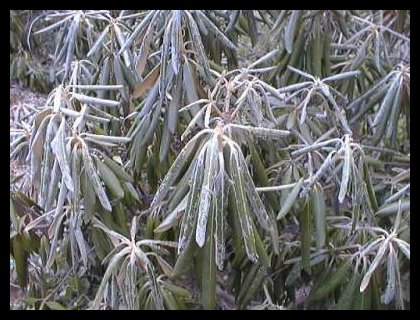
Rhododendron yakushimanum 'Mist Maiden'
Organic materials are your first line of defense when faced with water problems. Because they absorb several times their own weight in moisture, organic materials serve as a reservoir for times when rainfall is scarce. But, to be useful, they must be applied early in the season.
Even more important, organic materials promote growth of beneficent soil microorganisms and fungi. Some fungi, mycorrhiza, actually grow into rhododendron roots and provide an additional source of nutrients and moisture. In essence, mycorrhiza expand the size of a root system and increase its uptake of water and nutrients.
Soil microorganisms are also little chemical factories. As they break down organic materials into soil, they convert substantial quantities of chemicals into water soluble nutrients needed by your rhododendrons. These include such micronutrients as copper, manganese, molybdenum, zinc, etc. As if this were not already a veritable goldmine, they also convert aluminum, which kills root tip cells, into a nonpoisonous material. Thus mulch is highly important for improving the drought resistance of roots.
What you use for mulch is very important. The best materials are rather coarse and partially decomposed. This partial decomposition usually takes a year or two here in New England. Fresh mulch materials will, of course, help provide a reserve water supply but the high level of bacterial action during decomposition will deprive your plants of nitrogen. Fresh leaves and grass are particularly poor because they hold large amounts of water and deprive rhododendron roots of much needed oxygen. Leaves should be piled and allowed to decompose for a year or two before using. Any material that can become soggy and pack down, is a no-no because it, too, will cut off the oxygen supply. Peat moss is particularly poor for mulching because it sheds water (instead of absorbing it) when it becomes dry. My favorite mulch is two year old wood chips.
How deep the mulch is is quite important because if it's too deep it also can reduce the oxygen supply. The coarser a mulch material, the more of it that can be used safely. However, about three inches of mulch around a plant should be sufficient. Lastly, be careful to keep the mulch away from the trunk. If mulch becomes piled up around a rhododendron's trunk and keeps it wet above the soil line, deadly phytophthera fungi may invade and kill your plant.
Now, when was the last time you mulched your rhododendrons? If it has been as many as two years, get out there and put another inch on this spring! You'll be adding to the water reserves and also feeding the microorganisms that are important to root health. Remember, poor, unhealthy roots are the first to become water stressed.
Next issue's "NOTES" will be on "hidden hunger" and how to feed your rhododendrons so as to develop strong, healthy roots that will minimize drought stress.
"Life is short, so keep the agenda short. Concentrate on things that are truly important and don't get distracted by the rest."
Robert R. Kiley
The Wall Street Journal, October 14, 1988
I Had a Rhododendron But It Died
Ian E. M. Donovan, Pembroke, MA
I did. I had many that died. Some still do. The critical questions are: what killed them and how do we keep it from happening again?
My approach after having thought about my dead rhododendrons for some time—no tears—was that I needed to know what the plants required in order to survive in the wild and thrive in my garden. It seemed obvious to me that once I understood what the plants needed, I could give it to them. This is my personal report of what I learned about keeping my plants growing like weeds. Many of my efforts have been trial and error. But lately I've had many more successes than failures. At least now I can usually determine why I failed with that rhododendron that died.

R. mucronulatum 'Cornell Pink'
After twenty-five years of growing rhododendrons, I've had lots of time to observe and study them, pick the brains of my fellow ARS Members, and review the vast literature of the many who have explored and worked with the genus during the last one hundred years. If you look at pictures of rhododendrons in nature, or have seen them yourself in situ, then you know that those happy rhododendrons can just about take over their ecological niche. They become aggressive, allowing few interlopers. Many even become epiphytes if the vegetation in warmer climes attempts to shade them too much. After all, they are twenty million-year survivors.
Observations. I was shocked when I saw rhododendrons and deciduous azaleas growing in the mountains of the central and southern Korean peninsula twenty years ago. The North East Asian Continental climate is both harsh and life giving. Ernest H. Wilson in Plant Hunting, v. II, 1927, Land of the Morning Calm, reports that about two-thirds of the peninsula was deforested for firewood by the early 20th Century. A terrible war had been fought there in the early 1950s with almost every inch of land ravaged. Korean people cut down most of the few remaining trees during bitterly cold winter months for firewood, shelter, and to obtain sustenance from the bark.
But what did I see in the mountains, besides the overwhelming presence of rocks? Remember, the Korean Peninsula is mostly mountains, hills and relatively narrow valleys, with no broad plains as we know them. In spring, the dominant feature on some hillsides in latitudes near Seoul is the pink Royal Azalea, R. schlippenbachii, or the magenta R. mucronulatum. Stunning is the only way to describe an eastern slope in an early morning sun in spring, colors glistening as the heavy dew dries. The hillside takes on the coloration of the dominant plant. Equally thrilling is a northwestern slope, plants in bloom, as a setting sun illuminates them. The hillside comes alive with color.
What makes the sight so memorable is that spring arrives very quickly in southern Korea. The dominant Siberian high has generated cold and dry northwesterly winds since November. Within a few weeks during late March into early May, these winds lose their force as they shift south across China, south of the Himalayas to emanate from the warm waters of South East Asia. Bright sun, warmer winds, and a wonderful floral display explode in the landscape. Winter becomes a distant memory. Both Rhododendron species have survived another harsh winter for which they are well-adapted—R. schlippenbachii and R. mucronulatum are deciduous. The latter is a small-leafed, or lepidote, species and both are known for their hardiness. They are bathed most mornings in a life-giving fog in their mountain homes.
In May, as the winds shift their point of origin south, they pass over the Great Gobi Desert picking up fine particles of yellow dust. These particles are carried aloft by the winds and deposited by the rains to the East in China and Korea covering everything with a yellow stain. June through to September follow with intensely hot, humid days and daily rain showers, often punctuated with severe thunderstorms. The south and western coasts of the Korean Peninsula are vulnerable to the often-deadly monsoons moving in from the South China Sea.
By about the third week in August, the Dog Days begin to break and the torrential rains of August begin to diminish. Soon the southwest winds will again shift their point of origin northward as they move into Siberia for the winter. Koreans are privileged to enjoy two months of sparkling weather and fine autumn color, much as we experience here in New England and along the Allegheny and Great Smokey Mountains. Indeed, Northeast Asia is the other major geographic region of the world where deciduous tree leaves change into rich autumn colors before falling. (A small area of the Andes Mountains also experiences a similar phenomenon.)
And what of the thick layer of organic matter on the light brown, sandy soil that these beautiful mountain rhododendrons were growing in? It wasn't very thick, yet these plants were vigorous with bright green leaves and flouting a wonderful floral display. They were growing on a hillside in a thin layer of mostly decomposed granite based soil with a little organic matter. The soil seemed to be almost gravel in some areas. Water could flow rapidly through the growing medium, away from the roots. This was important during the summer monsoon season when the air temperatures often rise over ninety degrees F during the day, but a fine layer of humus maintained moisture around the roots.
Cultural Needs. I tell this climate story to illustrate my point that, for these two rhododendrons, life in the wild is good. They survive in a rigorous natural setting, far tougher than in most of our gardens.
Here in southern New England we can expect six to eight weeks of hot, humid weather during the summer months, on average, often with periods of ninety degrees F for three to four days in a row. We can have very warm nights, without cooling mists unless one gardens near the shore or in the mountains. Forty inches of annual precipitation on average can be expected. Winters can be very cold. Depending on your USDA Zone, zero to minus twenty degrees F are not unusual temperatures. Lately, we've not had the good fortune of heavy snow cover to protect plants all winter and add to the water table. We have seen droughts during spring, summer, and autumn, increasing the garden management challenge.
My Korean experience got me to thinking about growing hardy rhododendrons in my garden. How could I replicate the favorable conditions in my garden that are found in the wild as I had observed them? Joining the Massachusetts Chapter's Species Study Group furthered my understanding of why these wonderful plants have been so successful. My reading established that there has been a consensus in the 20th Century about which siting and cultural elements are necessary for successful rhododendron gardening. Among these are:
Sun, for deciduous varieties, and afternoon shade for most others
Water
Rapidly draining garden soil, coarse growing medium, like much of our New England garden soil
Oxygen in the vicinity of the roots
Acid pH soil
Mulch (not peat moss)-- two to three inches over the root ball, but six inches away from the shrub's central stem.
These same elements for the garden were, in part, what I had observed in the mountains of Korea. They matched closely what I had also observed about our native plants in North Carolina, Virginia, New Hampshire, and Massachusetts. Many of these native rhododendrons, e.g., R. maximum—the Rosebay- are large-leafed or elepidote types that enjoy a woodland environment rather than full sun of the deciduous azaleas and small-leafed plants.
So what are the practical aspects of all this? Let's review the elements. The following discussion assumes that you have selected rhododendrons and azaleas that have a hardiness rating compatible with your USDA Hardiness Zone, that you have prepared your beds properly, and have done your planting as recommended by the experts. Detailed guidance and technical details can be found in the suggested readings at the end of this article.
Sun. Fairly simple - give the deciduous plants sun to encourage flowering, and the evergreen varieties less sun. This varies, in my experience, as the size of the mature leaves increases. The bigger the leaf, the less sun. My lepidotes are grown in almost full sun, while my big leafed varieties get up to fifty percent shade. They all need sun to encourage flowering, but the evergreen, large leaves transpire water too rapidly in summer and winter to withstand full sun all day.
Water. All plants need water to live. As a general rule, David Leach says that a gallon of water each week applied to the root ball should sustain an established and mulched 4-foot rhododendron or azalea for a week during the growing season. One doesn't have to pour the water onto established plants. During the hot days of summer leaves may appear to wilt. Observe those leaves in the cool of early morning. If they have not recovered their natural appearance, then they should be watered deeply before the day progresses. This stress situation indicates that the moisture level in the surface soil is too low for healthy plants. The summer of 1999 presented me with just such a challenge.
Garden Soil. What we want is a garden soil that is rapid draining, contains a modest amount of organic matter to hold moisture, has a coarse or open structure so that oxygen can get to the roots, and has a pH of 4.5 to 5.5.
Rapid draining is the primary quality for the rhododendron bed. While the plants need moisture, the soil cannot be permitted to hold water to the extent that it excludes oxygen from the roots during the growing season. Our late ARS Massachusetts Chapter member Dick Leonard told the story of the rhododendrons growing at the back of his woodland property in Taunton, MA. The land there was low and in the spring as the snow began to melt, perhaps augmented by rains, sections of the property would flood. Because the ground was still frozen and surface drainage was poor, water would stand for days at a time, covering the root balls of his large plants. A month or so later, the ground having thawed and drained, the plants would be blooming riotously. The soil temperatures would eventually soar as summer progressed.
Why weren't Dick's rhododendrons affected by Phytophthora root rot, a malady that commonly attacks ericacaeous plants in overly wet situations during hot weather? Because the temperature was close to freezing when the plants were standing in water. When the ground thawed, the surface water drained away, leaving just enough soil moisture to keep the plants thriving. There was no standing water or too high a soil moisture level to encourage the disease, which requires standing water in warm weather. Had there been an underlying layer of clay, he probably could not have been successful with his woodland garden.
Oxygen at the Roots. The shallow network of fine roots in Ericaceae needs oxygen to survive. It is the nature of the genus, and is why they are not successful in water-logged soils or in soils that contain a high percentage of clay. Usually a rapidly draining bed will have an open or sandy soil, which contributes to rapid draining.
Soil - an acid pH of 5.5 to 6.5. Rhododendrons do grow in soils with a pH level outside this range, but the ideal is pH 5.5 to pH 6.5. At this pH level the appropriate nutrients, if present in the soil, can be taken up by the plant. Most New England soils are naturally acidic. Over time irrigation water can change soil pH. If you have concerns about your garden soil pH, have it checked through your state agricultural university system. The pH measurement scale uses 7.0 as the midpoint. Measurements above pH 7.0 are considered alkaline and readings below pH 7.0 are acid. The further from the pH 7.0 neutral point, the stronger the alkali or acid reaction.
Mulch. If all other siting and cultural elements are in place, then mulch is the frosting on the cake of a well planted rhododendron. Mulch is a coarse organic material which is applied on the surface of the root ball 2" to 3" deep. Its function is to even out the daily temperature swings in the soil while slowing evaporation of moisture from the soil. As it breaks down in the course of a season or over several years, the decaying mulch becomes available as that mysterious thing called organic matter in soil composition. Pine needles and bark, wood chips, and oak leaves are particularly good mulches. Many other readily available, economical materials can be recycled as an attractive mulch, but peat moss is not one of them.
Peat moss dries rapidly when exposed to air and becomes almost impossible to re-wet. Peat moss is very expensive per cubic foot when compared to other readily available materials. Most peat moss at the garden center today is so fine that it is easily blown about by the wind when dry. Finally, peat moss is a non-renewable resource in our lifetime. If you choose to use peat moss as a mulch or soil amendment, take precautions when handling it to protect your hands and to not inhale the fine particles. Adverse health-related reactions may occur. As a soil amendment, peat moss can carry Phytophthora root rot disease spores, which can be fatal to rhododendrons.
Summary. Growing rhododendrons successfully in the garden is like owning and driving a car. The first thing is to learn the rules for operation and maintenance. Practice them, and observe what is happening through the seasons. Add mulch and water when needed, but keep your eyes on the plant. It will tell you what is happening, usually in time so that you can make adjustments safely. At least if it dies, the plant is easily replaced. But find out why it died before planting another rhododendron in the same hole.
Recommended Reading. Several recent books are available through the ARS Massachusetts Chapter's Book Table currently run by Barbara and Henry Wrightington. Used copies of the older works can be found at reasonable prices on the World Wide Web at such sites as: www.bibliofind.com, www.bibliocity.com, and www.abebooks.com. Just search on "rhododendron".
Bowers, Clement Gray. Rhododendrons and Azaleas: Their Origins, Cultivation and Development. 2nd ed. New York: Macmillan, 1960.
Excellent discussion of siting, culture, and selection. Recommended varieties are obsolete for the most part. Readable discussion of hybrid history, selected species, and how to hybridize.
Clarke, J. Harold. Getting Started With Rhododendrons and Azaleas. Portland, OR:Timber Press, 1982.
Paperback reprint of the classic book first published in 1960. Good information for the beginner by an American rhododendron pioneer.
Cox, Kenneth. Rhododendrons: A Care Manual. San Diego: Laurel Glen, 1998.
Large format, superb color photographs, easy to read, authoritative, and not too expensive. The best hard cover book for beginners on the market today.
Cox, Peter A. The Cultivation of Rhododendrons. London: Batsford, 1993.
Written for the serious gardener of the Genus Rhododendron by one of the world's top experts. Extremely well done, answering most questions. Clear, not too technical, and fully illustrated. No better book for the medium to advanced aficionado.
Galle, Fred C. Azaleas. Revised and Enlarged Edition. Portland, OR: Timber Press, 1987
Everything your ever wanted to know about azaleas, almost. Clear, complete cultural guide, and more. Look for this revised edition, which corrects several errors in the 1985 first edition of the late Fred Galle's masterwork.
Greer, Harold E. Rhododendron Basics: Growing Healthy Plants.
This slim paperback is very economical (less than $5.00 including shipping) and well illustrated. Seventeen pages and forty-nine color photographs extracted from Greer's Guidebook To Available Rhododendrons: Species & Hybrids. 3rd. ed. Eugene, OR.: Offshoot, 1996. Both hard cover and paperbound. Either edition contains the same concise, accurate facts and "how to" cultural instructions.
Leach, David G. Rhododendrons of the World. NY: Charles Scribner's Sons, 1961.
The late David Leach's classic remains among the best comprehensive discussions of rhododendron and azalea culture in the garden. While some details of chemical nutrients and pesticides are obsolete, the overall information about how to grow is valid. Excellent discussion of 150 important garden species. Readily available used at about $40.00 plus. Be sure that the copy you purchase has the two loose inserts: a large folded color phylogenetic chart depicting the putative evolutionary relationships in the Genus Rhododendron and the black and white drawing "Rhododendron Regions in Europe and Asia".
Reiley, H. Edward. Success with Rhododendrons and Azaleas. Portland, OR: Timber Press, 1992.
Excellent technical information written by a professional horticulturist and ARS officer. Extensive "Good Doer" lists and up-to-date technical facts. Perhaps more about nursery production and propagation than the beginner requires. Available in paperback at a reasonable price, as well as used.
Subscribe to:
Posts (Atom)