http://rosebayblog.blogspot.com/search/label/Journal
Showing posts with label Journal. Show all posts

H: Saturday, March 29, 2008

The Rosebay Volume 2 Number 3 Fall 1973

NOREEN C. SLAVITZ and JOHN J. SLAVITZ, Editors
Pembroke, Massachusetts

PRESIDENT'S MESSAGE

I should like to take this opportunity to welcome our many new members and at the same time, once again greet our older members. Last season, climaxed by a splendid show and auction, was a year of definite growth and progress for the chapter. There is no doubt in my mind that with your continual interest and cooperation, this growth will accelerate. Under the supervision of Jack Cowles, our Vice President and Program Chairman, many exciting things are being planned. There will be outstanding speakers, clinics on many phases of rhododendron culture, and a "surprise" at each meeting. I urge you to attend each and every meeting.

A few words about the truss show and auction held last June 3rd. It set records of all sorts -- in terms of attendance (conservatively estimated at several hundred)-in terms of competitive entries (192 trusses and related material)-and not in the least in terms of financial success. Many thanks to each and all who participated and whose work and help made this event so successful.

I am sure that Louis Cook, our immediate Past President and Auctioneer, is not aware of this; one of our members clocked him. Louie sold approximately 275 plants in exactly one hour and forty-seven minutes. This, of course, is indicative Louie's outstanding ability. Yet it is also indicative of the tremendous growing interest in the field of rhododendrons. And this interest (as well as the growth of the chapter) is only limited by the time and effort necessary to make people aware of the existence of the chapter and of the inherent benefits of active membership.

Max L. Resnick, President

MEMBERS TOUR HUNNEWELL GARDENS
May 19

On May 19 members met at the Hunnewell place in Wellesley. While the group was convening, Jack Cowles and Willard Hunnewell showed early comers through the greenhouses where we saw seedlings from recent crosses as well as from the ARS seed exchange.

We then looked at the below ground level pit where the tender rhododendrons are stored in pots during the winter. Jack pointed out the damage to some plants which appeared as burnt edges to the leaves. This was caused by too warm weather in early spring while the plants were still in the dark pit and had no chance for photosynthesis.

We next went to look at the collection of iron dads but it was a little too early in the year for any but 'Boule de Neige' to be in blossom. A good number of these plants are at least 50 to 75 years old. By layering, some have spread into very large clumps. Several groups of handsome R. kaempferi were at peak of bloom.

We had a picnic lunch in the conservatory next to Mrs. Hunnewell's house. There was a fine display of tender rhododendrons and azaleas which cannot survive outdoors in the Wellesley area. One plant particularly admired was a specimen of 'Diane Titcomb'. Also in bloom were 'Mrs. G. W. Leak', 'Leo', hybrids by Mr. Walter Hunnewell between 'Cunningham's White' and 'Fabia', 'Butterfly', 'Scarlet Wonder', 'Mrs. Furnival' and fragrant R. formosum.

After lunch, as the group returned to their cars, we passed through one of the greenhouses and Jack offered seedlings of Abies Cilicica and Magnolia stellata to all.

Any interested member is welcome to come again at any time. Please call V.P. Jack Cowles or Willard Hunnewell in advance to let them know when to expect you.

Submitted by Willard Hunnewell

RHODODENDRON SHOW AND AUCTION HUGE SUCCESS

On June 3, 1973, the Mass. Chatter held its second annual Rhododendron Show and Auction at the South Shore Natural Science Center in Norwell, Mass. Under the direction of Show Chairman Max Resnick, the show was a tremendous success. Nearly two hundred entries were submitted for judging in the truss show and the exhibition hall was a veritable rainbow of colors. The show date came at the height of the blooming season, and viewers were treated to the widest possible variety of rhododendrons and azaleas, varying from the iron dads to exotic greenhouse types.

Faced with the enormous task of selecting the best from a multitude of excellent specimens, the judging staff did a highly commendable job. Those doing the judging were Ed Mezitt, Stephen Snell, Louis Cook and Charles Gredler on broad leafed rhododendrons; and James Wright and Jack Cowles on azaleas.

The following trophies were awarded:
Best of Show - 'Homer' by Dr. Max Resnick
Best Ironclad - 'lgnatius Sargent' by George Ware
Best New Hybrid - Pink Hybrid Seedling by Edmund Mezitt
Best Dexter - 'Westbury' by Charles Gredler
Best Azalea - Exbury Seedling by Charles Gredler
Photography Award - James Wright

Ribbons were awarded to the first three places in each of several classes.

After the judging the exhibition hall was opened to the public. The number of people attending the show exceeded all expectations. In addition to the truss show the hall contained a number of other exhibits and several clinics where the neophyte grower could secure the advice of the several experts on how to properly care for his plants. In addition, the chapter gained many new members at the show.

In the afternoon, Louis Cook took up the auctioneer's gavel and the rhododendron auction was under way. In just a short time hundreds of plants were placed on the block and sold "all over the place" to many satisfied buyers. In short, the whole day was a tremendous success. Plans are already being drawn to make the 1974 show bigger and better yet.

TO OUR NEW MEMBERS

This issue of The Rosebay finds its way to several new members as well as to many people who expressed an interest in joining the Society while at the show. To our new members we bid welcome and to the others a sincere invitation to join us.

NEW MEMBERS:

Mr. & Mrs. Richard A. Budka
3 North Street
Reading, Mass. 01867

Mr. & Mrs. John C. Kepper
Box 28
Salisbury, N.H. 03268

Mr. & Mrs. Edwin Cahill
175 Williams Ave.
Milton, Mass. 02186

Mr. & Mrs. Fred MacDonald
457 High St.
Hanson, Mass. 02341

Mr. Gustaf H. Carlson
4 Heath St.
Westboro, Mass. 01581

Mr. & Mrs. Charles Phillips
25 Waterhouse Rd.
Bourne, Mass. 02532

Mr. & Mrs. Stephen M. Tipton
22 Farm Rd.
Sherborn, Mass. 01770

AN APPEAL FOR HELP

The editors of The Rosebay overshot the deadline for this issue for a very simple reason: we had precious little material to print. If this newsletter is to succeed as a quarterly, It must depend heavily on the contributions of its membership for informative feature articles, book reviews, almost anything. We have a number of articles available for reprint but have hesitated in using them so far because we feel there is enough expertise within our own ranks that should be our prime source of supply. Remember, it's your newsletter.

BOOK LIST

Society Publications:

No. Copies Price Tax Total

RHODODENDRONS $ 5.00

Fundamentals of Rhod. & Azalea Culture .50

Azaleas (N.Y.Chapter) .50

Rhododendrons (N.Y.Chapter) .50

Rhododendrons & Their Relatives

(Brooklyn Botanic Garden Vol. 27, No. 2) 1.50 e05

THE ROTHSCHILD RHODODENDRONS

(Barber & Phillips) 33.00 .99

RHODODENDRONS & AZALEAS (Sunset Book) 1.95 .06

RHODODENDRONS (Krussman) 6.50 .20

RHODODENDRONS OF THE WORLD (Leach) 22.00 .66

RHODODENDRONS IN AMERICA (VanVeen) 15.00 .45

E.I. Dupont, Botaniste (Wilkinson) paper 3.95 .12

cloth. 7.95 .24

TOTAL

The Rosebay Volume 2 Number 2 Spring 1973

John J. Slavitz, Editor
Pembroke, Ma

RHODODENDRONS IN THE LANDSCAPE
LETTERS TO THE EDITOR
ANNUAL MEETING OF MASSACHUSETTS CHAPTER
REPORT ON THE SPRING FLOWER SHOW OF THE MASSACHUSETTS HORTICULTURAL SOCIETY
TRUSS SHOW AND AUCTION June 3
EDITOR'S NOTES
NEW MEMBERS

RHODODENDRONS IN THE LANDSCAPE
By Dick Leonard

The genus rhododendron offers many landscape uses even in the difficult and varying climates of Massachusetts. Unfortunately, however, the attraction between man and plant has led to widespread misuse in many home plantings.

Surely all of us have seen, and many of us own, examples of mature large-flowered hybrids which are threatening to push the house off its foundation, which successfully shut off all daylight from first floor windows, or which sprawl out at grotesque angles from the foundation plantings reaching for more light or growing space. These were planted, of course, with the best of intentions and tender loving care by people who purchased them as "cute" 18-24 inch plants but with no thought to knowledge of their ultimate size.

Those people who own large homes of the Victorian era or of the early twentieth century may still use the larger hybrids to advantage. However, owners of Capes or Ranch homes should restrict their use to marginal or screen plantings. If they are fortunate enough to have a natural wooded area on their property, they can establish them as an attractive underplanting.

What, then, is available to the small homeowner who wishes to use the genus Rhododendron in his foundation planting? First, there are among the large-leaf hybrids certain varieties which reach only medium height (4 ft) in ten or more years. Generally, these selections are spreading in growth and rather compact.

Such old favorites as 'Boule de Neige' and 'Cunningham's White' - both good whites -come to mind. Both do better in part shade, the former because there tt is less susceptible to lacewing damage, the latter to winter sunburn. Several of the Shammarello hybrids are semi-dwarf in their growth. Those often recommended are 'Besse Howells' (red with lustrous foliage), 'Cheer' (shell pink with red blotch), 'Sham's Juliet' (apple blossom pink, brown blotch), 'Sham's Ruby' (blood red) and 'Tony' (cherry red). Another good old white, 'Chionoides', is very useful too. These are all supposed to take -20 degree F temperatures in their stride.

Several small leaf varieties are available and grow successfully in most of our area. These include 'PJM', familiar to all of us; 'Ramapo' and 'Purple Gem', similar dwarf mound types with leaves less than an inch in length and blue-violet flowers early in May; 'Windbeam' (carolinianum x racemosum), which opens white and ages to a soft pink. This plant stands shearing, should it be necessary. 'Mary Fleming', although not familiar to this writer, sounds most interesting and is hardy to at least -15 degree F. Being a cross between R. racemosum and R. keiskei, it has small leaves and is a shapely and free-flowering plant which blooms pale yellow with salmon shading outside the corolla. An old variety much prized for its compact and dwarf habit is R. laetevirens. There are few plants that can surpass it as a foliage plant. However, the small rose-red flowers are, fortunately, rather inconspicuous. Some of the 'Waltham' hybrids, too, have excellent foliage, with compact growth and showy flower heads in shades of pink and white.

Dwarfs, such as R. impeditum, 'Purple Gem', 'Ramapo', the dwarf forms of R. keiskei and R. racemosum have a unique place in the rock garden or in a contemporary stone garden. They can also find good use as ground cover plants under the light shade of Dogwoods, Japanese Maples, etc. In fact the hot summer sun has proved too much for R. impeditum in my planting, and I shall try it again in part shade.

The old standby, R. maximum is still very useful as a background plant because of its excellent foliage, especially in shade. It will even survive under the deep shade of maples if given the encouragement of good soil preparation and regular watering and feeding.

The large-flowered hybrids, to my mind, are best adapted to screen and marginal plantings, unless one is fortunate enough to own a large lot. There, the choice is limited only by the climatic conditions of your area.

LETTERS TO THE EDITOR

Thank you for sending me the copy of "The Rosebay". Jack Cowles' article was very good. I have been thinking of Jack recently every time I see a row of pink R. mucronulatum raised from seed Jack sent me from 'Cornell Pink' selfed. They have been in bloom since February 21 and still look good. Normally there would be a frost to mess up the flowers before this.

About the only comment I can make is on the breeding behavior of R. mucronulatum 'Cornell Pink.' While I was at Waltham Field Station, I obtained a small plant of 'Cornell Pink' from the Arnold Arboretum. On the way back to the station I stopped at Weston Nurseries where Ed Mezitt used some pollen on R. carolinianum album, which resulted in his 'Shrimp Pink'. I used the pollen on R. racemosum, R. laetevirens and R. keiskei and in all cases the flowers are pink. The only cross attempted that hasn't resulted in pink flowers is with R. dauricum album. In this case, the flowers are a consistent magenta. Dr. Mehlquist would say that R. d. album isn't a genetically pure album form.

Robert L. Ticknor, President, American Rhododendron Society

Let me offer my congratulations on your publication. I surely hope that your Chapter is able to continue the good work. We have had an interesting meeting in Philadelphia (Feb.24, National Board Meeting) and I am sorry that no one was on hand to represent the Massachusetts Chapter.

Alfred S. Martin, Eastern Vice-president, A.R.S.

I am heading to Nepal soon, during the flowering season. I wonder if you can send me a copy of the last Rosebay. It had the directions on how to collect rhody seeds, and it will prove most useful if I can get it for Nepal now. I will bring home specimens for us all and a special lecture, if requested. I am leaving next week.

Michael Wiedman

I thought you might be interested to know that I am planning a trip to the Chelsea Show in London and will also visit a number of gardens, particularly rhododendron gardens around London. I am very excited. Perhaps I can take some slides. Also I might write an article for The Rosebay. Perhaps also something about rhododendrons in Norway too. I have found out that some of the gardens on the west coast of Norway are very good indeed.

Jon Shaw

You possibly know that T.H. Wing passed away about a month ago. All his disposable plants were taken up by a greenhouse nearby. I hope to get away again in May to Germany and Austria. My older sister two years younger than I died three weeks ago. Thank you for keeping me informed on Society matters. I do not like to engage in lengthy auto trips, hence my absence in Hopkinton.

Fred Schumacher

ANNUAL MEETING OF MASSACHUSETTS CHAPTER

On April 11 at Carbone's Restaurant the 1973 Annual Meeting was held. The following were elected: President, Max Resnick; Vice-President, Jack Cowles; Secretary-Treasurer, Elinor Clarke; Clerk, Eveleth Cowles; Director for 3 years, Jay Slavitz.

Elinor Clarke presented a nice plant of R. sataense, the Sata Azalea, to Jack Cowles in appreciation for his practical help at Chapter meetings. This plant had been grown from seed collected by Dr. Frank Doleshy in Japan and sent to our Chapter the year it was founded. It has raspberry pink blooms and roots readily from cuttings. It is Zone 7, so cannot be grown out of doors here.

Max Resnick made an acceptance speech, presented a gavel to Louis Cook as outgoing president, and then introduced the speaker, Larry Carville.

Larry was a Cornell graduate and worked at Serbin's Tumblebrook Nurseries before his current position at Rhode Island Nurseries in Middletown. He is a member of the Plant Propagators Society. "Propagating Can Be Fun" stressed the need to influence youngsters to enter the field of horticulture so as to insure "green survival". The current interest in ecology has been a great stimulus to the nursery business.
Larry described the wholesale operation at Rhode Island Nurseries. Six men on 400+ acres set out 600,000 plants, mostly of their own propagation. Included are 50,000 ericaceous plants, mostly evergreen, destined for Midwest sales.

Slides included November cuttings of Taxus in sand, upright junipers grafted to 1 year stock in clay pots, spruce in Jan., Feb. Also shown were slides of softwood summer propagation under mist out of doors in sand as well as some directly in loam, then covered with plastic and shaded. Hormex #8 is used for azaleas, which are trimmed, struck in peat and lighted in winter to produce more cuttings. Container-grown plant's were shown and the necessity for cutting into the rootball at time of planting emphasized.

A lively interest was shown by the audience in regard to detailed cultural suggestions. Hormex #8 from Brooker Chemical Co. is comparable to #3 Hormodin. Six strengths are available. A dip of Jiffy-Grow at 2 to 1 is good for hard-to-root types. The media used in houses is washed masonry sand, loam and peat (European has best fiber consistency).

For disease control, prevention through sanitation was stressed. Phytopthera can be controlled by mixing Benlate with #8 Hormex or washing the cuttings in a Benlate solution (less than 10%). This is a systemic and lasts for only one flush of growth. At Conard Pyle they have had success with Tru-Ban from Malencroft Chemicals in either a 25% emulsion or a 30% wettable powder.
For Botrytis Daconil purchased as a 75% wettable powder is very safe and effective.

The evening closed with a raffle of a number of beautiful plants donated by Larry to the Chapter.

Eveleth Cowles, Clerk

REPORT ON THE SPRING FLOWER SHOW OF THE MASSACHUSETTS HORTICULTURAL SOCIETY

"Return to Paradise" at the Commonwealth Armory, Boston, again featured the Stone acacias back in all their glory, lining a boulevard leading to the Weston Nurseries exhibit. The curving open bed of tall white birch with drifts of daffodils and lawn was one of the most charming displays ever in a flower show. Rhododendrons; pink laurel and imaginative companion plants including lady slippers and lily-of-the-valley, showed perfect examples of skill in forcing and design. A medal well deserved!

Alexander Heimlich of Woburn had an exhibit notable for exceptionally fine, color effects: pink primulas with clusiana tulips and superb Exbury azaleas, white and yellow combined with huge primulas to match. Also of note were 'Delaware Valley White' azaleas and a fine specimen of Prunus glandulosa sinensis albo plena

Winner of the Landscape Award was Kennedy's Gardens in Scituate. Their display featured the azaleas 'Wilhelmina Vuyk' (white), 'Johann Strauss' (pink) and Pieris.

The splendid Gardner Museum azaleas were used to good effect bordering the "sidewalk cafe." Pastel salmon and white variety 'Eric Schaeme' was mouth-watering.

Ericaceous plants were prominent in the following exhibits: De Vincent of Waltham (azaleas 'Treasure', 'Hino Crimson' and R. 'Nova Zembla', Dowd's of Dover (Dexter's 'Westbury' and a good pink Kalmia) and Windy-Lo of Natick with sortie nice R. vaseyi.

Carlton Lees is to be complimented on the overall effect and the highly imaginative use of art and lighting on a very difficult wall.

E.Cowles

Ed. Note: Our Chapter has been invited by Mr. Lees to consider an exhibit featuring species rhododendrons for the 1974 Flower Show.

TRUSS SHOW AND AUCTION June 3

Our annual truss show and auction will be held on Friday, June 3 at the South
Shore Natural Science Center in Norwell on Jacobs Lane, off Rte. 123
Registration for the Show will be from 8:30 to 10 A.M., judging from 10 to 11.
The doors open to the public at 11, with the auction beginning at 1 o'clock.
You will receive shortly a copy of the contest rules and some pre-registration forms. Please enter and enter often.
There will be a special category this year in the competition for 35mm slides showing varieties not in bloom at this time of year. A prize will be awarded for the slide demonstrating the best use of rhododendrons in the landscape and another for the slide of the best truss.
The auction committee has already acquired nearly 300 plants to sell. They range from tender greenhouse types from the west coast to the hardy ironclads. As everyone knows from our auctions in past years, the quality of the material is high and the prices are reasonable.
The committee asks that any members able to do so please be at the show at 8 A.M. to lend a much-needed hand.

EDITOR'S NOTES

Shortly after the last issue of the Rosebay was published, I received a very nice letter from Fred Knapp of Locust Valley; N.Y. Mr. Knapp is president of the N.Y. Chapter as well as Editor of their Newsletter. Along with some Congratulatory words regarding our effort, he generously gave his permission for us to reprint any article we might like, so in future issues I hope to share with you some very fine articles from New York. Incidentally, regarding the New York publication, I know what the chicken must have thought when she saw the ostrich egg: it's amazing what is being done elsewhere. Nice job, Fred!

While on the subject of upcoming issues, I must repeat my appeal for articles.
I'm sure everyone must have some bit of information they are willing to share with the rest of us. Send it to me and we'll print it. Don't forget the show June 3.
See you there!

NEW MEMBERS

These will be printed at the end of The Rosebay in such a way that you can cut them out and paste them on to the blank spaces of your current membership list.

Viki Ferreniea
Twin Brooks
Greenville, N.H. 03048

George J. McGoff
9 Gurney Drive
Pembroke, Mass. 02359

J. Otsuki
16 Winslow Rd.
Duxbury, Mass. 02332

The Rosebay Volume 2 Number 1 January 1973

John J. Slavitz, Editor
Pembroke, Ma

RHODODENDRONS FROM SEED
EDITOR'S NOTES
PRESIDENT 'S MESSAGE
DISPLAY GARDEN IN WESTERN MASS
UPCOMING EVENTS
ANY QUESTIONS?
FROM THE MAILBAG
BOOK REVIEW
BOOKS AVAILABLE THROUGH YOUR CHAPTER

RHODODENDRONS FROM SEED

By Jack Cowles

One of the most intriguing and yet deceptively simple things to get bitten by is the rhododendron seedling bug. While probably eight out of ten of us are perfectly happy to have and succeed in growing some plants of 'America,' 'Roseum Elegans' or 'P.J.M.,' there are always a few who are different.

There are many reasons for growing seedlings, once you qualify on the basics. To get the basics you just try each step in turn. Get the seed, sow it, grow and plant out the seedlings. Eventually you find out what the results are. Behind the excitement of planning and producing lies the dream of bedazzling the world with something new. The challenge comes when you realize what the tremendous possibilities are, and how much needs to be done. We in New England can only turn green with envy at what is being grown on the West Coast, in England and in the rest of the "Rhododendron Climates." One nice thing about being a seedling grower today is that much of the pioneering work has already been accomplished. Charles Dexter and Tony Consolini in our area, and within the same era Gable and Nearing, are recognized for their accomplishments. They produced hybrids that are important in the nursery business today, as well as providing material for further hybridizing. Fortunately all those really dedicated to rhododendron improvement have been remarkably generous with their materials and knowledge.

The real "moon landing" in rhododendron research, in my opinion, happened with the formation of a "seed exchange" by and for members of the American Rhododendron Society. Most of us don't fully appreciate how important this step is, but it can and already is beginning to open up tremendous possibilities. It speeds up what used to take a lifetime to accomplish to a matter of relatively few years. If enough people participate in the effort, lack of imagination will be the only limit in bringing about improved forms.

If you intend to try some seedling rhododendrons, you must either have a seed supplier or else produce your own. Each approach has its advantages. Usually there is quite a wait involved when you depend upon another source. If you harvest your own, you can process the seed and sow it in only a few days.

With the arrival of October's cool nights the seed pods seem to accelerate their ripening. The first sign of maturity will be the pedicel turning yellowish and wrinkled. (The pedicel is the short stem at the base of each capsule, which connects it to the main truss). The pod will not develop any more and can be picked at this stage. If left too long, the valves of the fruit capsule open, spilling out the seed to the wind. Usually it will be found that large-flowered types produce large (2") fruits, as in the case of R. fortunei. R. racemosum, which has small flowers, has correspondingly small (1/4") fruits. Evidently there is a correlation between flower and pod size.

While one is picking the pods, a system is needed for recording the identity of the different kinds. It is simple to use an envelope for each, writing on the envelope what it is. Sometimes it is well to include the field label with the pods, if it is legible.

The pods, kept in half-open envelopes, will dry out and become crisp after 3 to 5 days in house atmosphere. They can be lightly crushed with a block of wood or a pair of pliers. The seed can then be teased out of the valve segments or strained through a tea strainer. It is well to work over a piece of stiff white paper, and pour the seeds from this into labeled envelopes. One word of caution: some people are allergic to the resin in the dust, so if you have never handled seed before be on guard against a sneeze.

The seed itself varies from very fine and dark as in R. carolinianum and R. racemosum to the relatively large, winged and buff-colored R. fortunei.

Once it is processed, dry seed can be either stored or planted immediately. Longevity in storage depends on two factors - cold and dry. Ordinary room storage is all right for six months. If you plan to store the seed for a longer period, make sure it is thoroughly dry, put it into glass jars with tight lids, then place it in the freezer. I have had excellent germination from some seed after five years of freezer storage.

Generally one seedpod can supply several hundred seeds. It is well to consider the space and time that will be needed in caring for the subsequent progeny. But the most important consideration should be given to getting seed which stands a chance of producing what is expected of it. In the case of a species, it should be the finest form that approaches what you might be seeking. There is always a certain amount of variation in seedlings, so don't expect absolute uniformity.

When growing seedlings of hybrids, one should expect great variation, because that is what hybridizing is all about. In general, the closer one stays to one's own yard for seed source, the better is the probability of survival. The exotic sorts often do not stand the rigors of our climate.

For the first two seasons the seedling is very vulnerable to extremes in temperature, light and water. After two years the average seedling can be grown the same way rooted cuttings are. Seedlings make up for this two-year handicap by the promise of variety and uniqueness. It is the lure of something new and perhaps superior which challenges the seedling grower. Also in favor of seed is the fact that the initial cost is relatively low.

The question is: What is available for crossing, or else where can one obtain seed? A few seedsmen offer some. The American Rhododendron Society publishes its seed exchange list yearly. In it are seeds of rare and elite forms species, plus hybrid seed promising some or the most advanced "models" off the line.

One word of advice, before you start. This habit is a hard one to break, and once you succeed, you're hooked for life!

EDITOR'S NOTES

After many false starts, the ROSEBAY again shows some signs of budding. Hopefully this will become a quarterly, tentatively set for January, April, July and October.
The feature article this month by Jack Cowles is a summary of his fine presentation at our November meeting. In April there will be an article by Dick Leonard on the use of rhododendrons in landscaping. These men are typical of the untapped reservoir of expertise that we have within our membership. Hopefully, future issues of the ROSEBAY will serve as a medium of exchange of knowledge between our members.
Also in this issue is a letter from Jon Shaw, past vice-president and editor of the ROSEBAY, who has been teaching in Norway for the past school year.
For a newsletter like this to survive, it must depend heavily upon the willingness of members to submit articles. Great prose is not a prerequisite: willingness to share experiences relating to rhododendrons is. Tell us about your favorite rhododendron, where you have been, about books you have read. If we are going to learn from the experience of others, we have to know what's happening in your garden!

Send your articles, please, to:

Dr. Jay Slavitz
Ridge Ave.
Pembroke, Mass. 02359

PRESIDENT 'S MESSAGE

On behalf of the Massachusetts Chapter of the American Rhododendron Society, I wish to welcome all of the members who have joined this year and to thank the old members for doing so much to make this organization a success. I am hoping that this coming year each member of the association will bring in at least one new member, and also that this year the Chapter can establish two Display Gardens of rhododendrons and azaleas, one in the western part of the state and one in the eastern. * In both of these, rhododendron lovers should be able to see many varieties with which they are not otherwise familiar. Also I would like to see some of the more exotic varieties brought from the west coast to test for hardiness here.
Our Chapter owes a great deal to our past president, Ed Mezitt, for his fine work and generosity.
Under the chairmanship of our new vice-president and program chairman, Dr. Max Resnick, we are having some very interesting programs with fine speakers and are learning a lot about rhododendron culture.
If you haven't attended one of these meetings, try to make the next one!

Louis A. Cook, Pres.

DISPLAY GARDEN IN WESTERN MASS

The Committee for the Display Garden in western Mass. met at the Stanley Park in Westfield on Sat., Dec. 9, 1972 at 1 P.M. Present were Frank Pac, Supt. of the Park, Dick Leonard, Elliot Jessen and Elinor Clarke, chairman. Also serving on the committee are Jack Cowles and John Smart. Two os (sic) these men, Elliott Jessen and John Smart, represent the Conn. Chapter, who are collaborating with us.
The proposed site consists of about 2 3/4 acres. There is an excellent high canopy of mature pines and oaks. Although fairly level, the site is well-drained.
Arrangements with the Park are being patterned after those of the Great Lakes Chapter with the Ohio Agricultural Research and Development Center, as suggested by Dr. David Leach.
Fairly mature plants should be given to the Park. The chairman and others on the committee are willing to receive smaller plants to grow on. Durable aluminum labels are being provided.
Dick Leonard is in charge of drawing up plans in collaboration with Frank Pac. If you think you might have any plants to offer, please let Dick know as soon as possible.
T. Richard Leonard,
618 Church St.,
Raynham, Mass. 02767.

UPCOMING EVENTS

Mar. 17-25 New England Spring Garden and Flower Show, Commonwealth Armory, Boston. Let us know what you think of our Mass~. Chapter ad in the Flower Show program!
Mar.28 (Wed.), 7:30 P.M. at Weston Nurseries Garden Center, Hopkinton. Speaker, Gregory D. Armstrong, "A Mini-Tour of the Royal Botanic Garden at Kew."
Apr. 11 (Wed.), 7:30 P.M. Dinner and Annual Meeting. Speaker; Larry Carville, "Propagating Can Be Fun!"

TRUSS SHOW AND AUCTION
First Sunday in June, place to be decided. Needed is the assistance of the entire membership to serve on various committees, etc. As soon as possible, please say what you would like to do. Contact Louis Cook, Ridge Ave., Pembroke, Mass. 02359

ANY QUESTIONS?

As a regular feature of future issues, members are invited to submit questions about rhododendron culture to the editor, who will endeavor to get the answer from one of our resident experts. Questions of general interest, with the answers, will be printed.

FROM THE MAILBAG

Sept.26, 1972
Fugleliveie 23A
Oslo 6, Norway

Dear All,
Last weekend I amused myself by going to one of the largest nurseries here in Oslo and checking out the rhododendrons. Only five varieties were being sold: 'Catawbiense Grandiflora', 'Cat. Boursault,' 'America', 'Cunningham's White' and 'Elizabeth'. The first four seem to be very natural for a severe climate like Oslo's. The last may be hardy under snow, though I can't believe it.
Very few happy rhododendrons in gardens. Most seem to be chlorotic unhealthy plants -unmulched, roots injured by cultivation etc. We need to start a Norwegian Rhododendron Society!
Eugenie and I have rented a very nice house with plenty of room for our family. When the snow comes in late November it should be possible to ski in a park which is only a few hundred yards from here.
We are teaching in what is supposed to be Oslo's toughest school. It is tough but not up to American standards in that respect. Actually it is more difficult than any school I have taught in before.
Best wishes,
Jon Shaw

BOOK REVIEW

Rhododendrons and Their Relatives, Plants and Gardens Handbook, Brooklyn Botanic Garden Vol.27, No 02, 97 pp., $1.50
The Brooklyn Botanic Garden Handbooks are extraordinary buys for advanced or amateur gardeners (four issues a year for $4 - checks payable to Brooklyn Botanic Garden, 1000 Washington Ave., Brooklyn, N.Y. 11225). This issue is no exception. In fact, because of its color plates (a gift from a wealthy patron) it may be the handsomest the Garden has ever produced. here are twenty-five contributing authors, authorities on landscaping, growing, breeding and propagating ericaceous plants. The Handbook includes articles on America's Native Azaleas, Georgia's Rare Plant - Elliottia, New hybrids From Long Island, Favorite Rhododendrons and Azaleas by Region, that for New England having been written by former Mass. Chapter president Ed. Mezitt.

BOOKS AVAILABLE THROUGH YOUR CHAPTER. Save some $$ and help the Chapter make a little also. (Of your $10 dues, $7 goes right away to ARS headquarters to cover the Quarterly and your national dues) Suggestions for other books we might offer will be welcomed.

Barber and Phillips, THE ROTHSCHILD RHODODENDRONS

Leach, RHODODENDRONS OF THE WORLD

Van Veen, RHODODENDRONS IN AMERICA

Wilkinson, E.I.DuPont, Botaniste

FUNDAMENTALS OF R and A CULTURE (ARS)

RHODODENDRONS and THEIR RELATIVES (Brooklyn Botanic Garden Vo. 27, no.2)

Please make check payable to Mass. chapter and mail to E. Clarke, Bear Swamp Gardens, Ashfield, Mass.

The Rosebay Volume 1 Number 1 February, 1972

Jonathan Shaw, Editor
Newton, Massaschusetts

Massachusetts Chapter of the American Rhododendron Society

THE ORIGIN OF RHODODENDRON 'P.J.M.'

BY Edmund V. Mezitt

Rhododendron 'P;J.M.' is a cross between Rhododendron dauricum and Rhododendron carolinianum. However, the results of many other crosses made by myself and others have never before or since produced the vigor and beauty of 'P.J.M. ' The obvious reason for this is in choice of the parent plants.

In 1939 my father, Peter J. Mezitt, and I spoke to friends of missionaries who told of unusual and interesting plants growing in the mountains of Northern China. We gave them $50 to send us a few seedlings. Among these was one outstanding plant that proved to be a very evergreen form of Rhododendron dauricum.

Several years later I saved some pollen on a camel's hair brush and a number of weeks later remembered to dab the pollen on a flower of Rhododendron carolinianum which we were using as seed stock. This was the first cross I ever made. Fortunately, I remembered to gather the seed pod that fall and germination that winter was successful.

We had all but forgotten this hybrid over the next several years until one Sunday in early May in 1945. We were just developing our nursery in Hopkinton, and we were visiting it that morning, having been tied up during the busy season at Weston for most of the week. My heart still skips a beat when I recall the reaction of our entire family when we saw that ribbon of brilliant pink running across the hill. My Dad was so enthusiastic about these little dwarf plants - only six to eight inches tall - in full bloom, that he immediately made the remark that this was the most spectacular rhododendron of our time. We named it 'P. J.M.' right on the spot and those of us who knew him can see the vigor, excitement, and showmanship he possessed perfectly reflected in this plant.

A FAVORITE RHODODENDRON: "GOLDFORT"

'Goldfort' is a very beautiful yellow flowered rhododendron, one of the very few which can be grown anywhere in the Northeast. It has large, pale-yellow flowers and large medium-green leaves. My own plant has been growing in my garden on Cape Cod for the last six or seven years, is now six feet high, and blooms every year. Rhododendron Information lists it as hardy to at least -10 F. which certainly agrees with my own experience. I have no doubt it is hardy along the coast to Boston and beyond and perhaps inland as well. It is worthy of experiment by any rhododendron buff who would like to try a yellow-flowered rhododendron. 'Goldfort' is a cross of 'Goldsworth Yellow and fortunei, and introduced by the English nurseryman, Slocock, in 1937. 'Goldfort' itself is much superior to 'Goldsworth Yellow' in vigor, size of flower, and overall beauty. To the best of my knowledge, the only nuseryman in the East who sells 'Goldfort' is Warren Baldsiefen *. - Jonathan Shaw

The section of The Rosebay entitled "A Favorite Rhododendron" will need the support of the entire membership of the Massachusetts Chapter. Anyone who has a favorite rhododendron should write a paragraph or two about his favorite and send them to the editor. Immortal prose is not a prerequisite, but enthusiasm and careful observation are.

DEXTER RHODODENDRON CULTIVAR PROGRESS REPORT

Heman Howard, Horticulturist at Heritage Plantation, announced at his lecture (The Dexter Rhododendrons --- Past, Present and Future) on February 15 that the above report would be available free from Heritage Plantation as long as copies remained. The report, which is ten pages in length, contains "a list of nurseries and individuals known to be growing Dexter rhododendrons. The report also contains an alphabetical listing of the 79 Dexter cultivars with numbers indicating where this variety is being grown. For anyone interested in obtaining any of the more unusual Dexters this report is invaluable. Those interested should write: Heman Howard, Heritage Plantation, Grove St., Sandwich, Mass.02563

HYBRIDIZERS' WANT LIST

Any hybridizer who would like pollen from particular plants should let the Editor know, and his requests as well as his name and address will be listed in this newsletter. The Editor, for example, is looking for pollen of 'Full Moon,' 'Mrs. Lindsay Smith,' and 'Sappho.'

*Catalog: $1.50 Warren Baldsiefcn, Box 88, Bellvale, N.Y. 10912 (Baldsiefen's writing is as lush as the rhododendrons the describes)

WHAT'S IN A NAME

This newsletter takes its name from the Rosebay rhododendron (Rhododendron maxinum), which is the only evergreen rhododendron native to the 'The Bay State. The Rosebay is found all along the East Coast, growing as far north as Quebec, Ontario, and Nova Scotia and reaching its greatest abundance in the Smoky Mountains. In the South it grows in thickets of "hells". Interestingly enough, the northern forms of the Rosebay are not are vigorous as the southern forms, though some nurseries have plants which are both vigorous and compact. The Rosebay is not especially ornamental as a flowering shrub, but it is extremely hardy and makes a good background (for those with abundant land) for more interesting rhododendrons. The Rosebay blooms in July and can tolerate damper conditions than most rhododendrons.

Any member who has even the vaguest urge to write an article for this newsletter should call or write the Editor Jonathan Shaw Tel 244-0217 41 Roundwood Rd, Newton, Mass. 02164

In the next issue Dick Leonard, landscape architect and a member of our Board of Directors, will have an article on landscaping with rhododendrons.

QUESTIONAIRE

1. Future articles I would like to read would be on:

[] growing rhododendron from seed

[] propagating rhododendron by cuttings

[] well-known gardens

[] species rhododendron hardy in Massachusetts

[] meetings of the Massachusetts Chapter I could not attend

[] listings of nurseryman who sell rhododendron

[] other (please specify):

[] all the above

2. In this first issue of The Rosebay I was particularly interested in:

3. With a bit of arm twisting I am willing to write for The Rosebay on:

I have checked #3 My name is:

Address:

PLEASE RETURN TO:

Jonathan Shaw Editor, The Rosebay 41 Roundwood Rd. Newton, Mass. 02164

H: Thursday, March 27, 2008

The Leach Hybrids: A Personal Appraisal

Dick Brooks, Concord, MA

With the passing of David Leach in April 1998, the genus Rhododendron lost one of its principle champions, and rhododendron enthusiasts everywhere lost a real friend and mentor. David would be remembered for his monumental book Rhododendrons of the World alone, but his boundless energy and enthusiasm found outlets also in an outpouring of articles, many of them for the Society's Quarterly Bulletin and Journal, in a major testing and evaluation program at his garden in Ohio, in many research projects, in a lecture circuit worldwide, and in extensive breeding activity, which resulted in a bewildering array of rhododendron cultivar introductions.
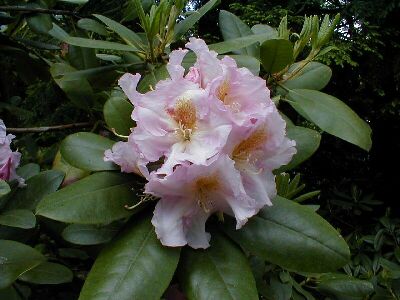
'Janet Blair'
'Janet Blair'

It has become fashionable among some rhododendron cognoscenti to express disdain, or even outright contempt, for the Leach introductions. Various reasons are cited: faults in plant habit, mediocre performance, lack of flower quality, and so on. In the case of certain cultivars, some criticism may indeed be justified. But it must be remembered that David was breeding and selecting plants for his own area of the Midwest, not for New England. I have seen magnificent specimens in his Ohio garden, while the same cultivar here in my Massachusetts garden languishes or develops a rangy habit.

I have been growing some fifty-seven of the Leach hybrids in my Zone 5b garden, some for as long as 30 years, and in my opinion there are many first-rate plants among them. What follows is a personal assessment of all the Leach plants that I have grown, based on my own experience with them. For purposes of comparison, I've grouped these into several categories, based on plant and flower characteristics. I have also given a numerical rating to each cultivar, using the old ARS rating designation, in which the flower, plant/foliage, and overall performance are rated by a number from l (poor) to 5 (superior). It should be emphasized that these ratings are by no means "official", but simply my own evaluation of the plants' appearance and performance in my own garden.

Full Size Plants with White Flowers
'Edmond Amateis'
'Edmond Amateis'

'Lodestar' A.E. and 'Swansdown' A.E. are among the earliest introductions (1965-1966) from David's breeding program, and are from the same parents ('Belle Heller' and white R. catawbiense). They form tall, wide-spreading, rangy plants; 'Swansdown' has somewhat more regular branching, resulting in a denser habit. Both are dependably floriferous year after year, budding at almost every terminal. The flowers, opening from pale lilac-colored buds, are white with a bold yellowish-green dorsal flare. They have the typical catawbiense form, but are considerably larger than the familiar "ironclad" hybrids, and the trusses of 15 to 20 flowers are quite impressive. My ratings: 'Lodestar' 3/2/4; 'Swansdown' 3/3/4

Another pair of siblings is 'Applause' and 'Finlandia' [catawbiense 'Catalgla' x ('Adrian Koster' x williamsianum)], introduced in 1972-1974. These are medium tall growers, forming well-branched, fairly dense plants. 'Finlandia' has uniquely shaped leaves, convex with a pronounced downward turn, that give it a "what's-that-strange-looking-plant?" appearance. Both varieties have good-sized, wide open, pure white flowers, with a slight shading of ivory in the center, in trusses of 10 to 12 flowers. My ratings: 'Applause' 4/3/3; 'Finlandia' 3/3/3.

Introduced about the same time, but from quite a different line of breeding [white catawbiense x fortunei x (arboreum x griffithianum)}] is 'Dolly Madison'. As might be expected from its pedigree, this is a lusty, vigorous plant that can easily reach 5 or 6 feet at 10 years of age. The very large flowers open the palest of pinks and quickly fade to white. My rating: 4/3/3.

Also dating from 1972 is 'Nepal' [white catawbiense x (wightii x fortunei)]. Although this is reported to reach an ultimate height of 15 feet, my plant, now 12 years old, has tended to be more spreading in habit: less than 5 feet tall but close to 7 feet across. It has impressive, substantial foliage now, but in its earlier years here the leaves tended to be somewhat chlorotic. I suspect this was a juvenile characteristic, now outgrown, because I have neither fertilized the plant nor attempted to correct the soil pH. The large fortunei-type flowers open from pink buds. My rating: 4/3/4.

Yet another mating of white catawbiense, this time with the pale yellow-flowered 'Goldfort', resulted in 'Luxor' A.E., introduced in 1973. A medium sized plant, 'Luxor' bears flowers sometimes described as yellow; they are actually ivory or cream-colored, presented in a full truss. My rating: 4/3/3.

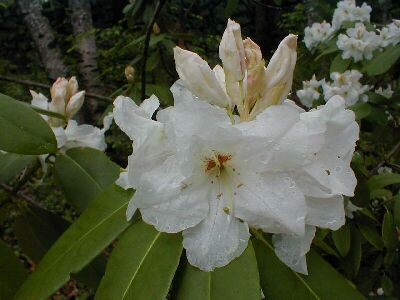
If all the Leach hybrids in the white-flowered category, my vote for the "best in class" goes to 'Edmond Amateis' (white catawbiense x Dexter seedling), introduced in 1969. This is a big, vigorous, well-branched, well-foliaged shrub, of almost ironclad hardiness. Unlike the ironclads, however, it bears large (3 ½ inch) flowers of classic fortunei form, held in upright trusses of impeccable bearing. They are a snowy white, whose purity is emphasized by a small flash of red in the center of each flower. About the only desirable feature it lacks is fragrance. My rating: 5/4/4.

Full Size Plants with Pink Flowers
'Bali'
'Bali'

From the same parents as 'Dolly Madison' came 'Bravo!', introduced in 1974. A similarly robust plant, 'Bravo!' was described by Leach himself as "a huge, blowsy, Rubenesque sort of rhododendron with buxom trusses of not very distinguished carriage". Despite that assessment, 'Bravo!' is of ironclad hardiness, and the light pink trusses are indeed huge for a hardy rhododendron. After 15 years in my garden, the sturdy, well-branched plant is towering over its neighbors, at 10 feet in height and spread. My rating: 3/3/4.

A trio of popular cultivars resulted from the cross of 'Mrs. Furnival' x white catawbiense: 'Cyprus', 'Persia' A.E. and 'Party Pink' S.P.A. Introduced from 1973 to 1983, all three are vigorous, floriferous plants; the two latter grow taller than 'Cyprus' and tend to become somewhat leggy with age. The blossoms of 'Cyprus' open almost white from pink buds, with a strong reddish flare that dissolves into speckling at its margins. 'Persia' has flowers of very pale pink with a greenish-yellow flare. The deepest colored of the three, 'Party Pink', sports cotton-candy pink trusses with less conspicuous coppery speckling; this is one of the very few plants to have received the coveted Superior Plant Award from the ARS. My ratings: 'Cyprus' 3/3/3; 'Persia' 3/3/3; 'Party Pink' 4/3/3.

From a cross by Tony Shammarello ('Cunningham's White' x red catawbiense hybrid), Leach raised 'Vernus' and introduced it in 1957. Notable for being one of the earliest flowering elepidotes, 'Vernus' blooms here in early May, and in late April in milder climates. The blossoms are a clean light pink, without purple overtones, and of typical catawbiense form. However, the plant habit leaves something to be desired, rather open and leggy. Perhaps a sunnier spot than I had for it would produce a shapelier plant. My rating: 3/2/3.

Perhaps the hardiest rated (-30°F) of all the Leach elepidote introductions is 'Pink Flourish' [white catawbiense x {(decorum x griffithianum) x catawbiense hybrid}]. Introduced in 1962, this is another vigorous but somewhat leggy plant that looks well in a woodland setting but less so in a more formal shrub border. It is dependably floriferous, year after year, with trusses of large flowers that open a vivid purplish-pink, and age gracefully to a more subdued light pink with deeper edges. My rating: 3/2/3

'Ballad' and 'Madrid' are both from the cross Dexter #1 x 'America', but were introduced eleven years apart, 1972 and 1983, respectively. As might be expected from the pedigree, 'Madrid' forms a rather open, leggy plant; my plant of 'Ballad' is still too young to evaluate. The flowers of the two siblings are similar in form: large, open and fortunei-shaped, but quite distinct in color. Those of 'Ballad' are a light purplish-pink, edged slightly deeper, while those of 'Madrid' are a more intense deep pink, still on the purplish side. Both have a prominent reddish flare in the throat. My rating for 'Madrid': 3/3/3.

Curiously unlike its parents in both habit and flower color is 'Rio', introduced in 1983. Its putative pedigree is 'Newburyport Beauty' x 'Newburyport Belle'; both parents are Dexter hybrids, and have the typical Dexter vigor and open habit, and both have flowers in undistinguished shades of lavender pink. Yet this offspring forms a neat, compact plant, only 4 feet tall and 5 feet wide after 9 years in my garden, and even more surprising, the blossoms are an ingratiating shade of salmon-pink, seemingly lit from within by a golden glow in the center. My rating: 4/4/3.

Possibly the most popular (and deservedly so) of all David's introductions is 'Janet Blair', introduced in 1962. Of unknown parentage, but probably including some Dexter blood, this has proven to be a star performer through large areas of eastern North America. It forms a vigorous, well-branched plant with superb foliage; a mature specimen will need plenty of space, but is well worth the area devoted to it. The very large, ruffled flowers are a pale pink ("negligee pink", according to one nurseryman) with a prominent yellowish flare. 'Janet Blair' is just one of those happy garden subjects that knows its job and proceeds to perform it in a thorough and enthusiastic manner. My rating: 5/4/5.

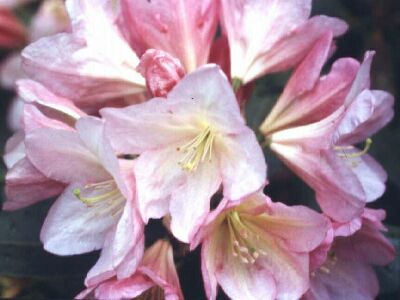
I give 'Bali' similar high marks, although it is quite different in stature and flower from 'Janet Blair'. From the cross [white catawbiense x {(neriiflorum x dichroanthum) x fortunei ssp. discolor}], 'Bali' was introduced in 1974. My plant, now 12 years old, is a dense mound of deep green foliage, 4 ½ feet tall and 7 or 8 feet wide. The flowers, elegantly simple in form and held in trusses of about 15, are a delicate light pink with a deeper reverse. A suffusion of pale yellow in the center of each flower gives the impression that the truss is illuminated from within. 'Bali' is altogether a superb plant, among the best in my garden. My rating: 5/5/5.


Plants with Flowers in Pastel Blends
'Casanova'
'Casanova'

From the same cross as 'Bali' is 'Nuance', introduced in 1968. It makes a similarly dense, well-foliaged plant, but more upright in habit. It has been a shy bloomer for me, setting just a few buds for the first time after 11 years in the garden. The flowers open a light pink with a suffusion of yellow in the center; they fade to almost white, with the barest hint of pink at the petal margins, but retain the yellow shading. My rating: 4/4/2 (the low third figure only because of the paucity of bloom).

A trio of cultivars, 'Bangkok', 'Duet' and 'Monaco' resulted from a single 1952 cross [white catawbiense x {dichroanthum x (griffithianum x auriculatum)}]. Introduced, respectively, in 1972, 1961 and 1984, all three offer flowers in a similar palette: pale yellow centers with broad edging of light pink. All three age considerably paler, 'Duet' in particular ending up almost white. 'Monaco', showing the auriculatum influence, is supposedly the latest to bloom, but this past spring (1998, an unusually early season, to be sure) it was in full flower for me the third week in May. Plant habit in all three is reasonably dense and well-behaved. My ratings: 'Bangkok' 3/3/3, 'Duet' 3/4/3, 'Monaco' 3/3/3.

'Hindustan' is a 1983 introduction from the cross [(maximum x 'Goldsworth Orange') x ('America' x 'Gertrud Schale')]. It is a prime example of a handsome flower (if and when it decides to bloom) on a perfectly terrible plant. Gangling and awkward, my plant at 12 years old had reached mature dimensions of 7 feet high and as wide, but still exhibited awkward adolescence in habit, and it had not yet favored the garden with a single blossom. Finally in 1996 this leggy monster deigned to set a grand total of 3 buds. Indeed, the flowers are rather spectacular, a luminescent shade of soft orange which on closer examination is seen to be made up of a buff-yellow background suffused throughout with pale pink. Perhaps a heavy flowering, with trusses on every terminal, would suffice to forgive the plant its wayward tendencies, but until that happens, my rating is 4/1/2.

With a plant habit just as straggling, and a flower far less comely, 'Shanghai' has even less to commend it. Introduced in 1973, 'Shanghai' [('Mrs. Furnival' x white catawbiense) x an unnamed seedling, mauve with gold blotch] in my garden is now a mature 16 years old, but has not outgrown its bad adolescent habits. The flowers are white flushed pink at the edges, which might be attractive if it stopped there, but the effect is spoiled by a large and prominent greenish blotch. Not surprisingly, my rating is 2/1/2.

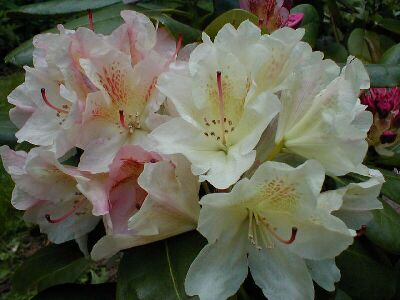
It's a relief to report that the next plant in this category is, at least in an early evaluation, a winner. 'Casanova' ['Newburyport Belle' x (white catawbiense x wardii)], introduced in 1985, is proving, after 7 years in my garden, to be a neat, well-mannered plant with an exceptional floral display. Widely touted as a hardy yellow, growers who acquire it and watch expectantly for the first flower are quite sure they have been sent the wrong plant, for the expanding buds are a vivid coral-red. The perplexing pigment rapidly dissipates after the flowers open, however, leaving a unique shade of buff-yellow highlighted with prominent coppery speckling on the upper lobe. (The story goes that David had not initially planned to release 'Casanova', but simply regarded it as a stepping-stone for further breeding; he used its pollen on a vast harem of other plants, thus earning it its name!) My rating (tentative): 5/4/4.

Another plant with a good deal of promise is 'Trinidad' ('Calcutta' x 'Tahiti'), introduced in 1982. After 8 years in the garden here, the plant is still only 2 feet tall, a slow, dense grower. It is not yet what I would call generous in bloom, but the flower is so unique it is well worth waiting for. From reddish buds, the developing flowers lose the red coloration, turning a pale ivory or cream except for a sharply defined edging of the same cherry red—a real show-stopper. My rating (tentative): 4/4/3.

Finally, a relatively new introduction, 'Santa Fe', provides a color accent virtually unknown until now in colder climates. From the cross ['Limelight' x {('King of Shrubs' x smirnowii) x 'Limelight'}], 'Santa Fe' blooms in a unique shade of orange-pink with cream shading and a center of deep red. The plant habit seems full and dense. Although I have had the plant for only a year, I'm ready to assign a tentative rating of 4/4/3.


"YAK" Hybrids
'Anna H. Hall'
'Anna H. Hall'

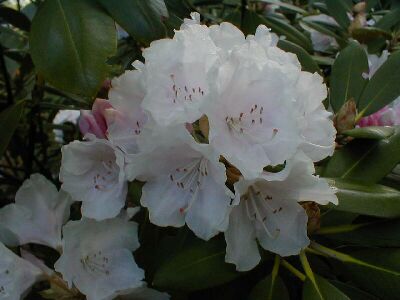
Like so many other hybridizers, David was keenly aware of the benefits of introducing genes from R. yakushimanum (now properly R. degronianum ssp. yakushimanum) into his breeding program. Its dense, compact plant habit, excellent foliage and foliage retention, and hardiness are all desirable traits to be passed on to its progeny. Among his earliest introductions (early 1960's) are several siblings from the cross (white catawbiense x yakushimanum). 'Anna H. Hall' has graced my garden for a quarter century, and although it is now leggy from being shaded out by taller plants around it, in its early years it did maintain a fine, compact habit. The abundant flowers are typical "yak" in color, pink buds opening white. I rate this and the very similar 'Spring Frolic' at 3/4/4.

From a 1962 cross (smirnowii x yakushimanum) by Ben Lancaster of Camas, Washington, Leach in 1976 introduced 'Crete'. Like other plants from this cross, 'Crete' is a good, vigorous grower that maintains a dense, well-branched habit and superb, heavily indumented foliage. Bright magenta-rose buds give promise of a colorful display, but the "yak" influence predominates and the flowers quickly turn white shortly after opening. I understand from some growers that fall bloom is a problem with this cultivar, but this has not so far been the case with my plant. My rating: 3/4/4.


Full Size Plants with Red Flowers
'Bikini Island'
'Bikini Island'

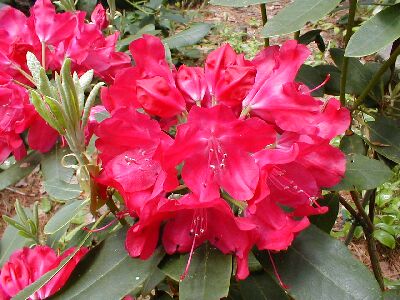
One of the first to be introduced (1976) in this category was 'Fiji', from an unlikely cross of 'Russell Harmon' x 'Goldsworth Orange'. The plant habit is low and spreading—I might say almost sprawling—and the flower is an interesting shade of light red ("claret-rose", according to one description). Its late flowering (early June for me) is a plus. My rating: 3/2/3.'Burma' is one of those plants that I saw putting on a splendid show in David's own garden in Ohio, but for me has been a dismal failure. Unable to hold up their heads, the new shoots flop over, and wind up creeping along the ground. This might be a virtue if I were looking for a ground cover plant. But the plant is deplorably stingy with bloom: in the ten years I have owned it, it has bloomed only once, and with only a single truss, albeit of a good dark red. Understandably, my rating is 2/1/2.

Two plants still too young to evaluate are 'Bikini Island' and 'Samoa'. Neither has yet bloomed. 'Bikini Island' at five years old seems destined to become a narrow, upright plant. Look for a full report in a couple of years.


Low Growing Plants with Red Flowers
'Small Wonder'
'Small Wonder'

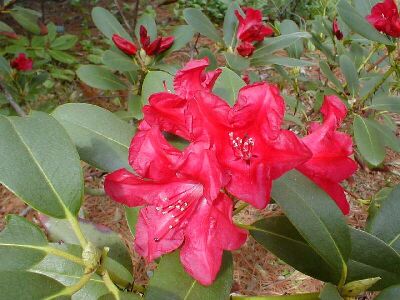
As a group, these have been less than successful for me. At least four of them, 'Flamenco', 'Rangoon', 'Singapore' and 'Small Wonder' are siblings, from the cross 'Fanfare' x 'Gertrud Schfile'. Another, 'Sumatra', is from the cross 'America' x 'Gertrud Schale'. Yet another, 'Ravenna', from the cross ['Scarlet Blast' x {(white catawbiense x yakushimanum) x ('Fanfare' x 'Gertrud Schale')}], is still too young to evaluate. All feature flowers in shades of clear red, largely free from the purple cast which flaws so many hardy reds.

Probably the best of the group in my garden is 'Small Wonder'. It blooms reliably, with medium-sized tresses of a fairly dark red. My plant's habit is open and somewhat leggy, but this I attribute to its being overshadowed by a huge overgrown Ilex crenata for the first seven years of its life. 'Singapore' is almost as good, although it has a tendency to produce a late flush of growth which features unattractive congested foliage around the flower buds. My rating for both: 4/3/3

'Flamenco' and 'Sumatra' are a different story. Both developed into weak, spindly, sprawling specimens, with an inordinate attraction for vine weevils. Eventually the situation got so bad that both were consigned to the brush pile.

'Rangoon', although it has been here nine years, has yet to flower. At least it has made a presentable plant, low and spreading. A rating will have to wait until it blooms, but I would downgrade it in any event, for its stinginess of bloom.


The "Yellows"
'Capistrano'
'Capistrano'

Probably more effort has been expended by Eastern hybridizers toward developing hardy yellow-flowered elepidotes, with less success, than on all other breeding pursuits combined. The goal of the luminous color of 'Crest' combined with Zone 5 hardiness has been elusive. David's early attempts in this area were lackluster, but at least one recent introduction holds promise of being a real breakthrough.

One of the earliest in this group to be introduced (1973) was 'Nile'. A hybrid of white catawbiense x wardii, 'Nile' in my garden presents an attractive plant with nice glossy foliage (albeit somewhat susceptible to leaf spot), but is now budded for the first time in 9 years. A long wait; I hope the flower is worth it. My rating: ?/3/2.  Of a similar pedigree (catawbiense 'Catalgla' x 'Crest') is 'Hong Kong', introduced in 1974. This is a similarly attractive plant, again clad in glossy leaves with the same leaf spot problem. Unfortunately, it has been similarly stingy with bloom for me. The flowers, when the plant deigns to favor us, are pale yellow, in some seasons almost cream-colored, with a tiny reddish flare. My rating: 3/3/2.

'Peking', introduced in 1973, represents the next generation of this breeding line: (white catawbiense x 'Hawk') x (catawbiense 'LaBar's White' x 'Crest'). Although this has been freer flowering than the two preceding, the blossoms are smallish and the color still from the standard set by 'Crest'. Nor is the foliage as good as 'Nile' or 'Hong Kong. My rating: 3/2/2.

The introduction of R. yakushimanum into the breeding lines resulted in a more compact plant than the preceding: 'Golden Gala' ('Great Lakes' x 'Good Hope'), introduced in 1981. It has reasonably good habit and foliage, but the flower color, a cream or ivory, could only be termed yellow by a myopic optimist wearing gold-tinted glasses. My rating: 3/3/3.

'Canary Islands', with a complex pedigree, [{white catawbiense x fortunei ssp. discolor x 'Fabia')} x 'Mary Belle'] x 'Peking', was registered in 1985. It has been touted as the "deepest yellow of all" but for me has fallen far short of the advertising hype. Even more parsimonious with its flowers than 'Hong Kong', it has borne exactly ONE truss in the ten years it has occupied a prime site in my garden. The flower color is recognizably yellow, but certainly not the daffodil color illustrated in the nursery catalog. The plant is reasonably presentable, bushy and dense with acceptable foliage that so far has shown resistance to leaf spot. My rating: 3/3/2.

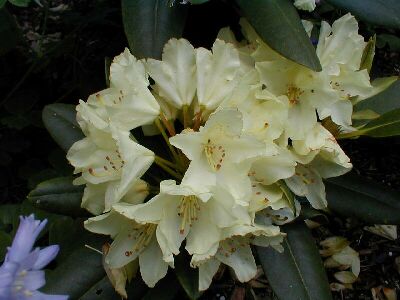
A recent introduction (1991) from the cross [white catawbiense x (dichroanthum ssp. apodectum x 'Loderi White Diamond')] is 'Borneo'. My plant is still too young to evaluate, and has not yet flowered. Stay tuned!  The most promising of this group, in my opinion, is 'Capistrano', introduced in 1994. This advanced generation hybrid again has a complex pedigree: [{white catawbiense x (fortunei ssp. discolor x 'Fabia')} x {'Russell Harmon' x 'Goldsworth Orange'}] x 'Golden Gala'. From its yakushimanum ancestor it has inherited a neat, mounding habit and deep green foliage. The full truss of flowers, opening from yellow buds (rather than the peachy-colored buds of 'Hong Kong' and 'Golden Gala') are yellow enough to make the "yellows" of David's earlier efforts look insipid by comparison. Although 1 have only had the plant for two years, I'm willing to assign it a rating of 4/4/4.


Season Extenders: Early and Late
'Summer Glow'
'Summer Glow'

'Spellbinder', a 1975 introduction, resulted from a cross of 'Russell Harmon' x (calophytum x sutchuenense), an attempt to combine the large, early flowers of the pollen parent with the hardiness of the seed parent. From the pollen parent it has also inherited huge leaves (9 to 10 inches long) and a stocky, vigorous habit, with new stems the diameter of a man's finger. Considering its pedigree, the plant is surprisingly dense. My eight-year-old specimen has still not flowered, but again considering the pedigree this is not unexpected; my plant of R. sutchuenense took 14 years to first flowering! My tentative rating: ?/4/3.

To extend the blooming season in the other direction, David developed several late-flowering hybrids. 'Summer Snow' [maximum x (ungernii x auriculatum)], introduced in 1970, is the only one of these to flower for me so far; it bears somewhat loose trusses of very large, widely funnel-shaped flowers of sparkling white, about the third week in June. The large leaves are a good foil for the blossoms. As might be expected from its ancestry, the plant is husky and vigorous, and has already made clear its intention to become a tree. My rating: 4/3/3.

With a plant very similar to 'Summer Snow' in appearance, 'Summer Summit' [maximum x (auriculatum x fortunei ssp. discolor)], introduced in 1984, seems headed in the same direction. The flowers, not yet produced on my seven-year-old plant, promise to add a touch of pink to the summer scene. My rating: ?/3/3.

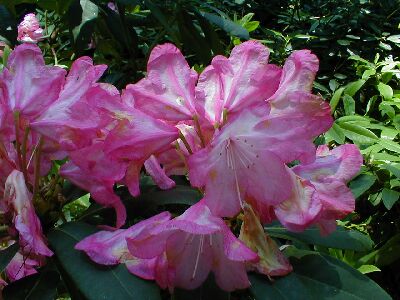
'Summer Glow' ('Summer Snow' x 'Scarlet Blast'), introduced in 1985, at six years old presents a reasonably good-looking, if not densely foliaged plant. The flower is described as deep pink shading to a paler center. And 'Red River' [maximum 'Mount Mitchell' x ('Mars' x 'Fanfare')], introduced in 1984, should carry the summer color palette into the red range. My ratings for both: ?/3/3.

A Caveat

I'm certain that some of the plants that I have downgraded in the foregoing pages are thriving and rendering good accounts of themselves in other New England gardens. A great deal depends on environmental factors: soil, sun/shade, moisture, root competition, etc. So do not hesitate to experiment with those to which I have assigned low ratings. Who knows, some day you might be able to take me by the hand and point with pride to a neat, compact plant of 'Hindustan' smothered in blossoms! On the other hand, I find it difficult to imagine that winners like 'Janet Blair', 'Bali', 'Casanova' and 'Malta' will be anything less than sensational in your gardens, as they have been in mine.

Reflections on the Massachusetts Chapter Species Survey

Dick Brooks, Concord, MA

Members of the Chapter have been aware for some time of a project undertaken by the Chapter's Species Study Group. The purpose of that project has been to accumulate information on what rhododendron species are being grown in New England, as well as what species should be possible here but are not yet being grown. To obtain that information, in 1994 the Group started a survey of members who are growing species, using feedback from the periodic Species Profiles which appear in the Chapter newsletter and a questionnaire sent to a number of knowledgeable growers in the area.

Rhododendron vaseyi
Rhododendron vaseyi

The results of that survey to date will be published in a booklet, to be available at the ARS convention in Burlington, MA. The information in that booklet has been gleaned from over fifty members, gardening in the full range of New England hardiness zones, USDA Zones 4A to 7A. A perusal of the data draws one to some interesting and sometimes puzzling conclusions.

For example, of the Group's "master list" of 235 different species rated by various authorities as hardy to -5°F or lower, fully 132 species have been reported as being grown by at least one member. This is a significant number, but the obvious question that arises is, "how about the other 103 species, which should be growable somewhere in New England? Are they lurking as hidden treasures in someone's back forty? Or have they been tried and deemed impossible as garden subjects for our area?" Probably the major reason for the lack of responses is that they are largely unobtainable from commercial sources. A quick check of 39 of the 103 unreported species revealed that only nine were available as plants from the major specialty nurseries, and for these nine most often there was only one source.

One way of overcoming this shortage is by growing these species from seed, and in fact this is a project that has been undertaken by the Chapter's Roundtable Group, with seed obtained from wild collected and hand-pollinated sources from both the ARS and RHS Seed Exchanges.

The Species Study Group has grouped the species reported on, according to the degree of success that may be anticipated by New England gardeners, into four categories:

A—Recommended: plants that are proven reliable performers.

B—Conditionally recommended: plants that may do well for some growers but not for

others or that may require special attention to certain cultural requirements.

C—Not enough data: plants for which there were three or fewer reports.

D—Not recommended: plants that pose a real challenge, even to experienced growers.

In the "A" list it is interesting to note the geographical origins of these "fail-safe" species. Not surprisingly, all of the eastern North American species, except the far southern natives RR. alabamense, austrinum, canescens and flammeum, and the far northern natives RR. canadense, lapponicum and groenlandicum, are represented in this category. The hardy natives of Japan, Korea and eastern Siberia have also proven to be well enough adapted to New England conditions to warrant their inclusion on the "A" list, and the same is true of certain species from central, eastern and northern China: RR. adenopodum, fortunei, micranthum, oreodoxa and sutchuenense.

More surprising, however, is the appearance on the "recommended" list of three Taiwanese species, RR. hyperythrum, nakaharae and pseudochrysanthum, and one from the southwestern Chinese province of Yunnan, R. russatum. The successful cultivation of these raises hopes that many other species from milder climates in southerly latitudes will prove similarly adaptable to New England's climate. Two natives of Europe/Asia Minor round out the "A" list, RR. smirnowii and myrtifolium.

A preponderance of successful reports for many species in the "B" list suggests that with additional input from members some of these might well be relocated to the "A" list of proven performers.

Included in the "C" list are species that were reported on by only one member, yet were obviously successful for that person. These are RR. amagianum, argyrophyllum, campylogynum, haematodes, kiyosumense, mimetes, primuliflorum, pronum, proteoides, ririei, searsiae, tsariense, and wallichii. Why are these not more widely grown? Is it the same problem of limited availability? Or perhaps lack of an adventurous spirit on the part of most of our members?

The eight current members of the Species Study Group were asked to make a list of their favorite species, interpreted to mean the most reliable garden-worthy subjects. The hands-down winner was R. vaseyi, appearing on seven of the eight lists. R. degronianum in its various forms was a close second, with six votes, and a trio consisting of RR. kiusianum, minus and mucronulatum followed with five votes each.

The sixty-page product of the Species Study Group's efforts will be available at the ARS convention in May 2000, for a nominal charge to cover printing costs. Other members will find it a most illuminating source of information, and hopefully will be tempted to try some of the many species covered in the survey.

What Have They Done With Our Names?

Ed Bensley, Bedford, MA

Most of the gardeners I run into fall into two categories: those who prefer scientific (Latin) names and those who prefer common names. Those who prefer scientific nomenclature point out that common names vary from place to place, so that a single species can be called by different names in different places and different species can have the same common name. Those who prefer common names complain that the scientists change names so often that no one could be expected to remember them.

Rhododendron minus var. minus Carolinianum Group
R. minus var. minus Carolinianum Group

In genus Rhododendron there are so many species that using common names is not in general practical; however, that doesn't keep rhododendron enthusiasts from complaining about the name changes.

The rules that govern scientific names for plants are rather complicated, so I won't go into them here, though you can get a good flavor of what they are like by reading the recent article, "What Are Those Azaleas?", by Donald H. Voss in the Summer issue of the Journal of the American Rhododendron Society. Generally speaking, a name can change for two kinds of reasons, either because botanists have decided that the current classification is in error or because it is determined that the existing name is not in conformance with the rules.

Even under the best of circumstances taxonomists (those who classify organisms) can differ as to whether different plants indeed represent different species. In a genus as large as Rhododendron in which hybridization is prevalent in the wild as well as in the hybridizer's garden, the chances of disagreement increase. In recent years, however, there has been a significant attempt by the scientific community to resolve some of these questions. The inevitable result is a series of name changes.

We have seen this effect in the names of our native lepidotes where R. chapmanii and R. carolinianum have been subsumed under R. minus (as R. minus var. chapmanii and R. minus var. minus Carolinianum Group respectively).

Probably the most confusing name changes, however, have taken place among the Japanese elepidotes (subgenus Hymenanthes) where both classification changes and invalid names have combined to confuse the nomenclature. To begin with, the name R. japonicum had been given to an azalea (currently named R. molle ssp. japonicum) as well, and under circumstances where it was controversial as to which name took precedence. In addition, in the process of sorting this all out it was determined that the name R. metternichii was invalid as well. When the dust had settled R. makinoi, which had been briefly classified as a subspecies of R. yakushimanum emerged as a species while R. metternichii and R. yakushimanum were subsumed under R. degronianum (as ssp. heptamerum and ssp. yakushimanum respectively). As an example of the name confusion, R. degronianum ssp. degronianum had the names R. degronianum, R. metternichii ssp. pentamerum, R. japonicum var. pentamerum at various times in the last half of the twentieth century. R. metternichii went through a similar series of name changes, including R. metternichii ssp. metternichii and R. japonicum var. japonicum and ending up as R. degronianum ssp. heptamerum var. heptamerum.

Is any of this going to change any time soon? Hopefully in the computer age there will be fewer problems with invalid names. However, the taxonomists now have more powerful tools, and as they apply them it is virtually certain that there will be further changes in the classification. DNA analysis is becoming more prevalent among those studying the genus. So far it has played a role in defining the boundaries of the genus; DNA analysis supported the incorporation of the genus Ledum in the genus Rhododendron (as section Rhododendron subsection Ledum). While it will continue to be used for this purpose (e.g. should subgenus Therorhodion be a separate genus? should genus Menziesia be incorporated in Rhododendron?), it is certain to be used to resolve issues within the genus as well. Either way, more name changes are certain to be part of our future.

Rhododendrons in Hawaii

R.A. `Mitch' Mitchell, Hawaii, Hawaii

Rhododendrons in Hawaii....ridiculous. Well, yes and no. In our garden in the village of Volcano at 4000 feet on the island of Hawaii (sometimes called 'The Big Island') you may see a few trusses on 'Vulcan', 'Scintillation', 'Gomer Waterer' and R. ponticum. These, however, are a few of what remain from those I bought in the early 1980's after spending several summers in the United Kingdom. It was then that my wife and I fell in love with the genus in places like Harlow Carr, Wisley, Kew, and along the canals we were exploring.

Rhododendron 'Calavar'

In conversations with British friends we told them about our hydrangeas, azaleas and camellias, our acid, humusy soil ,and cool temperatures in the winter. Their encouragement to try rhododendrons resulted in nursery purchases when we returned home. However, in all our contacts, both in the United Kingdom and the United States, no one told us that it wasn't enough for temperatures to drop to the mid-thirties and low forties at night. They must stay there in the day time as well! Furthermore, they must stay there for three to four weeks to expect to see flowers.

While in the UK in 1984, we heard of plans being made to attend the International Rhododendron Symposium in Federal Way, Washington the next year. A stopover there seemed to coincide with our annual return to England from Volcano. It was a fortuitous decision, because it was there we met E. White Smith and Bob Badger who had only recently begun to edit a newsletter, The Vireya Vine. They encouraged us to forget the hardies and try vireyas.

The Vireya section of the rhododendron genus was not familiar then to many United States nurseries, but we did learn about one with vireyas for sale, Bill and Bettye Moynier's Vireya Specialty Nursery in Los Angeles (no longer in existence). From them we ordered a good selection of plants, both species and hybrids. As you might imagine, they are quite large now, and some are in bloom every month of the year, which is a real plus when compared with others in the genus.

About that time I also learned that Lyon Arboretum on the Island of Oahu sometimes had vireyas available at its annual plant sale. They had been propagated from cuttings provided by Peter Schick and/or the Strybing Arboretum, San Francisco. After bringing in plants from Lyon and VSN we thought we were the only ones with vireyas on this island. Soon we learned that Dr. Clif Druecker was growing plants sent to him by his cousin, John Druecker of Ft. Bragg, CA. Then we read in the newsletter, The Vireya Vine, that they were also being grown by Charles Trommer, a recent transplant from Massachusetts, and Glen Sahara who had moved here from Berkeley, CA. Cuttings from our gardens were shared with friends, and now there are vireyas in gardens on this island from sea level to 4000 ft. Also they have found homes in several gardens on Oahu and at least one on Kauai, Naoaina Kai.

With this amount of interest , it was not surprising that the ARS director of District 5, Barbara Campbell, began to generate interest in the formation of what became the Hawaii Chapter in 1997. The chapter now has 37 members including those from New Zealand, Thailand, England, Denmark and Belgium.

Rhododendron 'Princess Alexandra'

In the year 2000, on March 17-18, the Hawaii Chapter will host a "Vireya Seminar" in Hilo at the Naniloa Hotel. Experts from the University of Hawaii, Hilo, and local nurseries will lead discussions in the mornings, and in the afternoons there will be garden tours. Reservations are anticipated from the mainland United States. as well as the Pacific Ocean area. Reservations may be made with the chapter treasurer:

Sherla Bertelmann, P.O. Box 508, Mountain View, HI 96771. email: tropical@ interpac.net.

Why do vireyas do so well in Hawaii? There will be better answers to this question when our chapter publishes the result of a research study that is recording the progress of five varieties in gardens located from sea level to 4000 feet. We generally agree that soil and climate have characteristics that make for healthy vireya propagation in the ground. Our volcanic origin provides outstanding drainage which vireyas demand. Also in many locations the rain forest environment provides the acid and humusy conditions they like.

As for climate, Atlas of Hawaii, published by the University of Hawaii Press, says: "The character of Hawaii's climate can be explained largely by its geographic location. Ranging from approximately 19 to 22 degrees north latitude, the inhabited islands lie at the margin of the tropics and inside a belt of persistent trade winds and accompanying down-welling of upper-level air". The same source says that if it weren't for the steep sloped high mountains, rainfall would range between 22 and 28 inches per year. This explains why our average annual rainfall ranges from ten inches to 445 inches for the state as a whole.

Usually there is more than enough rain on our islands to keep the vireyas happy. However, El Nino did make an exception and some of our members had to buy water because their water system went dry. In our garden at 4000 feet rainfall can vary between 170 inches to over 200 inches. My observations tell me that vireyas seem to thrive on lots of rain as long as the rain continues on down through the lava base and isn't allowed to sit in a pool around the roots. Of course, the fertilizer goes on down with it which means that more frequent fertilizing is required. So much for growth, but for flowering different varieties have their own sun requirements which must be reckoned with. I have found no substitute for moving them when they get too little or too much sun.

Another reason that vireyas do so well here is they are loved by a great group of people who enjoy each other's company at the chapter's monthly meetings on the third Sunday. We have a lot of fun the with a lucky number drawing for flowering trusses (that usually exceed fifty different varieties), plus an auction for mature potted plants.

R.A. 'Mitch' Mitchell, P.O. Box 298 Volcano, HI 96785 President, Hawaii Chapter, American Rhododendron Society

Plant Hunting: Privilege Pleasure Posterity

Captain Richard M. Steele, Nova Scotia

My first plant hunting was with my father in the Spring of 1919 just after the end of WWI. Travelling by horse and carriage and then by canoe, we explored the virgin areas of a long inlet of the Saint John river in New Brunswick Canada. We spent more than two weeks in the area and found many interesting plants and saw interesting wild life. I remember best two species of Gaultheria procumbens and hispidula (known to me then as "Wintergreen" and "Fairy Eggs" respectively). There were Jack in the Pulpits, Trilliums, Dogtooth Violets, Skunk Cabbage, Pickerel Weed, as well as a Moose, Deer, Partridge, and Shad which we fished and ate, a "gizzard" fish that we bought from a native that was net fishing at the head of this inlet. There was much more that my aged and jaded mind can no longer recall.

Joe Gable on Mt. Mitchell

Since that awe inspiring trip in my young life, plant exploring has been a joyous, relaxing, and very rewarding feature of my life. This absorbing avocation has usually been in company with others of similar interest.

One of the most memorable was ten days that Joe Gable and I spent exploring various areas in The Great Smokies in 1966. We were able to again see "Red Maximum" near Mount Mitchell and collect several scions from the largest old Plant. Joe also very studiously searched for a wild Rhododendron catawbiense that showed a distinct sign of purple in it's bloom, but in vain.

On another occasion, while searching in the wild near Hopewell, Virginia I located a truly significant form of the azalea then known as nudiflorum;...I called on the lady who owned the farm and took her to that beautiful plant, photographed the two together and arranged permission to return that fall to collect seed and a section from the plant. When I returned that October I found the whole area bulldozed level and that plant lost forever.

In 1954 enroute to take up duties in the Canadian Embassy in Washington, I stopped for an hour break in driving, near Pocologan, on the shores of the Bay of Fundy in New Brunswick, Canada and went off into shrubland to look at the masses of Rhododendron canadense that were in full bloom. About a half mile back from the road I found a rich deep purple form of the plant which I captured for posterity with my camera.

I returned to Canada 2 1/2 years later to collect both seed and the plant. To my chagrin a new Super Highway had been built through that area and the plant had been destroyed. We have the photo but the plant is gone. Similarly a new highway in Nova Scotia destroyed our only colony of the very rare white form of Rhododendron canadense.

When Gable and I were in the Great Smokies we again went to Roan Mountain. There we found a new road had just been opened to the top. We were able to drive on up. Where the excavating equipment had dug a ditch alongside the road they had ripped out a number of small rhododendrons. One was lying on top of the pushed back debris. It's roots were bare and the sun shining down on this wilted plant. I crossed the ditch and collected the sad thing. We wrapped it in a newspaper, then poured most of our drinking water into the paper and put it in the glove compartment of the car. A number of days later the plant was removed and potted and it is still occasionally a seed parent for crosses aimed at hardiness These atrocities and others led to the formation of "The Rhododendron & Native Plant Foundation"

The Purpose of the foundation is;

1. To Establish "Living Collections of plants important to the Future":

(a) by exploration
(b) by collection
(c) by breeding

2. To Demonstrate

(a) How these plants can be best grown on domestic cultivation.

(b) How they may be used to enhance the beauty of our surroundings, or serve some other significant needs.

Plant collecting in northern Newfoundland

The Foundation is a low key, hands-on operation. The dues are not cash, but require each member to annually contribute three hours of objective labour. The more distant members fulfill their obligation by tasks assigned on the Plant Expeditions, or by tasks assigned to them in or close to their area. Although the prime task of the organization is to ensure that important plants are retained for future generations, it was early established that "It was not intended to encourage heroic and wasteful efforts to sustain Minutiae or Oddities whose more appropriate destiny is departure"

The original concerns and objectives were to locate, record, photo, and collect scions and seed of fine specimens of rhododendrons and associated plants. However it became obvious that many other plants needed similar attention. The group decided that they would take on some of this broader work but that the geographic area should be defined and that the pace should be unhurried.

Because of geographic and climatic diversity it was decided that the area of operation would initially be the Canadian Atlantic provinces: New Brunswick, Nova Scotia, Newfoundland and Labrador with Gaspe and some eastern sections of the Province of Quebec when and where that was feasible.

A somewhat tentative preliminary program was established for the period 1990 - 2005. It is aimed at establishing a good broad fundamental knowledge of the Land, the Plants, and the conditions under which they succeed. There is to be a full review of the program after the completion of the 2005 Expedition.

R. lapponicum from seed - collected wild in northern Newfoundland

Successful expeditions have been conducted in each of the areas. Expedition 2000 will proceed in Northern Newfoundland and Labrador during the last week in August and the first week in September.

A very significant historic event is taking place in Northern Newfoundland this summer and a visit to that site is being included in this years schedule.

L'Anse-aux-Meadows at the northeast tip of Newfoundland is the site of a Viking Settlement 1000 years ago, more than 400 years before the arrival of Columbus. Ten Viking ships from various areas of the world are sailing to rendezvous in that area from 23 - 28 July. There are 3 replicas of the original grass and earth houses and Viking reenactors will be showing Viking skills daily until 8 September.

Some of the native plants that will be encountered on this year's visit to these northern sites include;

Rhododendron lapponicum, Empetrum eamesii, Cornus suecica, Rhododendron groenlandicum, Silene acaulis, Loiseleuria procumbens, Larix, Phyllodoce caerulea, Vaccinium vitis-idaea, Ledum decumbens, Pinguicula spp., Diapensia, Betula pumila, Vaccinium uliginosum, Saxifraga spp., Gaultheria procumben, Betula michauxii, Chamaedaphne calic, Juniperus horizontalis, Empetrum nigra, Primula spp., Gaultheria hispidula, Potentila spp., Andromeda glauca, and many, many others.

Anyone interested in joining Expedition 2000 can write for information to: R.M.Steele, Mail RR#1 Rose Bay, Nova Scotia, B0J 2X0 Canada. Email: steele.bayport@ns.sympatico.ca

Origin of the Hybrid

James Marchand, Ashland, MA

Many if not most rhododendron lovers, upon seeing the beautiful truss of a new hybrid, see only its color, size, fullness, and all of the other attributes that make it beautiful, and for them this is all that is important. Those of us who hybridize rhododendrons, however, see more. We see a combination of features that we know are derived from its parentage, from those species which, in combination, make up the genealogy of each hybrid. A tall conical truss most likely derives from catawbiense heritage, a yellow truss probably contains R. wardii or R. lacteum, and a truss with huge flowers may have R. griffithianum somewhere in its past. The same analysis can be applied to foliage and plant form, of course, and I think most of us can identify a hybrid with 'yak' parentage.

'Vulcan's Flame'
'Vulcan's Flame'

For the hybridizer a study of the species and their hybrids which, together, are then combined to produce new hybrids can provide an intelligent framework for the development of strategies that will lead to new and better hybrids. The following article is the first in a series, each of which will focus on one species and the hybrids derived from it. Emphasis in these articles will be placed on understanding the positive and negative features of that particular species and how crosses can be designed to accentuate the former and alleviate the latter.

I have chosen R. griersonianum as the "featured" species for this first effort. There are many reasons for this, all of which are indicated by an interesting statistic; a random tally of Salley and Greer's Rhododendron Hybrids (1992) determined that over 10% of all registered hybrids contain griersonianum in their parentage, a fact which supports the statement by Leach in Rhododendrons of the World (1961) that griersonianum has been used as a parent more than any other species. I suspect that in recent years hybrids with R. yakushimanum parentage may have surpassed the predominance of griersonianum, but I think this reflects the wonderful contributions yakushimanum has made to invigorating the hybrid gene pool and does not indicate that griersonianum has lost its value as a parent.

The species. R. griersonianum was introduced by George Forest in 1917 and was named for his friend and assistant, R.C. Grierson. It grows in thickets and in forest clearings at altitudes ranging from 7,000 to 9,000 feet in the western Yunnan province of China and in Upper Burma. It is a distinct species, as indicated by its assignation to subsection Griersoniana, of which it is the only member. It is characterized by long, pointed flower buds enclosed by a rosette of small, elongated bracts, by long and narrow leaves, and, most importantly, by the uniquely colored, vivid orange-scarlet flowers, often referred to as geranium scarlet. It is the unusual flower color which most accounts for the extensive use of griersonianum as a parent, providing a source of rich, brilliant pigmentation that strongly influences flower color of its hybrids.

The corolla also is a strongly positive feature, funnel shaped, dilating abruptly from a narrow fluted tube to a 3-inch wide trumpet, hairy on the outside. Trusses, unfortunately, are fairly loose, although they contain up to 12 flowers. Leaves are lanceolate, dull green, four to seven inches long, covered on the upper surface with indumentum on new growth, and on the lower surface with whitish to pale brown indumentum, which is retained through maturity. On the negative side, the plant form is relatively poor, open and upright, in contrast with the dense compact form evident in the preferred modern hybrids with yakushimanum. Leach reports that the various forms of the species vary widely, with some exhibiting a thin corolla texture and a dilute color, whereas others, in particular the Exbury form, having especially fine flowers, with a deep, vibrant crimson shade "which seems to glow in the landscape".

As expected from its origin at moderate latitudes, R. griersonianum is not very hardy, only to about 10°F, but, fortunately, it appears to gain hardiness with age, and many of its hybrids are hardier than would be predicted based on hardiness of the combined parentage. It is quite tolerant of heat and a dry siting, but is susceptible to foliage burn with too much exposure. It sets bud quite young, often flowering three to four years from seed. Last, but certainly not least, is the late time of flowering of griersonianum, which is a useful characteristic for extending the flowering time of its hybrids.

The hybrids. There are over two dozen primary species crosses including griersonianum as either the flower or pollen parent, most of which were produced in the first half of this century, mainly in England. Some of the more important of these, either as parents of well known hybrids, or as excellent plants in their own right, include 'Elizabeth' (x forrestii spp. forrestii Repens Group), 'F.C. Puddle' (x neriiflorum), 'Fabia' (x dichroanthum), 'Jock' (williamsianum), 'Matador' (x strigillosum), 'May Day' (x haematodes), 'Azor' (x discolor), 'Tally Ho' (x facetum), and 'Arthur Osborn' (x sanguineum ssp. didymum). 'Jock' is a charming hybrid with dark rosy pink flowers with an orange tint in the throat, displaying the scarlet-orange heritage from griersonianum. Because of the dominant influence of williamsianum, its habit is dense and spreading, and it does well in the sun. 'May Day' is another fine garden plant which fortunately has inherited the broad plant habit of haematodes, and the flower color, a brilliant orange-scarlet, is a combination of both parents. 'Arthur Osborn' also retains the smaller plant form of its parent, didymum, and the flowers are a very dark, almost black red, which bloom very late in the season. Perhaps the best combination for plant form and flower is 'Elizabeth', combining the low, spreading habit of forrestii Repens Group with large trumpet shaped flowers, derived from griersonianum. Flower color is a fine, rich red.

Finally, there is 'Fabia', the most widely used griersonianum primary species cross used in hybridizing. The combination of orange flowers of dichroanthum with the orange scarlet flowers of griersonianum results in a variety of flower colors ranging from orange, to orange with salmon edging, to a nearly pure salmon color, which are displayed by the many members of this large grex. Unfortunately, the lax trusses of both parents are retained, and the open plant habit of griersonianum is only partly tempered by the low spreading form of dichroanthum. As a parent for further hybridizing, however, 'Fabia' is the Diva of rhododendron hybrids, accounting for nearly a fourth of all griersonianum hybrids, and is easily the most common parent listed in Rhododendron Hybrids. To list the hybrids derived from the parent is obviously beyond the scope of this article, as a casual perusal of Rhododendron Hybrids will show. It often provides the orange shades to many of the more complex hybrids, and when combined with yellow crosses, the dichroanthum heritage will synergize to deepen the yellow color. Often, however, hybrids with 'Fabia' parentage will glow with that warm mixture of pink suffused with yellow and orange, a combination resulting from the rich orange-scarlet of griersonianum lightened by other parents, such as seen in the complex yakushimanum cross.

And then there are red and pink crosses resulting from griersonianum crossed with various hybrids. Among the reds the best known is 'Vulcan' ('Mars' x griersonianum) and the opposite cross 'Vulcan's Flame', very similar crosses with bright, fire-red flowers, dark green, pointed leaves, and rounded plant habit. The cross is surprisingly hardy, typically rated at -10° to -15°F, evidence of the relative hardiness of griersonianum hybrids. It also inherits the heat tolerance of griersonianum. Probably the best known pink is 'Anna Rose Whitney' (griersonianum x 'Countess of Derby'), a deep rose pink that seems to glow, certainly a result of the unique griersonianum pigmentation. Unfortunately, it is not particularly hardy (-5°F), although again hardier than might be expected considering that 'Countess of Derby' is only (-5°F) and griersonianum is +10°F.

The Plan. I could continue on in this vein for pages, but in this article I only intend to give examples which represent the range of crosses derived from griersonianum and how its characteristics are passed along. Further, as a hybridizer, I would like to suggest new avenues to pursue in the use of griersonianum, with the following goal. I would like to develop a hybrid with all of the best attributes of griersonianum, i.e., its rich orange-red flower with large trumpet shape, its dark green foliage with indumentum, its heat hardiness (important for New England summers), and its precocious blooming. I would like to remove the least desirable characteristics, i.e., lax truss, open plant habit, sun intolerance, lack of hardiness. In other words, I want a new and improved griersonianum, a concept similar to the artificial species that C.J. and Charlie Patterson are working on in their hybridizing program.

To start on this goal, I would make a griersonianum x yakushimanum cross, if it has not been made, or if I can't find it (I've looked, let me know if you hear of one). This would provide many of the missing ingredients: hardiness, plant habit, sun tolerance. Other species which might supply the same virtues are R. hyperythrum, R. pachysanthum, R. aureum (except for sun tolerance), and R. brachycarpum. Other possibilities which would provide some of the desired characteristics are R. catawbiense, (white forms such as 'Ken's Find', or 'LaBar's White', although frankly I'm not impressed with the plant form on any catawbiense), or one of the members of the Taliensia section, such as R. adenogynum. Of course, all these crosses would be pink, and fade to white, thereby losing the rich orange-scarlet of the species. No problem. Take the best progeny from these crosses and cross them with siblings or with progeny from the other crosses. This is called back crossing, which is the way to get back to the color, flower shape, and heat hardiness of the griersonianum, while retaining the hardiness, foliage, and sun tolerance of the other parent(s). In theory, one fourth of the progeny from these crosses would reacquire the striking color of griersonianum, but a much smaller percentage would display all of the good characteristics from both parents. I figure maybe 200 seedlings from the backcross grown on, tossing those first with poor foliage and plant form and hoping that one of the remaining will be all that your looking for.

How, you may ask, am I going to make crosses using a species that is hardy to only +10°F when I live in New England? Two ways, I answer. One, get some griersonianum pollen from the Rhododendron Species Foundation. Two, buy griersonianum seedlings from the RHS, plant them in two gallon pots, grow them outside during spring, summer, and fall, and put them in your basement (cold) over the winter (C.J. Patterson has promised me an article soon on overwintering tender rhododendrons). I have two griersonianum seedlings which I received from RHS two years ago and both budded up this year. One is only 10 inches tall and has four buds. It has made it through every winter just fine and I can't wait until early June to see the flowers and to start making some of the crosses I just described. But it's a numbers game, this hybridizing, and the more in on the chase, the faster we'll get there, so join me. I think the goal is worth it. Imagine being greeted one fine late May morning by full trusses of rich, glowing, orange scarlet on a dense, compact plant with indumented dark green leaves which grows well in New England in a hot sunny location. To die for.

Copyrighted material of Rosebay Blog